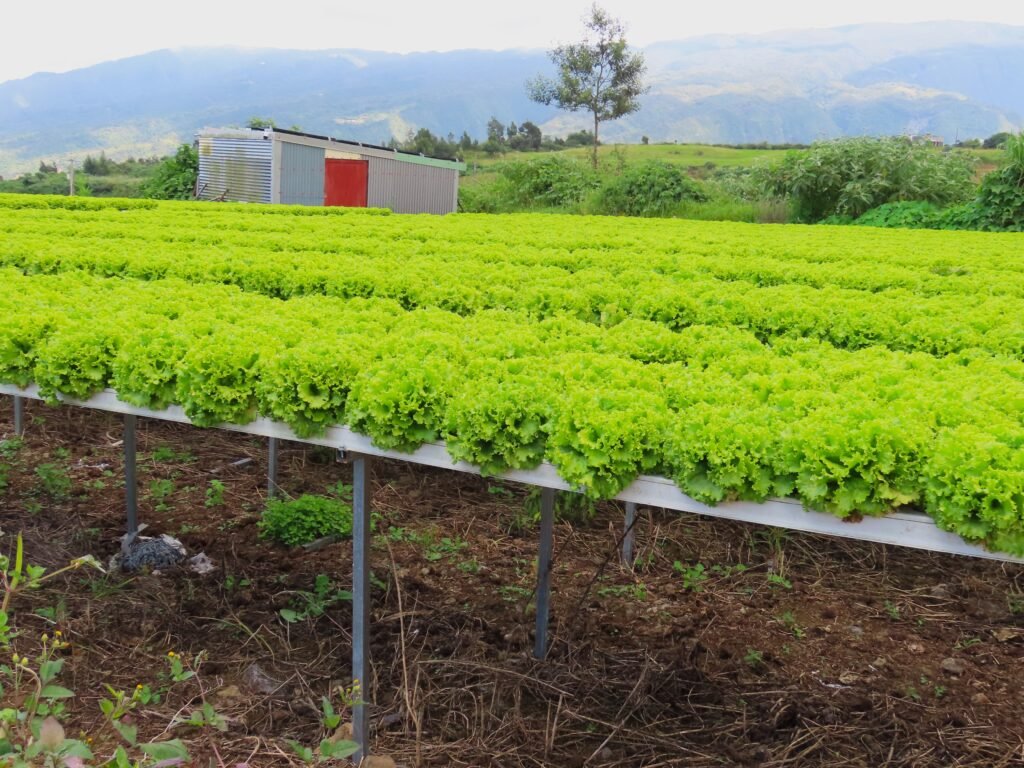
Hydroponics is the technique of growing plants in a water-based nutrient solution instead of soil. The U.S. National Agricultural Library (NAL) notes that a system may also include an aggregate substrate, or growing medium, such as vermiculite, coconut coir or perlite. Small farmers, hobbyists and commercial enterprises all use it, most often for leafy greens, herbs and greenhouse vegetables.
History of hydroponics
Growing plants in water is older than the word for it. NAL cites a source stating that the first published research on growing spearmint in water was carried out by John Woodward in 1699. Discoveries by the German scientists Sachs and Knop in the late 19th century then led to the technique of soilless cultivation. A 1965 USDA publication quoted by NAL adds that physiologists studying plant nutrition had used water culture and sand culture without soil for more than a century.
In the 1920s, Gericke of the University of California developed a solution culture technique. In 1938 Hoagland and Arnon, also at the University of California, developed a complete hydroponic nutrient mixture known as the Hoagland solution, which later researchers modified several times. The same history cited by NAL says soilless growing was first used on a large scale during World War II, to produce food for American troops stationed on infertile Pacific islands.
How hydroponics works
A plant needs light, water, carbon dioxide and a set of dissolved mineral nutrients. In a field, soil holds the minerals and anchors the roots. In hydroponics, the grower dissolves the minerals in water and delivers the solution straight to the roots, while a plug, mat or growing medium holds the plant upright. The plant still makes its own food through photosynthesis, using sunlight or electric grow lights.
Because the solution is the plant’s entire supply, management matters. Growers monitor the concentration of nutrients and the acidity of the solution, and they keep roots supplied with oxygen. NAL points out that closed systems, which reuse the solution, require nutrient management techniques to keep its composition balanced over time.
Light comes from the sun in greenhouses and from LED or other grow lights indoors, and indoor growers also control temperature, humidity and carbon dioxide. For that reason hydroponics is often grouped with controlled-environment agriculture, a field that also includes some soil-based greenhouse production.
Types of hydroponic systems
NAL classifies systems as liquid or aggregate. In liquid systems the roots sit directly in the solution. In aggregate systems the roots grow in a medium that the solution passes through. Aggregate systems can be open, letting excess solution drain away, or closed, recirculating it.
The nutrient film technique (NFT) is one of the best documented designs. Oregon State University Extension describes it as a thin, continuous film of nutrient-rich solution that flows through a channel, so that roots are bathed in a shallow stream and receive a steady supply of nutrients and oxygen. The plant rests in a plug of growing medium above the channel bottom while the solution runs over a textured surface. NFT channels can be laid out horizontally, which the university calls generally easier to set up and maintain, or stacked vertically. The method suits fast-growing, shallow-rooted crops such as lettuce and herbs, and it needs regular checks to catch clogs and nutrient imbalances.
Other common designs include deep water culture, where roots hang in an aerated tank, and drip systems, which feed solution to a medium around each plant.
Applications of hydroponics
NAL lists ornamental crops, herbs and vegetables including cucumbers, lettuce, peppers and tomatoes among the plants grown hydroponically. Greenhouses are the usual setting, and indoor and vertical farms use the method where land is scarce, soils are poor or growers want to supply a city from nearby. Plant scientists also use solution culture to study plant nutrition, because the grower controls exactly what the roots receive.
Space agencies study similar approaches. NASA’s Veggie plant growth system, used for the Veg-01 experiment on the International Space Station, has grown red lettuce in sealed plant pillows, showing the same goal of producing fresh food without field soil in a tightly controlled setting.
Advantages and disadvantages of hydroponics
Oregon State University Extension says NFT systems are known for their water and space efficiency, use less water than traditional methods and can be scaled up or down to fit a grower’s needs. More broadly, hydroponics frees production from poor soil, allows tight control of nutrition, can run through the year in a protected environment, and avoids many soil-borne pests and diseases.
Because growers can see and test the solution directly, they can adjust it quickly when a problem appears, which shortens the feedback loop compared with waiting for changes in soil to show up in the plants.
The costs are real. Equipment, pumps and lighting require capital and electricity, and the grower needs the skill to manage nutrient solutions. Because roots have no soil to buffer them, a failed pump or a blocked channel can damage a crop within hours. In a recirculating system, a disease organism can spread through shared water. The methods also suit some crops better than others: lettuce and herbs do well, while large staple crops are generally grown in fields.
Hydroponics vs. soil farming
Soil supplies minerals, stores water, supports a community of microbes and buffers mistakes. Soil farmers manage fertility over the long term, for example with practices such as crop rotation. Hydroponics gives up that buffer in exchange for control and speed. For wheat, rice and maize, which cover very large areas, field farming remains the practical choice. Hydroponics is concentrated in high-value, fast-growing crops that can be grown in compact, protected spaces.
More in Agriculture & Food
Key facts
- Hydroponics is growing plants in a water-based nutrient solution instead of soil, sometimes with media such as vermiculite, coconut coir or perlite.1
- NAL lists lettuce, cucumbers, peppers, tomatoes, herbs and ornamentals among hydroponic crops.1
- The first published research on growing spearmint in water is credited to John Woodward in 1699.1
- Hoagland and Arnon developed a complete hydroponic nutrient solution in 1938.1
- Soilless growing was first used on a large scale in World War II to feed U.S. troops on Pacific islands.1
- The nutrient film technique uses a thin, continuous film of solution and suits fast-growing, shallow-rooted crops such as lettuce and herbs.2
- NASA's Veggie plant growth system has grown red lettuce on the International Space Station.3
Related concepts
Quick checkWhat is hydroponics?Show answer
By the National Agricultural Library's account, a source cites John Woodward's 1699 spearmint research as the first published work on growing plants in water.
Sources
- 1. U.S. Department of Agriculture National Agricultural Library, Hydroponics, https://www.nal.usda.gov/farms-and-agricultural-production-systems/hydroponics
- 2. Oregon State University Extension Service, Hydro hints: Nutrient film technique, https://extension.oregonstate.edu/catalog/pub/em-9457-hydro-hints-nutrient-film-technique
- 3. NASA, Veggie Plant Growth System, https://www.nasa.gov/image-article/veggie-plant-growth-system/
Editorially reviewed by Specialty Digest Editorial TeamLast reviewed November 4, 2026Researched and drafted with AI assistanceReport an issue