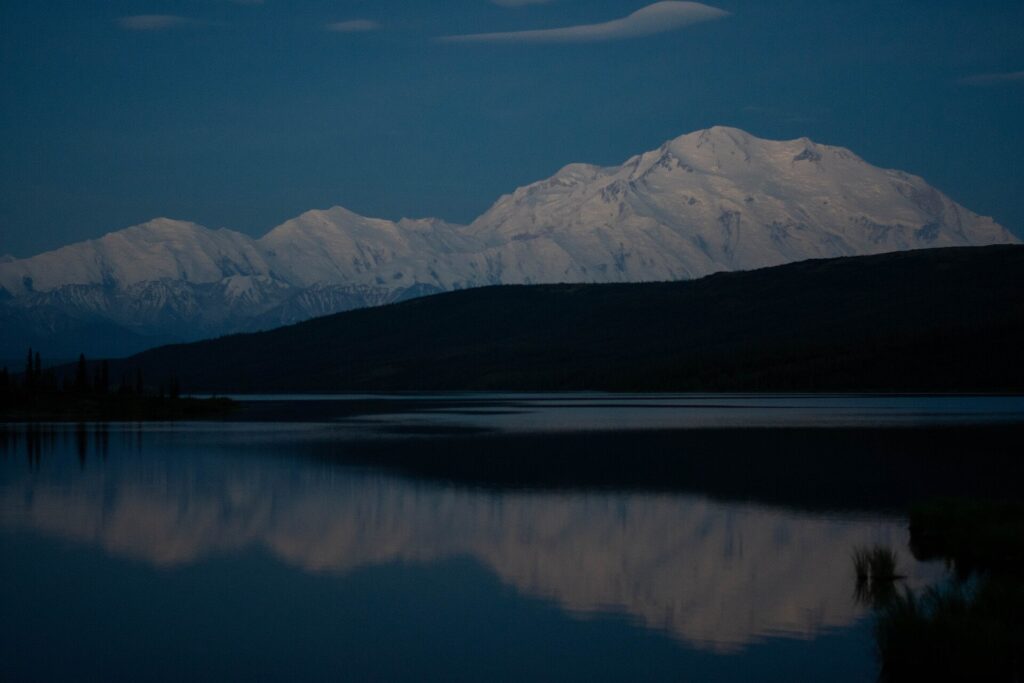
Denali, also known as Mount McKinley, is the highest mountain in North America. Its summit rises 20,310 feet (6,190 meters) above sea level in the Alaska Range of interior Alaska, and it is the centerpiece of Denali National Park and Preserve. Its base-to-peak rise of about 18,000 feet is among the greatest of any mountain that stands entirely above sea level, and it is the northernmost peak in the world above 6,000 meters [1].
| Elevation | 20,310 feet (6,190 m), USGS 2015 measurement |
|---|---|
| Prominence | 20,156 feet (6,144 m) |
| Range | Alaska Range |
| Park | Denali National Park and Preserve |
| First ascent | June 7, 1913 (Stuck, Karstens, Harper, Tatum) |
| Longest glacier | Kahiltna Glacier, 44 miles |
| Most popular route | West Buttress |
Geography and Measurement
Denali stands in the Alaska Range of interior Alaska, within the national park that bears its name. A USGS survey on September 2, 2015, gave its height as 20,310 feet, 10 feet lower than the 1952 photogrammetric figure of 20,320 feet. Its prominence is 20,156 feet, third in the world after Mount Everest and Aconcagua. The mountain has two summits: the South Summit is the higher, and the North Summit rises to 19,470 feet [1].
Names of the Mountain
The Koyukon Athabaskans have used the name Denali for centuries. Linguist James Kari explains that it is based on a verb theme meaning high or tall. During the Russian period the mountain was called Bolshaya Gora, a translation of the Native name. In 1896 the prospector William Dickey named it McKinley in support of presidential candidate William McKinley, who won the election the next year [1].
The federal government recognized the McKinley name when Congress established Mount McKinley National Park in 1917. The Alaska Board of Geographic Names renamed the mountain Denali in 1975, and the federal government restored the name Denali on August 28 to 29, 2015. In January 2025 the Department of the Interior changed the federal name back to Mount McKinley under an executive order, although the national park keeps the name Denali and Alaska officials continue to use Denali [1].
Early Exploration
British explorer George Vancouver was the first European on record to sight the mountain, in 1794. Dickey’s newspaper report in 1897 helped establish it as the highest peak in North America, ahead of Mount Logan. Robert Muldrow measured it at about 20,300 feet in 1898, and in 1902 the USGS party of Alfred Brooks reached its flanks and recommended an approach from the north [1].
The first recorded attempt was James Wickersham’s in 1903, the same year that Frederick Cook circled the mountain. Cook claimed a summit in 1906, but his claim was never verified, and the 1910 “Sourdough” climb of the North Summit by four Fairbanks-area men is also disputed. In 1912 the Parker-Browne expedition turned back about 200 feet short of the summit when a major earthquake on July 7 shattered the glacier they had climbed [1].
The First Ascent in 1913
The first verified ascent of the South Summit took place on June 7, 1913, when Hudson Stuck, Harry Karstens, Walter Harper and Robert Tatum reached the top by the Muldrow Glacier route. Harper, who was Alaska Native, reached the summit first. The expedition is remembered as a landmark in Alaska mountaineering [1].
Climbing History
The second ascent came in 1932. Barbara Washburn became the first woman to summit in 1947, and her husband Bradford Washburn became the first person to summit twice. In 1951 Bradford Washburn pioneered the West Buttress route, now the most popular and considered the safest and easiest. The Cassin Ridge was first climbed in 1961, and the first winter ascent came in 1967. Naomi Uemura made the first solo ascent in 1970, Sylvain Saudan skied the southwest face in 1972, and Sarah Doherty became the first amputee to summit in 1984. Karl Egloff set speed records in 2019 for the ascent (7 hours 40 minutes) and the round trip (11 hours 44 minutes) [1].
Most climbers spend two to four weeks on the mountain. In 2003 about 58 percent of climbers reached the summit, and by that year nearly 100 mountaineers had died there. Denali is one of the Seven Summits, the highest peaks of each continent [1].
Geology and Glaciers
Denali is a granitic pluton, mostly pink quartz monzonite, uplifted by the pressure of the Pacific plate subducting beneath the North American plate while erosion stripped away softer surrounding rock. Its height is linked to the Denali Fault and a restraining bend in that fault. Five large glaciers flow from the mountain: the Peters, Muldrow, Traleika, Ruth and Kahiltna. The Kahiltna, at 44 miles, is the longest glacier in the Alaska Range [1].
Weather
Weather at high altitude is severe. A weather station at about 19,000 feet recorded minus 75.5 degrees Fahrenheit on December 1, 2003, and the day before a North American windchill record of minus 118.1 degrees was measured. A 1932 thermometer recovered from about 15,000 feet recorded a low near minus 100 degrees [1].
Denali National Park and Preserve
The park around the mountain began as Mount McKinley National Park in 1917, and today the National Park Service manages it as Denali National Park and Preserve, one of the largest and best-known units in Alaska. Visitors come for wildlife viewing, hiking and views of the mountain on clear days [1][2][3].
Safety, Records and Risks
Denali is a demanding mountain, and its high latitude makes conditions harsher than the elevation alone suggests. Between 1947 and 2018, about 11 percent of mountaineering accidents in the United States occurred on Denali, and about 8 percent of related deaths. The worst single disaster came in 1967, when seven members of Joe Wilcox’s expedition died during a ten-day storm near the summit [1]. Climbers usually fly by ski plane to the Kahiltna Glacier and spend weeks hauling gear, acclimatizing and waiting for weather windows. The mountain has also hosted notable records, such as Anatoli Boukreev’s speed ascent of 10 hours and 30 minutes on the West Rib in 1990 [1].
Other Names and Naming Notes
Several other names have been attached to the mountain over time. A brief name in the late 1880s and early 1890s was Densmore’s Mountain, and in 1965 President Lyndon B. Johnson named the north and south peaks the Churchill Peaks, a designation that did not displace the older names. The North Summit, at 19,470 feet, has a prominence of about 1,270 feet, and some sources count it as a separate peak while others do not [1].
FAQs
How tall is Denali? 20,310 feet (6,190 meters), according to a 2015 USGS survey.
Who first climbed Denali? Hudson Stuck, Harry Karstens, Walter Harper and Robert Tatum reached the South Summit on June 7, 1913, with Harper arriving first.
What does Denali mean? It comes from a Koyukon Athabaskan word based on a verb theme meaning high or tall.
What is the most popular climbing route? The West Buttress, pioneered by Bradford Washburn in 1951.
Is Denali the tallest mountain in the world? No. It is the highest in North America, but Mount Everest is higher above sea level. Denali does have one of the largest base-to-peak rises of any mountain.
Sources
More in Earth Sciences
Key facts
Quick checkHow tall is Denali?Show answer
20,310 feet (6,190 meters)
Sources
- Wikipedia. Denali. 2026 (accessed 2026-11-11)
- National Park Service. Alaska parks. 2026 (accessed 2026-11-11)
- Encyclopaedia Britannica. Alaska. 2026 (accessed 2026-11-11)
Editorially reviewed by Specialty Digest Editorial TeamLast reviewed November 11, 2026Researched and drafted with AI assistanceReport an issue