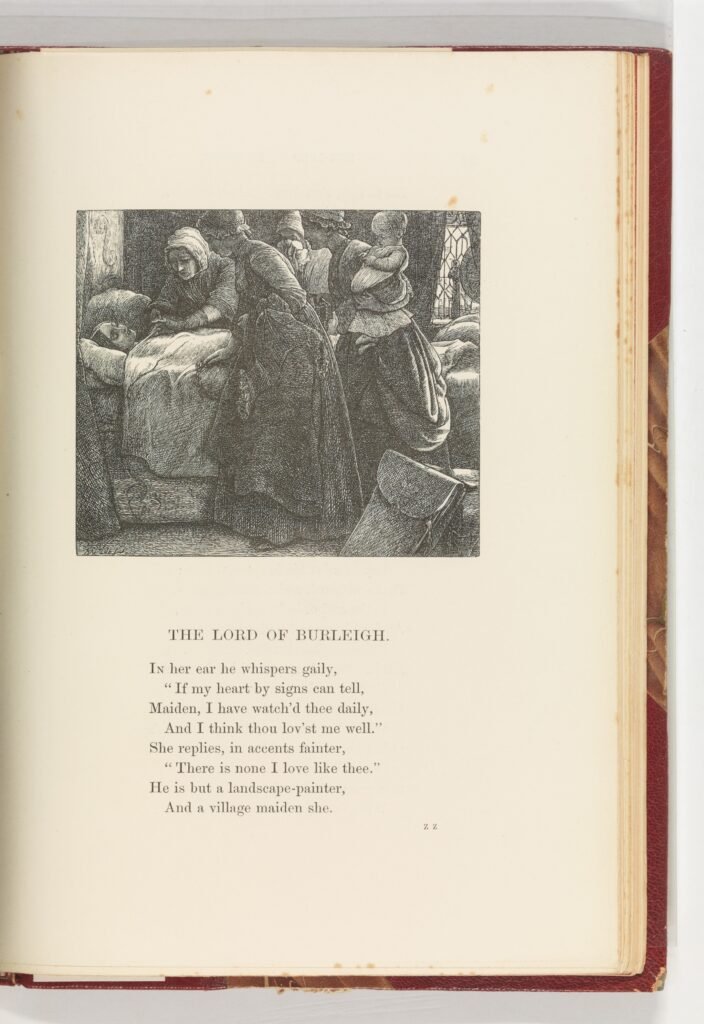
Poetry is a literary form that uses rhythm, sound, imagery, and condensed or heightened language to evoke meaning and emotion, often with greater intensity or compression than ordinary prose. Rather than simply conveying information in a straightforward sequence, poetry typically draws attention to the texture of language itself, through devices like meter, rhyme, line breaks, and figurative comparison, as part of how it communicates.
Oral poetic traditions predate written literature in virtually every culture studied by scholars, often serving practical as well as artistic purposes. Rhythmic, memorable language helped preserve long narratives, religious texts, and historical or genealogical knowledge across generations in societies without widespread writing, and poetry’s association with ritual, communal celebration, and storytelling remains visible in traditions ranging from ancient epic recitation to contemporary spoken-word performance.
Meter, Rhyme, and Form
Much poetry, especially before the twentieth century, follows a meter, a patterned arrangement of stressed and unstressed syllables that gives a line its rhythmic shape. English poetry has often used iambic pentameter, a line of ten syllables alternating unstressed and stressed beats, employed extensively by writers such as Shakespeare. Rhyme, the repetition of similar sounds at the ends of lines or within them, frequently reinforces a poem’s structure and can create a sense of closure, connection, or musicality between otherwise separate lines.
Many poetic traditions also rely on fixed forms with specific rules governing length, rhyme scheme, and sometimes subject matter. The sonnet, a fourteen-line form with established rhyme patterns, has been used across centuries by poets exploring love, mortality, and philosophical reflection. The haiku, a much shorter Japanese form traditionally built around seventeen syllables arranged in three lines, often captures a single, concentrated moment of observation, frequently drawn from nature or the changing seasons. These fixed forms impose creative constraints that many poets have found productive rather than limiting, using the form’s demands to sharpen a poem’s focus and economy of language.
The Rise of Free Verse
Beginning prominently in the nineteenth century and expanding dramatically through the twentieth, many poets moved away from fixed meter and rhyme toward free verse, which follows the natural rhythms of speech and relies on line breaks, spacing, and other visual or sonic choices rather than a predetermined pattern. Walt Whitman’s Leaves of Grass, first published in 1855, is often cited as an influential early example of free verse in English, breaking decisively from the metrical conventions that had dominated poetry up to that point.
Free verse does not mean the absence of craft or structure. Poets writing in free verse still make deliberate choices about line length, pacing, repetition, and the visual arrangement of words on a page, using these tools to control a poem’s rhythm, pacing, and emphasis even without a fixed, predetermined metrical pattern underlying the whole piece. The form’s flexibility has made it the dominant mode in much contemporary poetry, though formal, metered poetry continues to be written, taught, and genuinely valued alongside it rather than being displaced entirely.
Imagery and Figurative Language
Beyond sound and structure, poetry relies heavily on imagery, vivid sensory description, and figurative language such as metaphor and simile, comparisons that illuminate one thing by describing it in terms of another. These devices let a poem convey complex emotional or abstract content through concrete, often unexpected comparisons, compressing meaning into a small number of carefully chosen words in a way that extended prose explanation often cannot replicate with the same intensity or memorability.
Major Poetic Traditions
Epic poetry tells extended, often heroic narratives, typically in formal, elevated language, with Homer’s Iliad and Odyssey, composed in ancient Greece and traditionally dated to around the eighth century BCE, standing among the most influential examples in the Western tradition. Lyric poetry, by contrast, is generally shorter and more personal, focused on expressing a single speaker’s emotions, observations, or reflections rather than narrating an extended sequence of events, and it has become the dominant mode of much poetry written since the Romantic period.
Poetic traditions outside the European canon have their own distinct conventions and histories. Classical Chinese poetry developed intricate tonal and structural rules tied closely to the characteristics of the Chinese language itself, while Arabic poetry has a long tradition of formal meter and rhyme stretching back over a thousand years, historically central to Arabic literary and cultural life. Persian poetry, including the work of figures like Rumi and Hafez, blends intricate formal structure with mystical and philosophical themes that have influenced literature well beyond the Persian-speaking world. These varied traditions demonstrate that poetry’s reliance on sound, rhythm, and condensed language is a nearly universal feature of human culture, even though the specific forms and conventions used to achieve it differ enormously from one language and tradition to another.
FAQs
What is free verse?
Poetry that does not follow a fixed meter or rhyme scheme, relying instead on natural speech rhythms, line breaks, and visual arrangement for effect, rather than a predetermined pattern.
What is iambic pentameter?
A metrical pattern common in English poetry consisting of ten syllables per line, alternating unstressed and stressed beats, used extensively by writers such as Shakespeare.
What is a sonnet?
A fixed poetic form of fourteen lines following established rhyme patterns, traditionally used to explore themes like love, mortality, and philosophical reflection.
Did poetry exist before written language?
Yes. Oral poetic traditions predate writing in most cultures, often serving as a memorable way to preserve narratives, religious texts, and historical knowledge across generations.
Quick checkWhat is free verse?Show answer
Poetry that does not follow a fixed meter or rhyme scheme, relying instead on natural speech rhythms and line breaks for effect.
Editorially reviewed by Specialty Digest Editorial TeamLast reviewed November 2, 2026Researched and drafted with AI assistanceReport an issue