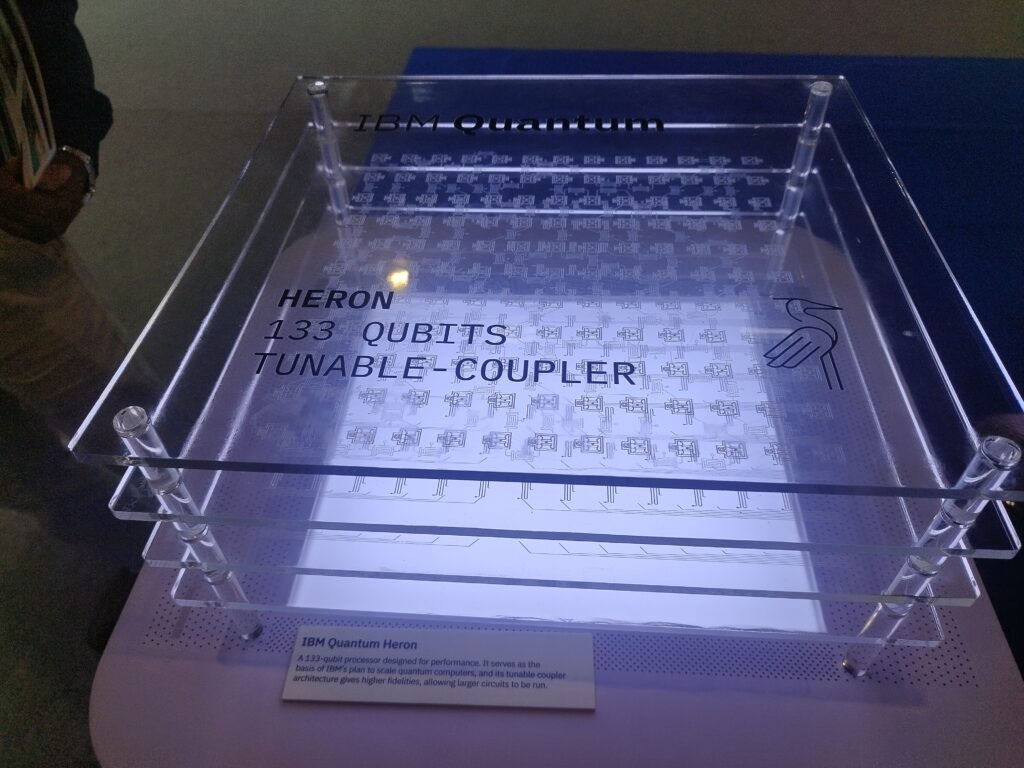
Quantum computing is a way of processing information that uses the rules of quantum mechanics, such as superposition and entanglement, instead of the on-or-off bits of conventional computers. Its basic unit is the quantum bit, or qubit. Working quantum computers exist, but they remain small, error-prone and largely experimental, and they are expected to outperform ordinary computers only on certain kinds of problems.
History of quantum computing
The science behind it dates to the birth of quantum physics in 1900, as the U.S. National Institute of Standards and Technology (NIST) notes. The idea of computing with quantum systems took shape much later. The National Academies of Sciences, Engineering, and Medicine report that quantum computing was first proposed in the 1980s as a way to improve computer modeling of quantum systems. In the early 1980s, the physicist Richard Feynman suggested that a quantum computer would be an effective tool for solving problems in physics. David Deutsch and Paul Benioff are also counted among the concept’s pioneers.
In the 1990s, several teams built the first quantum logic gates, the basic operations of a quantum circuit, using different physical methods to make qubits. A long debate followed over whether a machine with several hundred qubits could run without errors for long enough to be useful. Such a machine would matter because it could break widely used public-key codes, as an EBSCO overview points out.
In October 2019, a team at Google reported in the journal Nature that its Sycamore processor, which used 53 programmable superconducting qubits, sampled the output of a quantum circuit about a million times in roughly 200 seconds. The team estimated that the best classical supercomputer would need about 10,000 years for the same task and described the result as quantum supremacy for that specific task. The task was chosen to show a difference in speed rather than to solve a practical problem.
How quantum computing works
A conventional bit is either 0 or 1. NIST explains that a qubit can be in a superposition, which means it can be both 0 and 1 until it is measured. Combining qubits multiplies the possibilities. The Google team described a computational state space for 53 qubits with a dimension of 2 to the 53rd power, or about 10 to the 16th power.
Entanglement is a second resource. NIST describes entangled particles as ones that mimic each other no matter how far apart they are, a connection that researchers use in computing, sensing and communication. A quantum algorithm arranges these effects so that wrong answers cancel out and the right answer is more likely to be measured.
The difficulty is that quantum states are fragile. They can lose their quantum behavior when they interact with the environment, so many designs are cooled to temperatures near absolute zero, and controlling the system without disturbing it is one of the hardest problems in the field. Because a computation also has to be read out by measurement, programmers cannot simply inspect a qubit midway.
Types of quantum computers
Quantum computers differ mainly in what physical object serves as a qubit. Google’s Sycamore uses superconducting circuits, which behave as quantum objects at very low temperatures. Other research groups use different physical systems. NIST has been a leader in quantum research since the early twentieth century and built the world’s first atomic clock in 1949, a milestone built on quantum physics.
Researchers distinguish today’s small experimental machines from the large, fault-tolerant machine that most useful applications would need. The 2019 National Academies report assessed the feasibility and implications of building such a machine, including the hardware and software requirements.
Applications of quantum computing
The original motivation, modeling quantum systems, remains the most natural use, because simulating molecules and materials is hard for conventional computers. An EBSCO overview also lists advanced scientific modeling as a promising field. The best-known algorithmic threat is Shor’s algorithm, which would let a large enough quantum computer break the public-key encryption that protects much of the internet. Using a quantum algorithm like this one requires far more reliable qubits than exist today.
In response, NIST finalized its first three post-quantum encryption standards on 13 August 2024. These are algorithms designed to withstand attack by a quantum computer. NIST says the standards are meant to protect information ranging from confidential email messages to e-commerce transactions. NIST encouraged system administrators to start moving to them as soon as possible, because some experts predict a machine able to break current methods could appear within a decade.
Advantages and disadvantages of quantum computing
The advantage is potential speed on certain problems. The Google paper states that some tasks might run exponentially faster on a quantum processor than on a classical one. That does not mean quantum computers are faster in general, and they are not a replacement for laptops or phones.
The disadvantages are practical. Despite significant investment from technology companies and government agencies in recent years, EBSCO describes the field as still largely experimental. Hardware is delicate, expensive and often operates under extreme conditions, and errors are frequent. The National Academies committee was asked to assess the technical risks and realistic timelines for building a functionally useful machine, and to consider what such a machine would mean for signals intelligence, communications, banking and commerce, as well as the prospects for deploying quantum-resistant encryption.
Quantum vs. classical computing
Classical computers process bits one definite state at a time and are reliable, cheap and good at nearly every everyday task. Quantum computers handle probabilities carried by qubits and are suited to a narrow set of problems. Researchers expect the two to work together, with quantum devices acting as specialized accelerators next to conventional machines, and with superconducting hardware as one of several competing designs.
More in Computer Science
Key facts
- A qubit can be in a superposition of 0 and 1 until it is measured.1
- Quantum computing was first proposed in the 1980s to improve computer modeling of quantum systems.3
- Google reported in Nature in October 2019 that a 53-qubit superconducting processor sampled a circuit in about 200 seconds, a task estimated at 10,000 years for a classical supercomputer.4
- NIST finalized its first three post-quantum encryption standards on August 13, 2024.2
- Quantum states are fragile and can be lost through interaction with the environment.1
Related concepts
Quick checkWhat is a qubit?Show answer
A qubit is the basic unit of quantum information. Unlike a bit, which is 0 or 1, a qubit can be in a superposition of both until it is measured.
Sources
- 1. NIST, Quantum Frontiers: High-Impact Research at NIST, https://www.nist.gov/physics/international-year-quantum-science-and-technology
- 2. NIST, NIST Releases First 3 Finalized Post-Quantum Encryption Standards, August 13, 2024, https://www.nist.gov/news-events/news/2024/08/nist-releases-first-3-finalized-post-quantum-encryption-standards
- 3. National Academies of Sciences, Engineering, and Medicine, Quantum Computing: Progress and Prospects, 2019, https://nap.nationalacademies.org/catalog/25196/quantum-computing-progress-and-prospects
- 4. F. Arute et al., Quantum supremacy using a programmable superconducting processor, Nature, 23 October 2019, https://www.nature.com/articles/s41586-019-1666-5
- 5. EBSCO Research Starters, Quantum Computing, https://www.ebsco.com/research-starters/physics/quantum-computing
Editorially reviewed by Specialty Digest Editorial TeamLast reviewed November 4, 2026Researched and drafted with AI assistanceReport an issue