A computer is a machine that carries out arithmetic and logical operations automatically by following a set of instructions called a program. The modern electronic computer took shape during and just after World War II. Which machine counts as the first computer depends on the definition used, because several machines built between the 1930s and 1948 each have a claim, and no single inventor is credited.
History of the computer
The idea of an automatic calculating machine is older than electronics. The Computer History Museum notes that a team at the Science Museum in London, led by curator Doron Swade, built Charles Babbage’s second design for a mechanical calculating engine in six years using techniques that were available in his day. This showed that the design was accurate and could have worked in the nineteenth century.
Electrical machines came in the 1930s and 1940s. In 1941 the German engineer Konrad Zuse finished the Z3, which worked in complete isolation from developments elsewhere. It used 2,300 relays, performed floating-point binary arithmetic and had a 22-bit word length. It was used for aerodynamic calculations and was later destroyed in a bombing raid on Berlin.
In the United States, the physicist John Vincent Atanasoff conceived the basic principles of an electronic digital computer in the winter of 1937. With his graduate student Clifford Berry, he built a prototype in Ames, Iowa, in October 1939. The machine used binary numbers, vacuum tubes and a regenerative memory based on capacitors.
The full-size Atanasoff-Berry Computer, or ABC, was the size of a desk, weighed about 700 pounds and held more than 300 vacuum tubes. It could perform about one operation every fifteen seconds. The war prevented Atanasoff from completing the patent process, and the machine was dismantled when the building needed storage space.
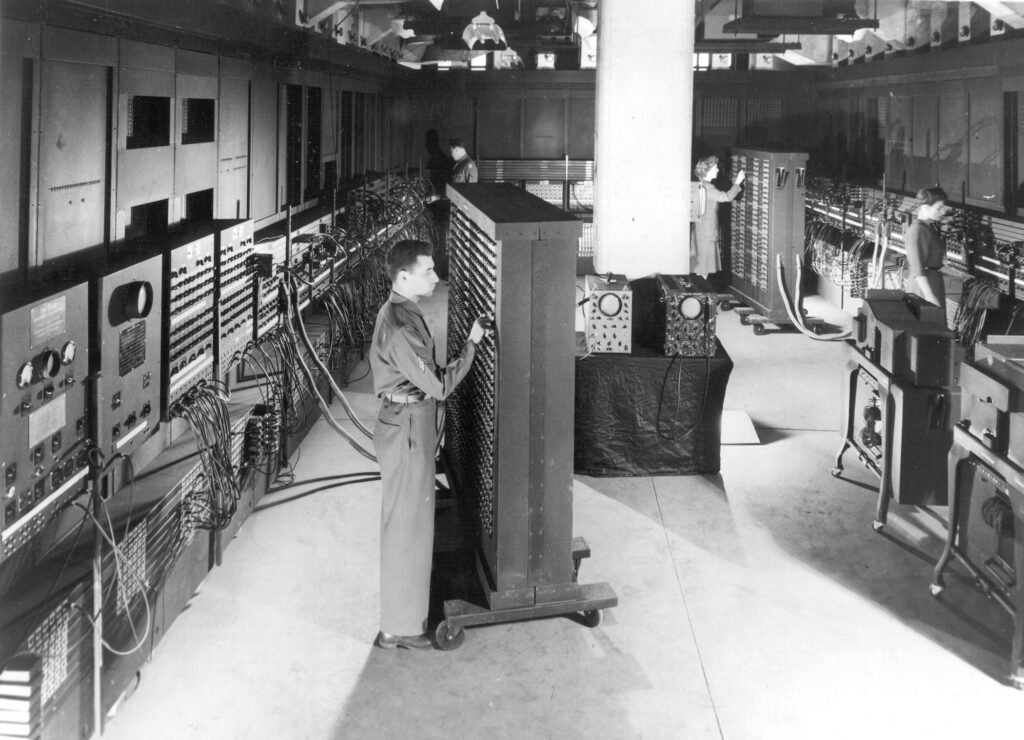
ENIAC, the Electronic Numerical Integrator and Computer, was built at the University of Pennsylvania’s Moore School of Electrical Engineering under a US Army contract. It was completed in 1945 and publicly announced on 14 February 1946. It held more than 18,000 vacuum tubes, weighed thirty tons and was nearly 100 feet long.
In 1948 researchers at the University of Manchester ran a program on the Small-Scale Experimental Machine, nicknamed the Baby. It was built to test a new form of high-speed electronic memory, the Williams tube, and it ran what the Computer History Museum lists as the first computer program to run on a computer.
Inventor and origins of the computer
The question of the first computer has several honest answers. Babbage designed mechanical calculating engines, Zuse built a working binary relay machine, Atanasoff and Berry built an electronic digital prototype, and ENIAC became the first large-scale electronic general-purpose digital computer.
The qualifiers matter. The IEEE record for the ABC calls it the first computing machine to use electricity, vacuum tubes, binary numbers and capacitors. The IEEE record for ENIAC calls it the world’s first large-scale electronic general-purpose digital computer. Both statements can be true because they define the first differently.
The idea of storing a program in memory, rather than setting it up with switches and wiring, was another turning point. The Computer History Museum describes it as a revolutionary innovation that replaced hardware setup with software that could be changed easily.
How a computer works
A computer takes in data, stores it, processes it by following instructions and sends out results. Its processor carries out the instructions, its memory holds both data and programs, and its input and output devices connect it to people and other machines.
Inside, nearly all computers represent information in binary, using only two states that stand for 0 and 1. Atanasoff chose binary numbers instead of the usual base ten for his machine. Instructions are lists of simple operations, and a step-by-step method for solving a problem is called an algorithm.
The switching parts changed over time. Relays gave way to vacuum tubes, and the transistor then reduced the size and power needs of electronics. Transistors were later combined by the millions in an integrated circuit, made from a semiconductor material.
Types of computers
Early electronic machines were one-of-a-kind computers built for specific tasks. Setting them up was cumbersome and time-consuming, according to the Computer History Museum.
In the 1950s businesses recognized the broad potential of computers and asked for flexible, large-scale machines that could consolidate varied tasks. The mainframe computers that met this demand reshaped how businesses operate. The IBM System/360 family is an example, and its Model 67 was the first in the series to use virtual memory.
The personal computer followed. The IBM PC, formally the Model 5150, used a 4.77 megahertz Intel 8088 microprocessor and Microsoft‘s MS-DOS operating system. It was the first personal computer to gain widespread adoption by industry, and it was widely copied, which created a large ecosystem of software and accessories.
Impact of the computer
The IEEE record for ENIAC says the machine extended the capacity of human reason in the way that the airplane extended the physical reach of people. Its first major job, studies of thermonuclear reactions, took a little over two hours and would have taken years by conventional calculating methods.
Speed has grown enormously since then. ETHW notes that the ABC performed about one operation every fifteen seconds, whereas a computer today can perform 150 billion operations in the same time.
Computers also became the foundation of networks. Connected computers carry the World Wide Web, and the International Telecommunication Union estimates that 76 percent of the world’s population, about 6.3 billion people, is online in 2026.
Uses of computers today
Computers now run in homes, offices, laboratories, hospitals, vehicles and factories. Most are not seen, because they are built into other devices such as phones and appliances. Many of the services people use online run on large shared systems, a model known as cloud computing.
What a computer does depends on its software. The same hardware can run word processing, scientific simulation or a game, which is the practical benefit of the stored-program idea.
More in Computer Science
Key facts
- Atanasoff conceived the design of the Atanasoff-Berry Computer in 1937 and, with Clifford Berry, built a prototype in October 1939.1
- Konrad Zuse's Z3, finished in 1941, used 2,300 relays and performed binary floating-point arithmetic.3
- ENIAC, built at the University of Pennsylvania under an Army contract, was publicly announced on 14 February 1946 and contained more than 18,000 vacuum tubes.2
- The Computer History Museum lists the 1948 Manchester Small-Scale Experimental Machine as the first computer program to run on a computer.3
- Storing programs in memory replaced switches and wiring with software and made computers far more flexible.4
Related concepts
In the news
- ScienceDragonfly Completes Its First Simulated Flight Ahead of a Titan Launch
- TechnologyNew Mars Helicopter Blade Design Targets Flights of Nearly 19 Kilometers, NASA Says
- ScienceHubble Gravitational Lens Image Prepares Astronomers for Roman Telescope Science
- ScienceHubble Finds Missing Oxygen in 37 Nearby Dwarf Galaxies, NASA Reports
- BusinessGlobal EV Outlook 2026: Electric Cars Reach 25 Percent of New Sales
Quick checkWho invented the first computer?Show answer
No one person did, and the answer depends on definition. Charles Babbage designed mechanical engines, Konrad Zuse built the relay-based Z3 in 1941, John Atanasoff and Clifford Berry built an electronic digital prototype in 1939, and ENIAC became the first large general-purpose electronic computer in 1946.
Sources
- Engineering and Technology History Wiki, Milestones: Atanasoff-Berry Computer, 1939, https://ethw.org/Milestones:Atanasoff-Berry_Computer,_1939
- Engineering and Technology History Wiki, Milestones: Electronic Numerical Integrator and Computer, 1946, https://ethw.org/Milestones:Electronic_Numerical_Integrator_and_Computer,_1946
- Computer History Museum, Timeline of Computer History: Computers, https://www.computerhistory.org/timeline/computers/
- Computer History Museum, Revolution: Birth of the Computer, https://www.computerhistory.org/revolution/birth-of-the-computer/4
Editorially reviewed by Specialty Digest Editorial TeamLast reviewed November 4, 2026Researched and drafted with AI assistanceReport an issue