A personal computer is a computer designed for use by one person at a time, small and inexpensive enough to sit on a desk or in a home. The first models appeared in the early 1970s, and the IBM PC of 1981 turned the category into a standard business tool.
History of the personal computer
The idea of a computer in every home surfaced in the 1950s, when commentators half-jokingly predicted it alongside personal helicopters. Early computers were large mainframes owned by scientists and businesses. Electronics hobbyists built simple calculators based on their designs, and the concept changed little for two decades. The arrival of the microprocessor in the early 1970s moved the idea toward reality. Minicomputers were small enough for a desktop but too expensive for most buyers, and cheaper microcomputers soon followed.
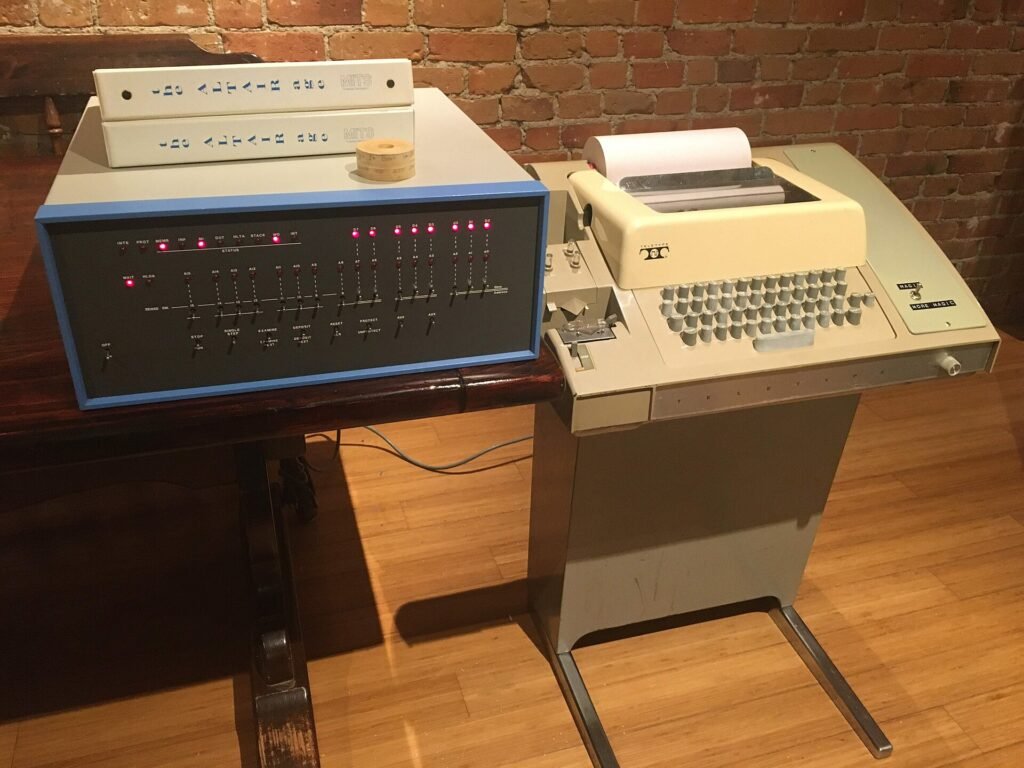
A milestone came in January 1975, when the magazine Popular Electronics featured the MITS Altair 8800, a microcomputer kit that cost under $500. The Computer History Museum records that the Altair sold for $297, or $395 with a case, and that it came with 256 bytes of memory that could be expanded to 64 kilobytes. Bill Gates and Paul Allen wrote a BASIC interpreter for it, and the company that became Microsoft began there. MITS was sold in 1977 and did not survive as an independent maker.
Steve Jobs and Steve Wozniak founded Apple in 1976 and demonstrated the Apple I to hobbyists at the Homebrew Computer Club. Their first order was for 50 Apple I computers at $500 each. The Apple II of 1977 was a complete product, with keyboard, power supply and BASIC language built in and a television as the display. Apple promoted it as an extraordinary computer for ordinary people. A floppy disk drive in 1978 and the VisiCalc spreadsheet in 1979 helped make it a hit.
IBM entered the market with its Personal Computer, model 5150, in 1981, nearly ten years after the first rivals, and its name lent the category instant credibility. Many companies were doubtful that small computers could be serious business tools, and the IBM label reassured them. The company advertised the PC to the general public with a folksy campaign, but its biggest effect came in offices. Unlike earlier IBM products, it used hardware and software from other companies, including an Intel microprocessor and the MS-DOS operating system from Microsoft. A team led by Don Estridge in Boca Raton, Florida, developed it, and more than a million had sold by the time Estridge died three years later.
Who invented the personal computer?
No one person did, and the answer depends on the definition. The IEEE’s history site says personal computers resulted from the creativity of thousands of inventors over decades. In 1986 the Computer Museum in Boston ran a contest to find the earliest one, and the judges chose John Blankenbaker’s Kenbak-1. Designed in 1971 before microprocessors existed, it had 256 bytes of memory and used small and medium scale integrated circuits. The company sold only about 40 units for $750 each and closed in 1973.
The first personal computer to use a microprocessor, by the same account, was the Micral of 1973, designed in France by André Truong Trong Thi and François Gernelle. It used the Intel 8008 and sold fully assembled for $1,700. Most Micrals went into industrial roles such as tollbooths, so the machine reached the public less than the Altair did. The Computer History Museum credits Altair designer Ed Roberts with coining the term personal computer.
How a personal computer works
A personal computer is built around a microprocessor, a single chip that carries out instructions. It works with memory that holds programs and data, storage on disks, and input and output devices such as a keyboard and a display. The microprocessor is a complex integrated circuit, and its transistors are built from a semiconductor material.
An operating system ties the parts together and lets programs run. Gary Kildall’s CP/M, the first commercially successful operating system for microcomputers, served the hobbyist era, and MS-DOS ran the IBM PC’s floppy and hard disk drives. The Altair’s open bus design, with 100 lines, evolved into the S-100 standard that many hobbyist machines used.
Types of personal computers
Early personal computers were kits and hobbyist machines like the Altair, which buyers assembled and programmed themselves. The Apple II belonged to a second type, the ready-to-use home or school computer. The IBM PC created a third, the business desktop, and the clones that followed because IBM published its design details made it an open standard.
Later types included machines with a graphical user interface and a mouse, such as the Macintosh. The IEEE’s history site also notes later desktop, laptop, pocket and wireless designs. They share the idea of a general-purpose computer that its owner controls.
Impact of the personal computer
The IBM name reassured companies that personal computers were serious tools, and businesses bought them in bulk. Spreadsheet and word-processing software became integral to corporate life, and a growing library of programs made PCs more useful, which drove more sales. Microsoft became the largest software company in the world by the late 1980s.
Networks added another layer of change. As the World Wide Web grew, the browser extended what a computer could do, and by the end of the twentieth century the personal computer had gone from a hobbyist’s toy to a necessity of daily life.
Personal computers today
The personal computer is still a main platform for office work, and its shape has changed from desktop towers to laptops and smaller machines. The IEEE history site notes that personal computers of all brands evolved to take advantage of networks, and the browser became a new kind of software that expanded what they could do. The split between hardware makers and software suppliers that IBM and Microsoft helped create is still a feature of the industry.
More in Computer Science
Key facts
- Array
Related concepts
Quick checkWho invented the personal computer?Show answer
No single person did. The Kenbak-1 of 1971 was named the earliest, the Micral of 1973 was the first with a microprocessor, and the Altair 8800 of 1975 started the hobbyist era.
Sources
- Array
Editorially reviewed by Specialty Digest Editorial TeamLast reviewed November 4, 2026Researched and drafted with AI assistanceReport an issue