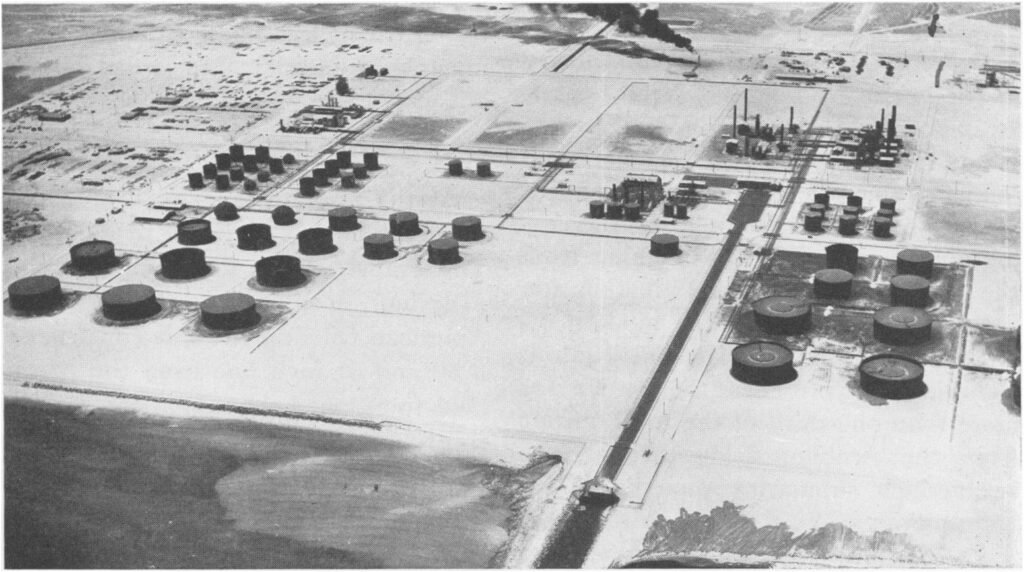
Saudi Aramco, formally the Saudi Arabian Oil Company and branded as Aramco, is a Saudi Arabian oil and gas company based in Dhahran. It produces crude oil and natural gas, refines and trades petroleum, and makes chemicals. For 2025 it reported adjusted net income of $104.7 billion.
History of Aramco
Aramco traces its beginnings to 1933, when Saudi Arabia signed a concession agreement with the Standard Oil Company of California. A subsidiary, the California Arabian Standard Oil Company, was created to manage the agreement. Surveys of the desert came first and drilling began in 1935. After years with little to show, executives asked their chief geologist, Max Steineke, for advice in 1937, and he told them to keep drilling.
That advice paid off in 1938, when commercial production began from Dammam No. 7, known as the Prosperity Well. The company, later named the Arabian American Oil Company, or Aramco, reached 500,000 barrels per day in 1949. In 1950 it completed the 1,212-kilometer Trans-Arabian Pipeline, then the longest in the world, which linked eastern Saudi Arabia to the Mediterranean. In 1951 it located the Safaniyah field, the largest offshore oil field discovered at that time, and in 1958 production passed 1 million barrels per day. By 1962 cumulative production had reached 5 billion barrels, and by 1971 average daily output was 4.49 million barrels, roughly 1.6 billion barrels a year.
Ownership then moved to the Saudi state. The government bought a 25 percent interest in 1973, raised it to 60 percent in 1974, and took 100 percent in 1980. The Saudi Arabian Oil Company was established in 1988 to take over all of Aramco’s responsibilities, and Ali I. Al-Naimi became its first Saudi president and chief executive that year.
The company also expanded abroad. In 1989 it formed Star Enterprises with Texaco in the United States, which became Motiva, and in 2017 Saudi Aramco became sole owner of the Port Arthur, Texas, refinery, the largest single-site refinery in North America. It bought a 35 percent stake in a South Korean refiner in 1991, later renamed S-Oil, 40 percent of Petron in the Philippines in 1994, and half of a Greek refiner, Motor Oil (Hellas) Corinth Refineries, in 1996. As a result, the company says it is represented in the three major global energy markets of Asia, Europe and North America.
Products and services of Aramco
Aramco’s main product is crude oil, but its activities extend to natural gas, refined fuels, lubricants and chemicals. In the early 2000s it set out to become an integrated energy and chemicals enterprise, which means a company that handles production, refining and chemical conversion under one roof. It describes ways of turning a barrel of oil into nonmetallic materials and crude-to-chemicals products that go beyond traditional fuels. These activities sit alongside its core business of finding and producing oil.
Technology is a stated focus. In 1997 it developed POWERS, a reservoir simulator that models the behavior of very large oil fields, and it built a research and development center in Dhahran in 2000. Later versions, GigaPOWERS in 2010 and TeraPOWERS in 2016, handle ever larger models. The company says its artificial intelligence, digital and other solutions delivered $5.3 billion of realized value in 2025, bringing the total since 2023 to $11.3 billion.
Corporate structure and operations of Aramco
Aramco’s headquarters are in Dhahran, and its president and chief executive is Amin H. Nasser. The company reports to investors on a quarterly basis. In its results for 2025, issued on 10 March 2026, it listed adjusted net income of $104.7 billion, cash flow from operating activities of $136.2 billion and free cash flow of $85.4 billion.
It invested $52.2 billion in capital projects in 2025 and guided to $50.0 billion to $55.0 billion for 2026. Total shareholder distributions reached $85.5 billion, and the board declared a base dividend of $21.89 billion for the fourth quarter. The gearing ratio, which compares debt with capital, stood at 3.8 percent at the end of 2025. The company also announced a share buyback program of up to $3.0 billion over 18 months, and it reported its lowest total recordable case rate, a standard measure of workplace injuries, since its initial public offering.
Growth plans focus on gas. Aramco aims to raise sales gas production capacity by about 80 percent by 2030 from 2021 levels, and in 2025 it started production at Jafurah and began operations at the Tanajib Gas Plant. It also brought additional crude oil capacity onstream at Marjan and began water injection at Berri. According to the company, the gas expansion matches rising domestic demand and delivers significant volumes of high-value associated liquids.
Impact of Aramco
Aramco’s output affects global supply of fossil fuels, and its decisions influence the price of benchmarks such as Brent crude. For Saudi Arabia, the company is central to the economy, and its in-kingdom total value add program, called iktva, reached 70 percent localization in procurement, with a target of 75 percent by 2030.
Its history shows how a foreign concession became a national enterprise. Saudi ownership rose from 25 percent in 1973 to 100 percent in 1980, a change that gave the state direct control over its oil resources. The Trans-Arabian Pipeline, for its part, sharply cut the time and cost of exporting oil to Europe when it opened in 1950, which helped establish Saudi crude as a major source of supply for that market.
The company has also moved into new fields. It announced plans to acquire a significant minority interest in HUMAIN, an artificial intelligence venture, and it says it is investing in lower-emission energy and solutions. In its 2025 statement, the chief executive said the world had seen another year of record oil demand. That remark is the company’s own view, and demand and supply forecasts differ among independent analysts.
Key facts
- Aramco traces its beginnings to a 1933 concession agreement between Saudi Arabia and the Standard Oil Company of California.1
- Commercial oil production began from Dammam No. 7, the Prosperity Well, in 1938.1
- The Saudi government raised its interest in Aramco from 25 percent in 1973 to 100 percent in 1980, and the Saudi Arabian Oil Company was established in 1988.1
- Aramco reported adjusted net income of $104.7 billion and capital investment of $52.2 billion for 2025.2
- It aims to raise sales gas production capacity by about 80 percent by 2030 from 2021 levels.2
Related concepts
In the news
Quick checkWhen did Saudi Arabia take full ownership of Aramco?Show answer
The Saudi government bought 25 percent of Aramco in 1973, raised its share to 60 percent in 1974 and reached 100 percent in 1980. The Saudi Arabian Oil Company was formally established in 1988.
Sources
- [1] Aramco, Our history, https://aramco.com/en/about-us/our-history
- [2] Aramco, Aramco announces fourth quarter and full-year 2025 results (10 March 2026), https://aramco.com/en/news-media/news/2026/fourth-quarter-and-full-year-press-release
Editorially reviewed by Specialty Digest Editorial TeamLast reviewed November 4, 2026Researched and drafted with AI assistanceReport an issue