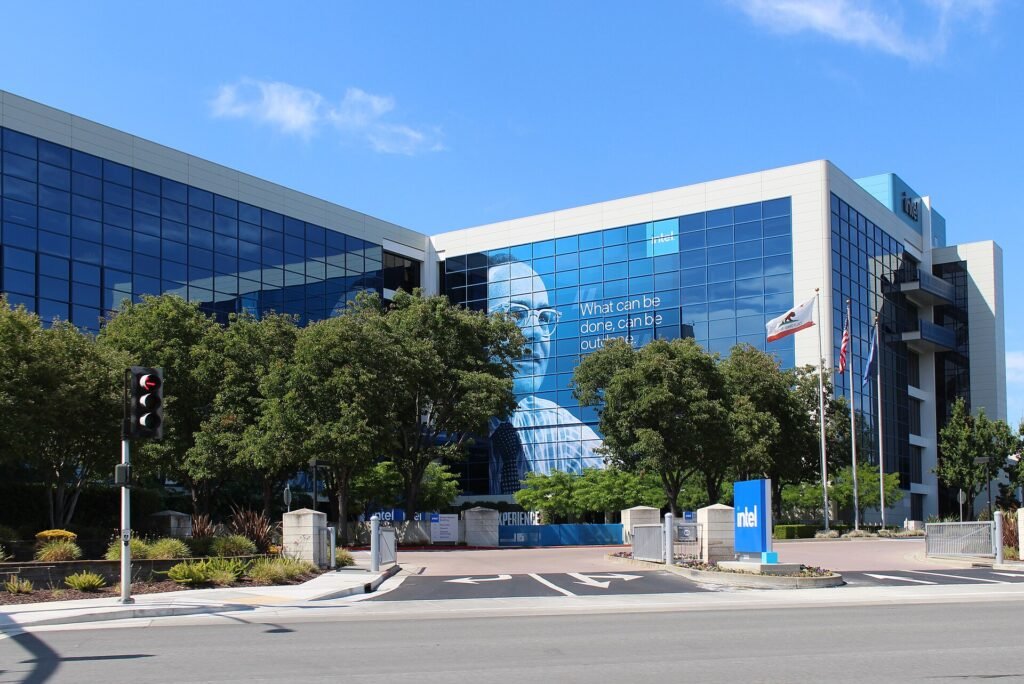
Intel Corporation is an American semiconductor company based in Santa Clara, California, that designs and manufactures microprocessors and related chips for personal computers, data centers and other devices. It reported net revenue of $52.9 billion for fiscal 2025, which ended on December 27, 2025, according to its annual report filed with the U.S. Securities and Exchange Commission (SEC). A microprocessor is a computer’s central processing unit built on a single chip.
History of Intel
Robert Noyce and Gordon Moore founded Intel in 1968, according to the Science Museum Group. Both were scientists who had worked in the early semiconductor industry in Silicon Valley, and the company first became known for memory chips.
Intel introduced the first commercial microprocessor in 1971. The Computer History Museum explains that a customer asked for custom chips for a new calculator, and Intel engineer Ted Hoff proposed a general-purpose four-bit computer on four chips instead. Federico Faggin adapted Intel’s memory technology to fit the 4004 processor and its 2,300 transistors onto one chip. Seeing wider potential, Intel secured the right to sell the design to other customers and released it as the MCS-4 family.
That decision opened a new industry. Later Intel processors, built on the x86 design, became the standard engines of personal computers in the 1980s, and the company grew into one of the world’s largest chipmakers.
In recent years Intel has tried to reposition itself. Its annual report describes a strategy of becoming a foundry, meaning a factory that makes chips for other companies, in addition to selling its own products.
Products and services of Intel
Intel’s report describes two broad activities: selling its own chips and offering manufacturing services. The Intel Products business includes the Client Computing Group (CCG), which makes processors for laptops and desktops, and the Data Center and AI group (DCAI), which makes chips for servers and artificial intelligence work.
Those chips are made by the Intel Foundry operating segment and, in some cases, by outside manufacturers. Intel Foundry also offers semiconductor design and manufacturing services to external customers, along with packaging, assembly and testing. Packaging is the step that connects a finished chip to the system it will run in.
The foundry offering lets outside customers design their own chips and manufacture them with Intel’s process technologies. It also lets them use Intel’s advanced packaging services for wafers produced by other foundries.
The company reports three main segments: CCG, DCAI and Intel Foundry. It also has other businesses, including Mobileye, a subsidiary that develops technology for driver assistance and autonomous vehicles, in which outside investors hold a minority share.
In 2024 Intel announced a strategic collaboration with United Microelectronics Corporation (UMC) as part of its foundry strategy. The annual report also refers to a planned process known as Intel 14A, for which the company is seeking customers.
Corporate structure and operations
Intel operates its own factories and also depends on outside suppliers. The annual report describes a workforce of 85,100 people as of December 27, 2025.
Net revenue was $54.2 billion in 2023, $53.1 billion in 2024 and $52.9 billion in 2025, so sales were roughly flat over the period. Gross profit was $18.4 billion in 2025, or 34.8 percent of revenue, compared with $17.3 billion, or 32.7 percent, in 2024 and $21.7 billion, or 40.0 percent, in 2023.
Profit moved more sharply. Net income attributable to Intel was $1.7 billion in 2023, then a loss of $18.8 billion in 2024 and a smaller loss of $267 million in 2025. The 2024 loss equaled 35.3 percent of that year’s net revenue, while the 2025 loss was 0.5 percent. The report lists alternative financing arrangements and the pursuit of government grants among the factors affecting its plans.
The annual report also says that the U.S. government acquired a significant equity interest in the company in 2025. The company issued shares to the government at a discount to the market price, and a warrant could add more. The filing warns that these transactions dilute existing shareholders and reduce the voting and governance rights of other shareholders.
Impact of Intel
The microprocessor changed what a computer is. Before 1971, a computer’s processing was spread across many components. Putting the processing on one integrated circuit made computers smaller, cheaper and easier to build into other products, from calculators to cars.
Intel’s x86 processors also created a long-lived software ecosystem. Programs written for them ran across machines from many manufacturers, which helped the personal computer market grow.
The company’s current role has strategic importance beyond its own business. Governments treat domestic chip manufacturing as a matter of economic and national security, and in 2025 the U.S. government acquired an equity interest in Intel. The annual report cites trade and geopolitical tensions, including those involving China and Taiwan, among its risks.
Criticism and controversies
Intel’s best-known legal dispute is with the European Commission (EC). In 2009 the EC found that Intel had broken European competition law by offering rebates that required customers to buy all or most of their x86 processors from it, and by making payments to prevent sales of rival products. It imposed a fine of 1.1 billion euros, which Intel paid in the third quarter of 2009.
The case went through years of appeals. In January 2022 the EU’s General Court annulled the EC’s findings on rebates and the fine, and the money was returned to Intel in February 2022. The Court of Justice rejected the EC’s appeal on that point in October 2024.
The finding about payments to prevent sales of specific rival products stayed in force. In September 2023 the EC imposed a new fine of 376 million euros on that basis. In December 2025 the General Court reduced it to 237 million euros, and Intel may still appeal.
More in Electrical Engineering
Key facts
- Robert Noyce and Gordon Moore founded Intel in 1968, and the company introduced the first microprocessor in 1971.2
- Intel reported net revenue of $52.9 billion for fiscal 2025 and a net loss attributable to Intel of $267 million.1
- The Intel 4004 fit 2,300 transistors on a single chip and was released as part of the MCS-4 family in 1971.3
- Intel had 85,100 people as of December 27, 2025.1
- Intel reports three segments: CCG, DCAI and Intel Foundry.1
Related concepts
In the news
Quick checkWhat did Intel introduce in 1971?Show answer
The first microprocessor, the Intel 4004, a four-bit processor with 2,300 transistors on one chip.
Sources
- Intel Corporation, Form 10-K for the fiscal year ended December 27, 2025 (SEC EDGAR), https://www.sec.gov/Archives/edgar/data/50863/000005086326000011/intc-20251227.htm
- Science Museum Group Collection, Intel Corporation 1968, https://collection.sciencemuseumgroup.org.uk/people/cp21430/intel-corporation
- Computer History Museum, Intel's Microprocessor (CHM Revolution), https://www.computerhistory.org/revolution/story/285
Editorially reviewed by Specialty Digest Editorial TeamLast reviewed November 4, 2026Researched and drafted with AI assistanceReport an issue