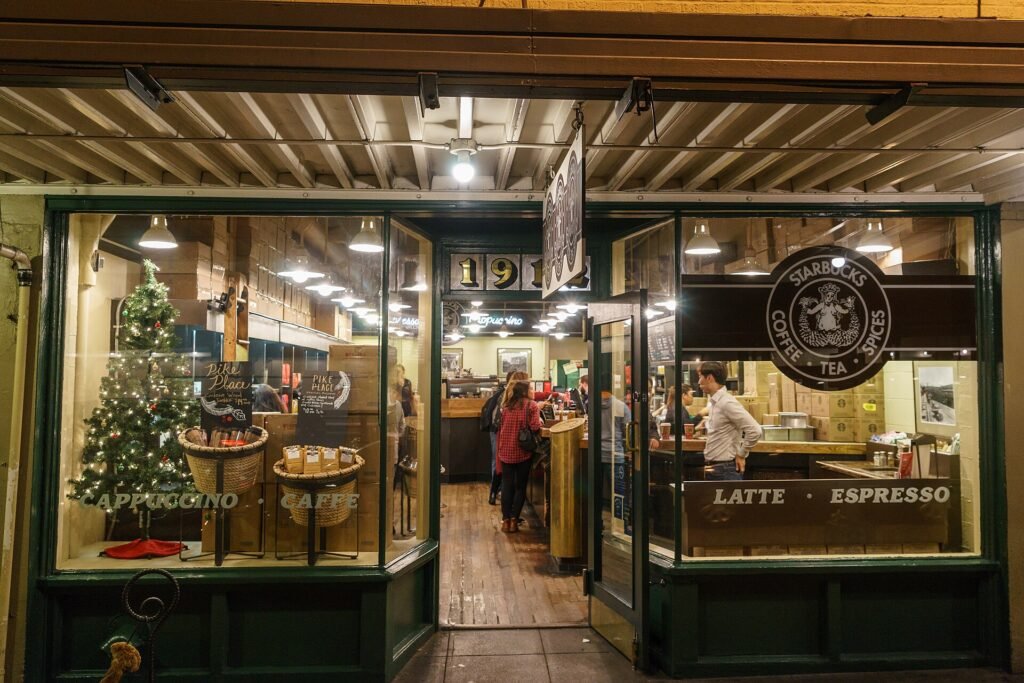
Starbucks is an American coffeehouse company headquartered in Seattle, Washington, that sells coffee, tea, beverages and food through company-operated and licensed stores around the world. It reported revenues of $37.184 billion for fiscal 2025, which ended on September 28, 2025.
History of Starbucks
The first Starbucks opened in 1971 in the historic Pike Place Market area of Seattle. At that time the company was a single store that sold freshly roasted whole coffee beans, not prepared drinks. The company says its name was inspired by the novel Moby-Dick and the seafaring tradition of early coffee traders.
The modern company took shape through Howard Schultz. According to the company’s history page, he first entered a Starbucks store in 1981 and joined the company a year later. On a trip to Italy in 1983 he was struck by the espresso bars there and wanted to bring a similar cafe tradition to the United States, as a gathering place that he described as a third place between home and work.
Schultz left Starbucks briefly to open a cafe chain called Il Giornale, then returned in August 1987 and bought Starbucks with the help of local investors. The business then grew from a Seattle roaster into an international chain of coffeehouses. The company’s own history page describes its aim as sharing great coffee with friends while helping to make the world a little better, and it presents the coffeehouse as a place for conversation as well as a place to buy a drink.
Products and services
Starbucks sells hot and cold coffee drinks, teas, packaged coffee, pastries and sandwiches. Its annual report says that, in addition to its flagship Starbucks Coffee brand, it sells goods and services under the Teavana, Ethos and Starbucks Reserve names. Starbucks Reserve is a premium line of small-lot coffees and roastery locations.
The company also sells coffee and tea through channels other than its own stores, including grocery stores and foodservice, under what it calls its Global Coffee Alliance with Nestlé. Under this arrangement Nestlé sells packaged Starbucks products in stores and to food service customers, which allows the brand to reach customers who rarely visit a cafe.
Coffee drinks involve a long chain of work that starts with coffee roasting, which brings out the flavors in green beans, and ends with preparation at the counter.
Corporate structure and operations
Starbucks Corporation is a publicly traded company whose principal executive office is at 2401 Utah Avenue South in Seattle. Its fiscal year ends on the Sunday closest to September 30, and the 2025 fiscal year ended on September 28, 2025.
The company operates through company-operated stores, in which it employs the staff, and licensed stores, which are run by partners under license, often in airports, grocery stores or in countries where a local business operates the stores. Its filings describe operating segments covering North America, International and Channel Development, which handles sales outside its own stores.
Licensed stores matter for reach, since they let Starbucks open in places where a conventional store would be hard to run. Examples include airports, hotels, university campuses and markets where a local partner has the operating knowledge.
Dated figures from filings with the U.S. Securities and Exchange Commission show the scale of the business:
- Revenues of $35.976 billion for fiscal 2023.
- Revenues of $36.176 billion for fiscal 2024.
- Revenues of $37.184 billion for fiscal 2025.
The fiscal 2025 report also says that approximately 158,000 employees worked outside the United States, including about 153,000 in company-operated stores, with the rest in regional support operations. The company calls its employees partners. The revenue figures imply growth of about 0.6 percent from fiscal 2023 to fiscal 2024 and about 2.8 percent from fiscal 2024 to fiscal 2025.
Impact of Starbucks
Starbucks helped make espresso-based drinks part of everyday life in many countries, and it is a standard example in discussions of brand equity and of how a retailer can charge a premium for an experience as well as a product. The company also uses digital marketing and loyalty programs to build repeat visits.
Its supply chain begins with farmers in coffee-growing regions. The annual report notes that the supply and price of green coffee can be affected by weather and extreme weather events, water supply, natural disasters, crop disease and pests, farm input costs and political and economic conditions, and that climate change may worsen many of these factors. Questions of sustainable food and beverage sourcing are therefore central to the company’s long-term planning.
The company says that it provides benefits to its employees, including up to 18 weeks of fully paid leave for birth parents and up to 12 weeks for non-birth parents who average at least 20 hours a week.
The company also faces competition from independent cafes, other chains and convenience stores that sell coffee. Its annual report lists price pressure, changing consumer preferences and the costs of ingredients, labor and rent among the factors that affect its business. As coffee drinkers move toward cold drinks, mobile ordering and delivery, stores have changed their layouts to handle more orders that customers pick up instead of drinking on site.
Criticism and controversies
Labor relations have been one of the most visible issues in recent years. Workers at a Starbucks store in Buffalo, New York, voted in December 2021 to unionize, the first company-operated store in the United States to do so, and organizing spread to other stores. The company’s report says that partners in approximately 6 percent of its U.S. company-operated stores are represented by unions. Starbucks and the union have disagreed in public over bargaining and over alleged violations of labor law, and the dispute has been before regulators and courts.
Coffee growing and sourcing are also subject to scrutiny, since growers in many regions earn low incomes and face climate risks. The company has said that it operates its own sourcing standards and supports farmer programs, and independent assessments of such programs vary. This entry is general background and not investment advice.
More in Management
Key facts
- Starbucks has its principal executive office in Seattle, Washington.2
- The first Starbucks opened in 1971 in the Pike Place Market area of Seattle.1
- Howard Schultz returned in August 1987 and bought Starbucks with local investors.1
- Revenues were $37.184 billion in fiscal 2025, which ended September 28, 2025.2
- Partners in about 6 percent of U.S. company-operated stores are represented by unions.2
Related concepts
Quick checkHow did Starbucks begin?Show answer
Starbucks began in 1971 as a single store in Seattle's Pike Place Market selling whole coffee beans, and it became a coffeehouse chain after Howard Schultz bought it in 1987.
Sources
- Starbucks Coffee Company, History (Starbucks Azerbaijan), https://www.starbucks.az/en/about/history
- Starbucks Corporation, Annual Report on Form 10-K for fiscal year 2025, U.S. Securities and Exchange Commission, https://www.sec.gov/Archives/edgar/data/829224/000082922425000114/sbux-20250928.htm
Editorially reviewed by Specialty Digest Editorial TeamLast reviewed November 4, 2026Researched and drafted with AI assistanceReport an issue