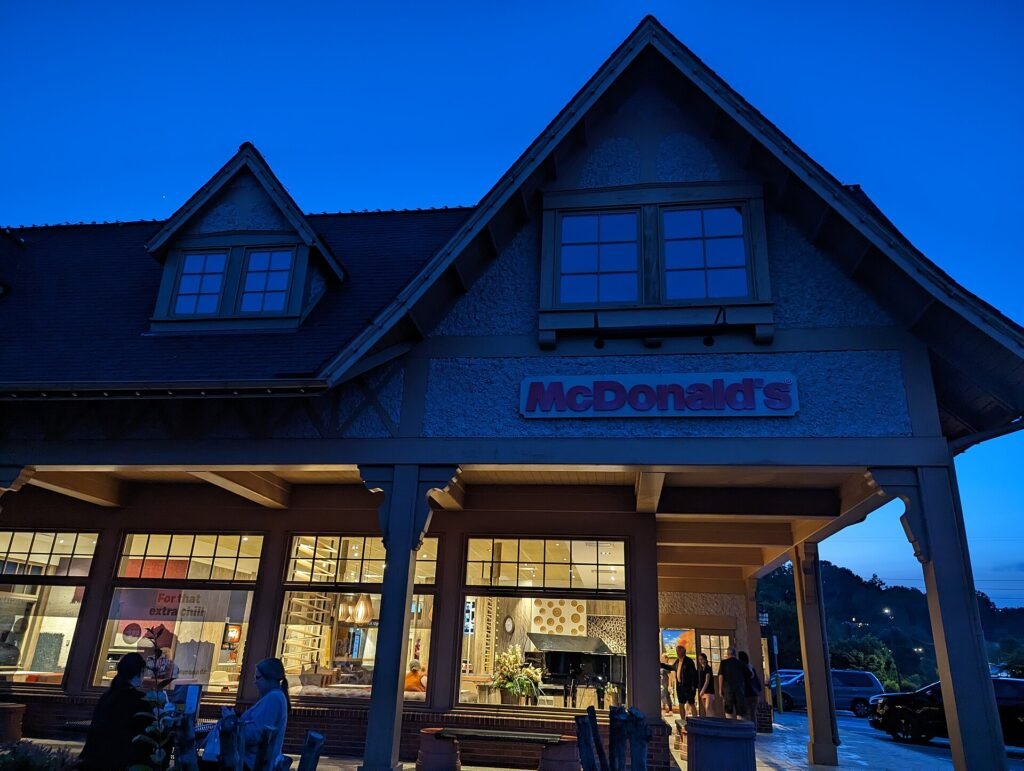
McDonald’s is an American fast food company headquartered in Chicago, Illinois, that runs one of the largest restaurant systems in the world, most of it through independent franchisees. Its annual report calls the company primarily a franchisor, and it reported revenues of $26.885 billion for 2025.
History of McDonald’s
The restaurant began as a family business. Brothers Richard and Maurice McDonald opened a food stand near Monrovia, California, in 1937, then moved to San Bernardino in 1940 and named the drive-in McDonald’s Barbeque. In 1948 they closed for three months and relaunched with a smaller menu, lower prices and self-service windows in place of carhops, a format they called the Speedee Service System.
The idea spread through franchising. The first franchise opened in Phoenix, Arizona, in 1953. In 1954 the salesman Ray Kroc, who sold milkshake mixers, visited the San Bernardino restaurant after noticing how many mixers the brothers ordered. In 1955 he opened his own McDonald’s in Des Plaines, Illinois, and in the early 1960s he bought the business from the brothers for $2.7 million. Kroc’s company then grew into the corporation that exists today.
The change appears to have worked. According to the history article, profits at the San Bernardino restaurant were 40 percent above pre-conversion levels by 1951, and by 1954 the brothers had sold 21 franchises. Kroc saw the system as something that could be repeated almost anywhere, because the kitchen layout and menu were simple enough to copy.
Over the following decades McDonald’s expanded outside the United States and added menu items for local tastes while keeping a core menu of burgers, fries and drinks.
Products and services
The company’s menu centers on hamburgers, chicken sandwiches, french fries, breakfast items, desserts and beverages. Its annual report says its marketing and promotional efforts focus on value, quality, food taste, menu choice, nutrition, convenience, cultural relevance and the customer experience.
McDonald’s has also built a large digital and delivery business. The report says the company set a target to increase the share of systemwide delivery sales originating from its mobile app to 30 percent by the end of 2027, and that its loyalty programs operate in 70 markets. It also says the company has the most drive-thru locations worldwide, with nearly 29,000 globally, including over 95 percent of the approximately 13,700 locations in the United States.
Corporate structure and operations
McDonald’s is primarily a franchisor. That means most restaurants are owned and operated by independent business people who pay the company rent, royalties and fees, while the company owns or leases much of the underlying real estate. Franchised restaurants operate under one of three structures: conventional franchise, developmental license or affiliate. This is a different model from companies that own most of their own outlets, and it affects how the company reports its revenues, since franchised sales are not recorded as company revenue.
For financial reporting, the company’s significant segments are the United States and International Operated Markets, together with a third segment called International Developmental Licensed Markets and Corporate. The latter includes the results of over 75 countries as well as corporate activities.
Revenue figures from the company’s filings with the U.S. Securities and Exchange Commission show steady growth:
- $25.494 billion in 2023.
- $25.920 billion in 2024.
- $26.885 billion in 2025.
The report also describes three technology-enabled platforms that the company says are designed to build competitive advantages and keep it ahead of customer expectations.
Its franchising approach has also meant that the company’s results combine rent and royalties from franchisees with sales from company-operated restaurants, which gives a different financial profile from a business that sells only food.
Impact of McDonald’s
McDonald’s helped popularize assembly-line food preparation, standardized menus and franchising as a way of expanding a restaurant brand. Its operating model is closely tied to supply chain management, because restaurants in many countries rely on consistent supplies of beef, potatoes, chicken, dairy and packaging.
The company is also a frequent example in teaching about brand equity and market segmentation, since it adapts menus to local markets while keeping a single global identity. Its annual report says its Global People Brand Standards apply to all restaurants, whether company-owned or franchised, and cover areas such as employee health and safety.
Delivery has become a significant channel as well. The annual report says the company has long-term strategic partnerships with delivery providers that benefit the company, customers and franchisees by improving operating efficiency and the customer experience. Systemwide sales to loyalty members, which the company measures across 70 markets, are one of the metrics it uses to track the growth of digital sales.
The company is also a large employer, although most restaurant employees work for franchisees rather than for the company itself.
Criticism and challenges
Fast food in general draws public health debate over calories, sodium and marketing to children, and McDonald’s, as the best-known brand in the sector, is often named in that debate. The company says it focuses its marketing on value, taste, choice and nutrition, and many governments have adopted rules on menu labeling that apply to chains like it.
The company also reports that franchise development decisions depend on factors such as the availability of people with entrepreneurial experience and financial resources, and on local rules for property ownership and franchising. In practice, this means the structure of its business can look quite different in the United States than in markets where local partners hold more of the responsibility.
The franchise model also raises recurring questions about who is responsible for working conditions, wages and safety when workers are employed by an independent franchisee but work under the brand’s standards. Legal and regulatory views on this question differ across countries. This entry is general background and not nutrition or investment advice.
More in Management
Key facts
- McDonald's describes itself as primarily a franchisor.1
- The McDonald brothers moved their drive-in to San Bernardino, California, in 1940.2
- Ray Kroc opened his first McDonald's in Des Plaines, Illinois, in 1955.2
- Revenues were $26.885 billion in 2025, up from $25.920 billion in 2024.1
- The company has nearly 29,000 drive-thru locations worldwide.1
Related concepts
Quick checkDoes McDonald's own most of its restaurants?Show answer
No. McDonald's describes itself as primarily a franchisor, so most restaurants are owned and operated by independent franchisees, with the company earning rent, royalties and fees.
Sources
- McDonald's Corporation, Annual Report on Form 10-K for fiscal year 2025, U.S. Securities and Exchange Commission, https://www.sec.gov/Archives/edgar/data/63908/000006390826000035/mcd-20251231.htm
- PBS SoCal, The Real McDonald's: The San Bernardino Origins of a Fast Food Empire, https://pbssocal.org/food-living/the-real-mcdonalds-the-san-bernardino-origins-of-a-fast-food-empire
Editorially reviewed by Specialty Digest Editorial TeamLast reviewed November 4, 2026Researched and drafted with AI assistanceReport an issue