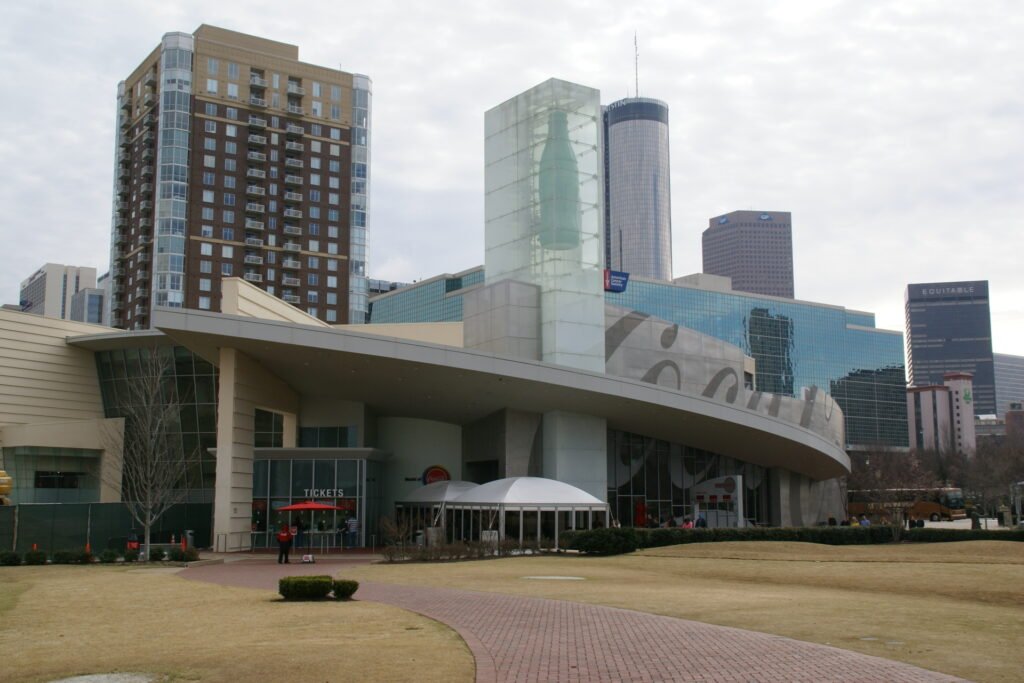
The Coca-Cola Company is an American beverage company headquartered in Atlanta, Georgia, that makes and sells concentrates, syrups and finished drinks under brands such as Coca-Cola, Sprite, Fanta and Dasani. Its annual report states that drinks bearing its trademarks are consumed at a rate of about 2.2 billion servings each day, out of an estimated 65 billion servings of all beverages worldwide.
History of the Coca-Cola Company
The company traces its origin to May 8, 1886, when the pharmacist John Pemberton took his syrup to Jacobs’ Pharmacy in downtown Atlanta and the first glass of Coca-Cola was poured. The company says the drink sold at about nine glasses per day during its first year.
The businessman Asa Candler later acquired the rights to the formula and incorporated the business in 1892. Early in the twentieth century the company chose to sell syrup to independent bottlers rather than bottle the drink itself, an arrangement that shaped how the business is organized today. In 1899, two lawyers from Chattanooga, Tennessee, Benjamin Thomas and Joseph Whitehead, obtained rights to bottle the drink across most of the United States, and independent bottlers soon spread across the country. This franchise bottling network became the template for the modern system, in which the company supplies concentrate and local partners handle packaging and delivery. The distinctive contour bottle, which the company says has been celebrated in art and music, became one of the most recognized pieces of packaging in the world.
Advertising has also marked the company’s history. A 1971 television commercial built around the line “I’d like to buy the world a Coke,” known as “Hilltop,” remains one of its best-known campaigns. The company marked 140 years of operation in 2026.
Products and services
The company groups its drinks into several categories. Sparkling soft drinks include Coca-Cola, Diet Coke, Coca-Cola Zero Sugar, Sprite and Fanta. Hydration brands include Dasani, smartwater, Powerade, BODYARMOR and Topo Chico.
In coffee and tea the company owns Costa Coffee, Gold Peak and FUZE. Its juice, dairy and plant-based range includes Minute Maid, Simply, fairlife and innocent. The company also offers a small group of alcohol ready-to-drink products, including a Jack Daniel’s and Coca-Cola mixed drink, through partnerships with other firms.
This breadth reflects a strategy of offering a drink for many occasions, not only soda. The annual report describes the aim as expanding into other profitable categories of the commercial beverage industry while keeping its core sparkling brands strong.
Corporate structure and operations
The company does not bottle most of its drinks itself. It makes concentrates, beverage bases and syrups, which it sells to bottling partners and other customers. Those partners mix the concentrate with water and sweeteners or other ingredients, package the drink and distribute it to stores, restaurants and vending machines. The company also operates some finished-product businesses and holds ownership stakes in certain bottlers.
For financial reporting, its annual report for 2025 describes four geographic operating segments and a separate Bottling Investments segment. In 2025 the company sunset a Global Ventures segment, created in 2019 to oversee Costa, innocent and its Monster Beverage distribution arrangements, to simplify its structure.
The business is heavily international. Outside the United States, the company reports, unit case volume made up 84 percent of its worldwide total in 2025, and the United States made up the remaining 16 percent. Mexico, China, Brazil and India together accounted for 33 percent of worldwide unit case volume. A unit case is the company’s standard measure of volume, equal to 24 eight-ounce servings.
The company reported net operating revenues of $47.941 billion for fiscal 2025, up from $47.061 billion in 2024, according to its filing with the U.S. Securities and Exchange Commission. Unit case volume and revenue differ because much of the physical bottling and delivery work is done by partners.
Impact of the Coca-Cola Company
The company’s supply chain reaches farmers who grow sugar cane, citrus and other crops, as well as bottlers, distributors and retailers around the world. Because most of its volume is sold outside its home market, local partners, exchange rates and regional regulation all shape its results. Its marketing has made the main brand one of the best-known examples of brand equity, the commercial value that comes from consumer recognition and loyalty.
The company has also been a long-standing sponsor of major sporting events. It has publicly described a partnership with FIFA tied to the 2026 World Cup. Sponsorship deals of this kind are one example of the wider practice of sport sponsorship.
The company also reports on sustainability goals covering water use, packaging, emissions, agriculture and community programs. Its own materials say that sustainability efforts began as early as 1917, although the focus and scale of those efforts have changed over time.
The company also competes in the wider non-alcoholic beverage market, where bottled water, tea, coffee and juice sit beside soft drinks. Its acquisitions of Costa Coffee and fairlife show how it has moved beyond its original product.
Criticism and controversies
Public health authorities have long linked high intake of sugar-sweetened drinks to risks such as weight gain and tooth decay, and governments in many countries have responded with taxes, labeling rules and limits on marketing to children. The company’s own annual report lists potential new or increased taxes on sweetened beverages and further regulation of ingredients, advertising, labeling and packaging among the risks to its business. It has responded by expanding lower-sugar and zero-sugar drinks, including Coca-Cola Zero Sugar and Diet Coke.
Packaging waste is another recurring area of criticism, since single-use plastic bottles and cans are a visible part of litter and waste streams. The company has set stated goals on packaging and recycling, and researchers and campaign groups continue to debate how far those goals have been met.
These issues apply to the beverage industry as a whole, and the company is regularly named in them because of its size. The information here is a general description of the company, not health or investment guidance.
More in Management
Key facts
- The Coca-Cola Company is headquartered in Atlanta, Georgia.1
- The first glass of Coca-Cola was poured on May 8, 1886, at Jacobs' Pharmacy in Atlanta.1
- Drinks with its trademarks are consumed at a rate of about 2.2 billion servings per day.2
- The company reported net operating revenues of $47.941 billion for fiscal 2025.2
- Outside the United States, unit case volume was 84 percent of the worldwide total in 2025.2
Related concepts
Quick checkDoes the Coca-Cola Company bottle all of its own drinks?Show answer
No. It mainly makes concentrates and syrups and sells them to bottling partners, which package and distribute the finished drinks, although the company also runs some finished-product operations.
Sources
- The Coca-Cola Company, Coca-Cola History, https://www.coca-colacompany.com/about-us/history
- The Coca-Cola Company, Annual Report on Form 10-K for fiscal year 2025, U.S. Securities and Exchange Commission, https://www.sec.gov/Archives/edgar/data/21344/000162828026010047/ko-20251231.htm
Editorially reviewed by Specialty Digest Editorial TeamLast reviewed November 4, 2026Researched and drafted with AI assistanceReport an issue