The snow leopard is one of the hardest large animals on Earth to see. It lives on cold, steep slopes between roughly 600 and more than 5,000 meters, its smoky coat blends into rock, and it moves alone. Because so few people ever meet one, it is easy to forget it exists at all. International Day of the Snow Leopard, observed each year on October 23, asks the world to remember a cat that most people will never see, and to protect the high mountains it depends on.
How the day came about
The idea began with the countries where the cat lives. A 2013 forum in Bishkek, Kyrgyzstan, held on October 22 and 23, called on range states to declare 2015 the International Year of the Snow Leopard and October 23 an annual Snow Leopard Day, according to the Convention on Migratory Species (CMS). The CMS reported that the day was celebrated for the very first time on October 23, 2014, with awareness and education events in Bishkek.
Global recognition came ten years after the forum. According to the United Nations, in 2024 the General Assembly proclaimed October 23 as International Day of the Snow Leopard, in resolution A/RES/79/143, to enhance international and regional cooperation in support of efforts to conserve the species, given its role in the overall ecosystem. The UN page also links the day to Sustainable Development Goals 6 (clean water), 13 (climate action) and 15 (life on land).
A cat of twelve countries
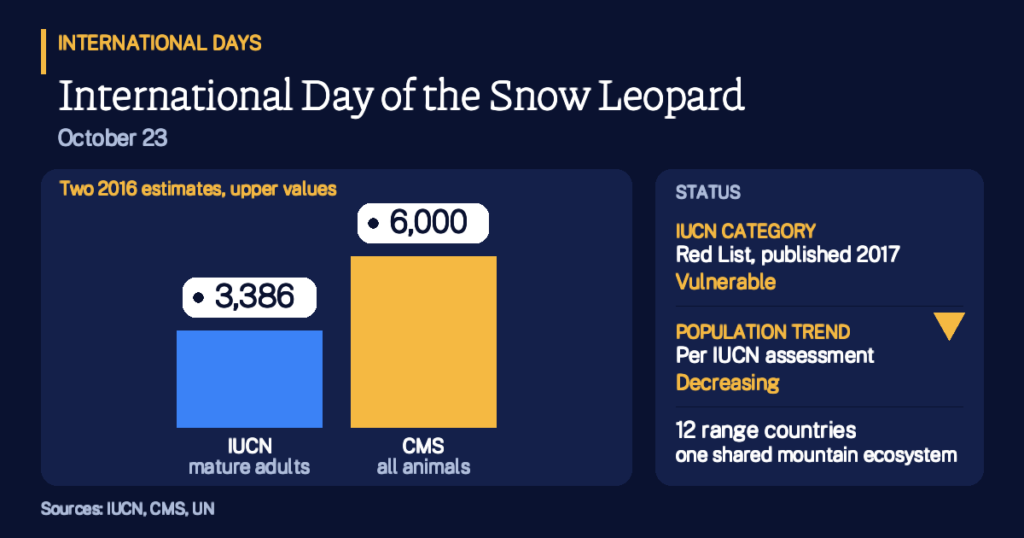
The UN lists twelve range countries: Afghanistan, Bhutan, China, India, Kazakhstan, Kyrgyzstan, Mongolia, Nepal, Pakistan, the Russian Federation, Tajikistan and Uzbekistan. Together they hold a range that the International Union for Conservation of Nature (IUCN) puts at about 2.8 million square kilometers of occupied habitat. The CMS noted in 2016 that about one third of the range lies within 100 kilometers of a national border. A cat that ignores borders cannot be saved by one country alone, which is why the day is framed around cooperation.
Counting snow leopards is notoriously difficult, so the numbers come with caution. The IUCN’s 2016 assessment, published in 2017, estimated between 2,710 and 3,386 mature individuals and described the population trend as decreasing. It projected a decline of at least 10 percent over the next three generations, or 22.62 years, while noting that there is almost no documented evidence of actual trends. The IUCN also explains that the move from Endangered (2008) to Vulnerable (2017) was a non-genuine change, because the earlier listing had been made in error, not because the cat recovered.
Example 1: what a 10 percent decline means. Imagine a valley with 20 adult snow leopards. A decline of 10 percent over about 23 years would remove two animals. That sounds small, but in a population this size two fewer adults can mean a lost breeding pair. The numbers are round and illustrative.
Why the mountains matter to everyone
The snow leopard sits at the top of its mountain food web, so its presence signals that the ecosystem below it is working. The mountains also supply water. A 2013 World Bank program document described Himalayan glaciers as the headwaters of ten major river systems in Asia, and noted that almost 90 percent of Kyrgyzstan’s electricity came from hydropower stations on the Naryn River. Protecting snow leopard country therefore protects slopes, pastures and water far downstream, a link shared with World Water Day.
- 12range countries (UN)
- 2.8 million km²occupied range (IUCN, 2017)
- 1975CITES Appendix I listing
- 2024UN proclaims the day
What threatens the snow leopard
The UN names four pressures: habitat loss and fragmentation, depletion of prey, illicit trafficking and illegal hunting including poaching, and climate change. The IUCN adds competition with livestock, retaliatory killing, and emerging mining, road and infrastructure projects. These problems feed each other. When wild prey declines, a hungry cat may take a goat, and a herder may respond by killing it.
The people who share the mountains
Snow leopards live where herders graze animals, so conservation is also about livelihoods. A family that loses livestock to a predator can lose much of its income. Solutions that work with communities tend to matter as much as protected areas, because people on the ground decide whether a cat lives or dies.
Example 2: one bad night. Suppose a family keeps 100 goats worth $100 each and a snow leopard kills 5 in one night. The loss is $500, which could be a large share of a household’s cash income. Compensation, secure corrals and insurance are ways to make that loss smaller than the temptation to retaliate. The numbers are round and illustrative.
How the day is marked and what progress needs
The 2013 Bishkek forum launched the Global Snow Leopard and Ecosystem Protection Program (GSLEP). Its stated goal, in the 2013 program document, was to identify and secure at least 20 healthy snow leopard populations across the range by 2020, each with at least 100 breeding-age animals, enough prey and connected habitat. The CMS later reported that only one of the 23 landscapes identified was transboundary, which shows how much cross-border work remained. In 2017 the twelve range countries signed the Bishkek Declaration, “Caring for snow leopards and mountains: our ecological future.”
Example 3: the arithmetic of the goal. Twenty populations of at least 100 breeding-age animals each means at least 2,000 breeding-age cats. Set beside the IUCN’s 2,710 to 3,386 mature individuals, that goal would require most of the species to be in well-protected, connected populations. This is illustrative arithmetic, not a forecast.
On October 23, governments, schools, conservation groups and mountain communities hold talks, exhibitions and educational events. Individuals can support the day by learning about the cat, backing community-based conservation, and avoiding any product made from wildlife.
Key Takeaways
- The day is October 23. The UN General Assembly proclaimed it in 2024 in resolution A/RES/79/143.
- The idea came from range countries. The Bishkek forum of 2013 called for the day, and it was first marked on October 23, 2014.
- Twelve countries share the cat. No single government can protect a species whose range crosses so many borders.
- The cat is Vulnerable and declining. The IUCN estimated 2,710 to 3,386 mature individuals and a decreasing trend.
- Estimates are uncertain. Different counts measure different things, so they should not be read as a trend.
- Mountains and water are linked. Protecting snow leopard country also protects headwaters that rivers depend on.
- People are part of the solution. Herders and mountain communities decide the cat’s future.
How solid is this? Population figures are estimates, and the IUCN says documented trend evidence is very limited. The water and hydropower facts come from a 2013 World Bank program document, and the 2013 to 2020 goals are historical. Range size and population figures differ by source and year. The three worked examples use round, made-up numbers to show an idea. See also the International Days hub and the International Days Calendar.
More in Nature
- United Nations, International Day of the Snow Leopard (resolution A/RES/79/143)
- UNEP, International Day of the Snow Leopard 2025
- IUCN Red List, Panthera uncia (assessed 2016, published 2017)
- CMS, Snow Leopard Day 2016
- CMS, International Snow Leopard Day celebrated for the very first time (2014)
- World Bank, Global Snow Leopard and Ecosystem Protection Program (2013)