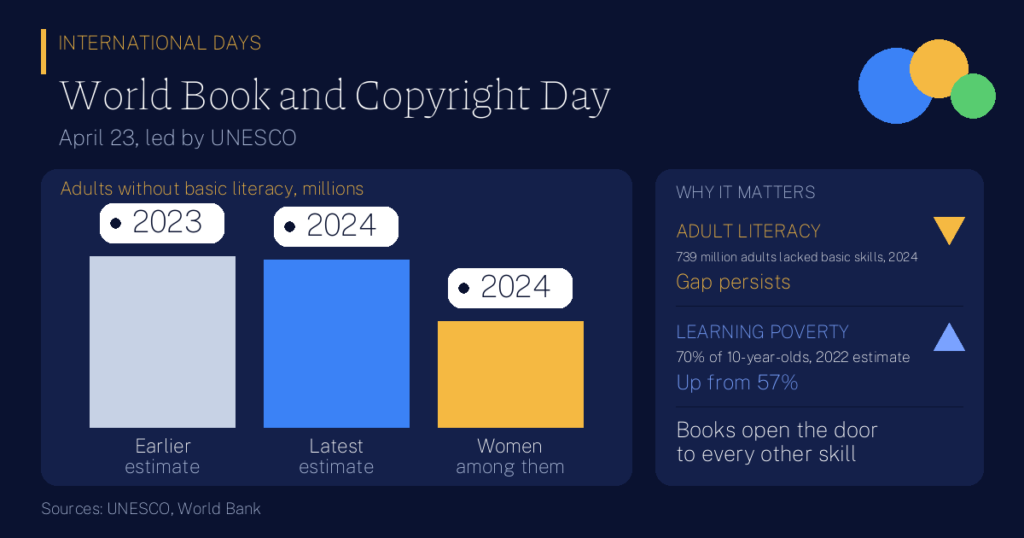
A book is one of the oldest technologies still in daily use, and one of the most unevenly shared. Some homes hold more volumes than shelves. In 2024, UNESCO counted 739 million adults who lacked basic literacy skills, and for them a book is a closed door. World Book and Copyright Day, observed every April 23, asks two questions at once: who gets to read, and who gets to write and be paid for it. Its answer is that a healthy society needs both. It pairs naturally with the International Day of Education and with World Poetry Day.
Why April 23
The date began as a literary coincidence and became a symbol. The United Nations observance page explains that April 23 is a symbolic date for world literature because, in 1616, Cervantes, Shakespeare and Inca Garcilaso de la Vega all died on it. Other writers share the date through a birth or a death, among them Vladimir Nabokov, Halldór Laxness, Maurice Druon, Josep Pla and Manuel Mejía Vallejo.
The day itself was created by UNESCO. At the 28th session of its General Conference, held in Paris from October 25 to November 16, 1995, member states adopted a resolution proclaiming World Book and Copyright Day. UNESCO describes it as a recognition of “the power of books as a bridge between generations and across cultures.” The day encourages everyone, and young people in particular, to discover the pleasure of reading.
Two ideas in one name
The day joins two causes that can seem separate. The first is reading. The UN page describes books as carriers of values and knowledge, as windows onto cultural diversity and as tools for dialogue. The second is copyright, the legal protection that lets authors, translators, illustrators and publishers earn a living from their work. UNESCO notes that the Universal Copyright Convention was adopted in 1952 under its aegis and revised in 1971.
The link is simple. A world full of readers needs a steady supply of new books, and a steady supply needs creators who can be paid. Weaken either side and the whole chain suffers.
Example 1: what a sale is worth. Imagine a novel that sells 10,000 copies at $20 each, with the author earning 10 percent of the cover price. The author receives $2 per copy, or $20,000 in all, which may be the reward for two years of work. These numbers are round and illustrative, but they show why fair terms matter: when copies are taken without payment, the person who made the book loses first.
The reading gap in numbers
The scale of the gap is easy to miss in a country where nearly everyone reads. UNESCO’s International Literacy Day 2025 factsheet reports that in 2024, 739 million adults still lacked basic literacy skills, and that women made up nearly two thirds of them, about 466 million. The same factsheet shows the total falling from 754 million in 2023, and it notes that part of the drop reflects revised population estimates and an update to India’s literacy rate, from 77 to 81 percent, rather than new classrooms alone.
Where people live matters. Nearly 77 percent of adults without basic literacy live in sub-Saharan Africa (225 million) and Central and Southern Asia (347 million). Adult literacy rates in those regions are rising, from 65 to 69 percent in sub-Saharan Africa and from 72 to 77 percent in Central and Southern Asia between 2015 and 2024, yet the rise is slow against growing populations.
- 272 millionchildren, adolescents and young people out of school, 2023
- 36% vs 3%of school-aged youth out of school in low-income versus high-income countries
- 30%reached minimum reading proficiency at the end of primary school in sub-Saharan Africa, 2019, versus 97% in Europe and North America
- 63cities in the UNESCO Creative Cities Network put literature at the heart of their strategies
Learning poverty: when reading never arrives
Literacy is not only an adult problem. The World Bank uses the term learning poverty for children who cannot read and understand a simple text by age 10. In June 2022, it reported that 57 percent of 10-year-olds in low- and middle-income countries were in this position before the pandemic, and it estimated the figure had risen to 70 percent, an increase of about a third. Those 2022 numbers are estimates, and the regional ones are simulations, but they point in one direction.
Example 2: a classroom of 100. Picture 100 ten-year-olds in a low- or middle-income country. At the pre-pandemic rate, 57 of them could not read a simple text. At the 2022 estimate, 70 could not. That is 13 more children in every hundred, a round and illustrative calculation of what the change means in one room.
Who is left behind, and what helps
The patterns repeat. Two thirds of adults without basic literacy are women. More than half of the 272 million children and young people who are out of school live in sub-Saharan Africa. Children in low-income countries are far more likely to be out of school than children in high-income ones. Each of these gaps begins with a missing chance to read, and a book in a language a child understands is often the first step across it.
Example 3: a library shelf. Suppose a child reads 20 minutes a day at about 150 words per minute. That is 3,000 words a day, or roughly 1.1 million words a year. A child with no books at home or school reads none of them. The figures are rounded and illustrative, but the lesson is that small daily habits compound, and they need something to read.
A city that carries the title
Since 2001, UNESCO has named a World Book Capital each year, beginning with Madrid. Cities with the title undertake to promote books and reading for all ages and groups, within and across national borders, and to organize a programme of activities for the year. UNESCO says the goals include literacy, lifelong learning, copyright protection and freedom of expression.
- 2023Accra, Ghana
- 2024Strasbourg, France
- 2025Rio de Janeiro, Brazil
- 2026Rabat, Morocco, from April 23, 2026
- 2027Medellín, Colombia
UNESCO named Rabat for 2026 in an announcement dated October 8, 2024, citing its commitment to literary development and its fight against illiteracy among underserved communities. It also pointed to the city’s publishing sector and to a planned initiative to strengthen literacy for all citizens.
How the day is marked
The day is observed by people in many countries, with readings, book fairs, library events and school projects. The most useful actions are modest: read aloud to a child, give or swap a book, visit a library, and buy or borrow books lawfully so that writers are paid. Reading in a mother tongue matters too, which links the day to the International Mother Language Day.
Key Takeaways
- April 23 is a symbol. Cervantes, Shakespeare and Inca Garcilaso de la Vega all died on this date in 1616.
- UNESCO created the day in 1995. Its 28th General Conference proclaimed World Book and Copyright Day.
- It protects both readers and writers. Reading access and copyright depend on each other.
- The reading gap is large. In 2024, 739 million adults lacked basic literacy skills, and nearly two thirds were women.
- Children are at risk too. The World Bank estimated 70 percent learning poverty in low- and middle-income countries in 2022, up from 57 percent.
- Cities can lead. The World Book Capital programme, begun in 2001, now includes Rabat in 2026.
- Small habits help. Read aloud, share a book and pay for the work of writers.
How solid is this? Literacy figures are UNESCO estimates for 2024 and are revised as population and survey data change. The 2022 learning poverty numbers are World Bank estimates and simulations, not direct measurements. The three worked examples use round, made-up numbers to show an idea. See also the International Days hub and the International Days Calendar.
More in Education
- UNESCO, World Book and Copyright Day
- United Nations, World Book and Copyright Day observance page
- UNESCO, Youth and Adult Literacy: International Literacy Day 2025 factsheet
- UNESCO, What you need to know about literacy
- World Bank, 70% of 10-Year-Olds now in Learning Poverty (June 23, 2022)
- UNESCO, World Book Capital
- UNESCO, UNESCO names Rabat as World Book Capital for 2026