Most international days ask the world to look at a problem. This one asks it to do something. Greening means more than planting a tree for a photograph. It means protecting the plants that already grow, letting damaged land recover, and restoring ecosystems so that soil, water and people can rely on them again. The International Day of Greening the Planet falls on April 22, the same date as International Mother Earth Day, and it is one of the newest days on the UN calendar.
A day born from a speech and a vote
According to reports on the proclamation, the idea was first proposed by Kazakhstan’s President Kassym-Jomart Tokayev at the General Debate of the 80th session of the UN General Assembly in September 2025. The General Assembly then adopted a resolution in New York on August 31, 2026, proclaiming April 22 as the day. Reports say 32 countries joined as co-sponsors. Because the day is so recent, the first observance will be the first April 22 after the proclamation.
What “greening” really means
The resolution, as reported, aims to raise awareness of greening and restoring natural ecosystems, and it encourages governments, the UN system, international and regional organizations, civil society and other stakeholders to undertake related initiatives. No single theme or lead agency was named in the reports reviewed, so this article does not invent one.
The forest data shows why the word is broader than planting. Of the world’s forest area, 92 percent is naturally regenerating forest, about 3.83 billion hectares, while planted forests cover an estimated 312 million hectares, about 8 percent. In other words, most of the green cover that exists today grew back or was never cleared. Greening starts with keeping it, then helps nature repair what is damaged.
Example 1: planting versus protecting. A town plants 1,000 saplings, and suppose 600 survive their first dry season. Next to it, a 50-hectare woodland is fenced off from grazing and left to regrow on its own. The numbers are round and illustrative, but they show a real choice: a planting only counts as greening if the trees live, and sometimes protection is the cheaper way to get there.
The numbers behind the day
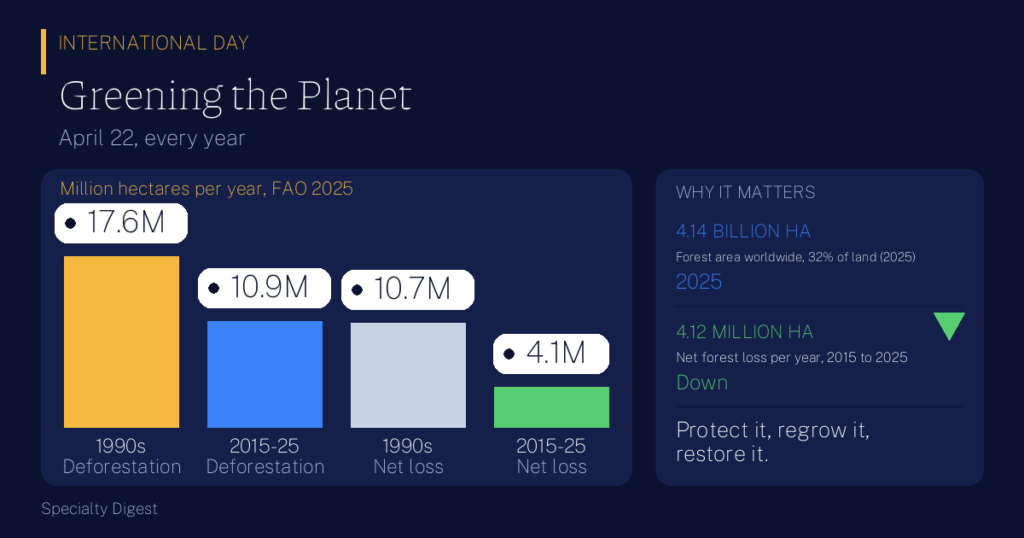
The latest Global Forest Resources Assessment from the Food and Agriculture Organization (FAO), published in October 2025, found 4.14 billion hectares of forest, 32 percent of the world’s land, or about 0.5 hectares per person. The trend is better than it was, but the loss is still large. Deforestation fell to 10.9 million hectares a year in 2015 to 2025, down from 17.6 million in 1990 to 2000. Forests also expand, by 6.78 million hectares a year in 2015 to 2025, so the net loss was 4.12 million hectares a year, down from 10.7 million in the 1990s.
- 4.14 billion haof forest worldwide, 32% of land (2025)
- 0.5 haof forest per person on average (2025)
- 10.9 million hadeforested each year, 2015 to 2025
- 3.2 billionpeople affected by land and marine degradation (UNEP, 2019)
Not all forest is equal. FAO reports at least 1.18 billion hectares of primary forest, about one third of the total, and about 20 percent of forest, 813 million hectares, lies in protected areas. Primary forests are the hardest kind to replace, which is why protecting them sits alongside planting in any serious greening plan.
Why restoration matters
Healthy land is the base of food, water and climate stability. UNEP wrote in 2019 that the degradation of land and marine ecosystems undermines the well-being of 3.2 billion people and costs about 10 percent of annual global gross product in lost species and ecosystem services. The UN General Assembly declared 2021 to 2030 the UN Decade on Ecosystem Restoration. UNEP said that restoring 350 million hectares of degraded land by 2030 could generate US$9 trillion in ecosystem services and remove an additional 13 to 26 gigatons of greenhouse gases from the atmosphere. It also noted more than two billion hectares of deforested and degraded landscapes with potential for restoration.
Example 2: counting the net. Imagine a region loses 100 hectares of forest in a year but regrows 70 hectares elsewhere. Its gross loss is 100 and its net loss is 30. The figures are made up for illustration, but this is how FAO reports the global picture: 10.9 million hectares deforested yet a net loss of 4.12 million, because forests also expand.
Who is working, and who is left waiting
Greening is slow, local work, often done by the people who live on the land. Africa’s Great Green Wall is the best-known example. Its targets for 2030, as set out by the UN Convention to Combat Desertification (UNCCD), are to restore 100 million hectares of degraded land, capture 250 million tonnes of carbon and create 10 million rural jobs. The UNCCD said in March 2023 that US$2.5 billion of US$19 billion pledged had been disbursed, and that vast tracts had already been restored by local communities. Those figures are from 2023, so check current reports before quoting them as today’s status.
Example 3: jobs on the ground. Suppose a village restores 50 hectares of degraded grazing land and needs one worker for every 5 hectares to plant, guard and water it. That is 10 workers, plus the families who gain shade, firewood and steadier water. The ratio is invented for illustration, but it shows why the Great Green Wall counts rural jobs among its goals.
How the day will be marked
As a new observance, it has no established campaign history yet. The resolution as reported invites governments, UN bodies, civil society and others to organize related initiatives. Sensible actions are easy to picture: community tree planting with follow-up care, protection of existing woodlands and wetlands, school gardens, and local restoration projects. The test of the day will be whether the trees and the land are still healthy years later.
Key Takeaways
- It is a new day. The General Assembly proclaimed April 22 as the International Day of Greening the Planet on August 31, 2026, at Kazakhstan’s initiative.
- Greening is more than planting. About 92 percent of forest is naturally regenerating, so protection and natural recovery matter most.
- Forests are large but shrinking. The world has 4.14 billion hectares, 32 percent of land, with a net loss of 4.12 million hectares a year.
- The trend is improving. Deforestation fell from 17.6 million to 10.9 million hectares a year between the 1990s and 2015 to 2025.
- Degraded land touches billions. UNEP says land and marine degradation undermines the well-being of 3.2 billion people.
- Restoration has a deadline. The UN Decade on Ecosystem Restoration runs from 2021 to 2030.
- Survival is the real measure. A tree counts only if it lives, so ask who will care for it next year.
How solid is this? The resolution details come from media reports of the proclamation, which did not give a resolution symbol or an official theme, so check the UN observances page for updates. Forest figures are from FAO’s 2025 assessment, the Great Green Wall figures are from 2023 and the UNEP figures from 2019. The three worked examples use round, made-up numbers. See also International Mother Earth Day, the International Days hub and the International Days Calendar.
More in Nature
- The Astana Times, “UN Declares April 22 International Day of Planet Greening at Kazakhstan’s Initiative,” September 2026
- FAO, “Global deforestation slows, but forests remain under pressure,” October 2025
- FAO, Global Forest Resources Assessment 2025, Key findings
- UNCCD, “Progress accelerated but targeted action needed to realize Africa’s Great Green Wall ambition,” March 2023
- UNEP, “New UN Decade on Ecosystem Restoration offers unparalleled opportunity,” 2019