Feeding a baby is one of the oldest human acts, and one of the most shaped by the world around the mother. World Breastfeeding Week, held in the first week of August each year, asks a practical question: what support does a mother need so that breastfeeding is possible? WHO, UNICEF and many ministries of health and civil society partners back the week, and each year it carries a new theme. In 2026 the theme is “Breastfeeding for a Sustainable Start in Life: Strengthen What Works.” Notice the emphasis. It is not about pressure or blame. It is about support. The week sits naturally beside the International Day of the Midwife, because skilled care at birth is where that support often begins.
A week, not a single day
Most observances fill one date on the calendar. This one fills seven, from August 1 to 7, which gives health workers, employers and families time to run clinics, webinars and community events. In 2018, a World Health Assembly resolution endorsed World Breastfeeding Week as an important health promotion strategy, which turned an annual awareness effort into a recognized part of global public health.
The theme changes every year, and the themes tell a story. In 2023 the call was “Let’s make breastfeeding and work, work!” In 2025 it was “Invest in breastfeeding, invest in the future.” In 2026 the focus turns to strengthening the services and policies that already work. The thread is constant: breastfeeding succeeds when mothers are supported by health systems, workplaces and communities, not left to manage alone.
What the guidance says
WHO recommends that mothers begin breastfeeding within one hour of birth, that infants be exclusively breastfed for the first six months, and that safe, nutritionally adequate complementary foods be introduced after six months while breastfeeding continues for up to two years or beyond. “Exclusive” means breast milk alone, with no other food or drink for the baby.
WHO also notes that breastfeeding lowers a mother’s risk of breast and ovarian cancer, type 2 diabetes and postpartum depression, and that infant formula does not contain the antibodies found in breast milk. The benefits therefore run in two directions, to the child and to the mother.
The numbers behind the week
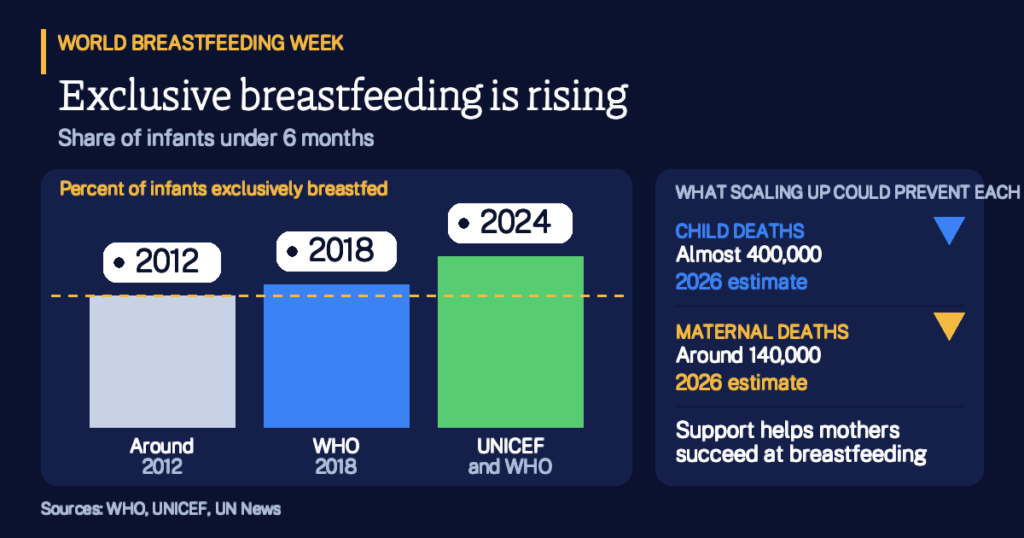
Progress has been real but slow. A joint statement by UNICEF and WHO in July 2026 says exclusive breastfeeding in the first six months rose from around 37 percent in 2012 to over 47 percent today. A 2024 statement from the same agencies put the figure at 48 percent, and a 2018 WHO publication gave 40 percent. Statements round and update differently, so treat the exact decimal with care. The direction is clear, and the rate sits just short of the WHO target of at least 50 percent by 2025. The 2026 statement adds that breastfeeding up to two years of age rose from 38 percent to 50 percent in the past five years.
- 47%+of infants under 6 months exclusively breastfed, 2026 statement
- 50%breastfed up to two years of age, up from 38% in five years
- Halfof all countries collect data on breastfeeding rates
- 50%WHO target for exclusive breastfeeding by 2025
Example 1: what five points means. Imagine a country with 1,000 babies under six months old. If 40 percent are exclusively breastfed, that is 400 babies. If support lifts the rate to 50 percent, 500 babies benefit, 100 more. The numbers are round and illustrative, but they show why a few percentage points matter when multiplied across millions of births.
Lives saved, money returned
The July 2026 statement says that scaling up breastfeeding could prevent almost 400,000 child deaths and around 140,000 maternal deaths each year. Earlier assessments gave larger child figures: WHO wrote in 2018 that near-universal breastfeeding would save about 820,000 child lives every year, and UN agencies repeated “over 820,000” in 2024, citing the latest available data. The numbers differ between statements, so read them as estimates and always check the year.
The same statement estimates that every $1 invested in breastfeeding promotion generates about $59 in economic returns.
Example 2: a small program. Suppose a health ministry spends $100,000 on training counselors for new mothers. At the cited estimate of $59 per dollar, the implied return would be about $5.9 million. The spending figure is made up and the arithmetic is only an illustration, since real returns vary by place and program, but it shows why the statement urges investment.
Who is left without support
Breastfeeding is natural, but it is not always easy, and many mothers lack help. UN News reported in 2024 that an estimated 4.5 billion people, more than half the world’s population, do not have full coverage of essential health services. Many women do not receive trained, empathetic and respectful advice and counseling. Only half of all countries collect data on breastfeeding rates, which makes gaps hard to see and fix. The 2024 statement said that when breastfeeding is protected and supported, women are more than twice as likely to breastfeed. It also called for protection and support for mothers in emergencies and for under-represented communities, as part of routine health coverage.
The 2026 statement calls for six actions. Two stand out for their practical reach: enforcing the International Code of Marketing of Breast-milk Substitutes, which was adopted in 1981, and investing in paid maternity leave. The first limits how substitutes are marketed to families. The second gives mothers time.
Example 3: why leave matters. Picture a mother who must return to work after eight weeks. Reaching six months of exclusive breastfeeding would be hard without a place and time to express milk. With 26 weeks of paid leave, the six-month window fits inside her leave. The weeks are round and illustrative, but they show how a workplace policy can decide what a family can choose.
How the week is marked
Ministries of health, UNICEF and WHO country offices, hospitals and civil society groups hold events through the first week of August. Useful actions are simple: employers can offer paid leave and a private space to express milk, health facilities can train staff to give respectful counseling, and communities can make feeding in public welcome. Support also means respect for every family’s circumstances, including parents who cannot or choose not to breastfeed, who deserve accurate information and kindness too.
Key Takeaways
- It is a week of support. The 2026 theme, Strengthen What Works, centers services and policies rather than blame.
- The guidance is clear. Start within one hour, breastfeed exclusively for six months, then add foods and continue up to two years or beyond.
- Progress is real. Exclusive breastfeeding rose from around 37 percent in 2012 to over 47 percent, close to the 50 percent target.
- Lives are at stake. The 2026 statement estimates almost 400,000 child and around 140,000 maternal deaths could be prevented each year.
- It pays back. UNICEF and WHO estimate $59 in economic returns for every $1 invested in promotion.
- Support decides outcomes. Counseling, paid leave and enforcement of the 1981 Code help mothers succeed, and data gaps hide who is missing out.
How solid is this? Rates and lives-saved figures are estimates from UNICEF and WHO statements dated 2026, 2024 and 2018, and they differ between statements because they are updated and rounded differently. The 2012 starting rate is the figure quoted in the 2026 statement. The three worked examples use round, made-up numbers to show an idea. See also the International Days hub and the International Days Calendar.
More in Health
- WHO and UNICEF, Countries urged to strengthen breastfeeding support and health systems (July 31, 2026)
- UN News, More access to breastfeeding support could save 820,000 young lives annually (July 31, 2024)
- WHO, Facts in pictures: Breastfeeding (2018)
- WHO, World Breastfeeding Week campaign page
- WHO, The International Code of Marketing of Breast-milk Substitutes