About 700 women die every day from causes linked to pregnancy and childbirth, and the great majority of those deaths could be prevented. Standing between families and that outcome is a profession that rarely makes headlines: midwives. International Day of the Midwife, observed every May 5, honors their work and asks a pointed question. If midwives can deliver most of the essential care that mothers and newborns need, why does the world still lack hundreds of thousands of them? The day is led by the International Confederation of Midwives (ICM), and its 2026 theme, One Million More Midwives, turns that question into a demand. It shares its date with World Hand Hygiene Day, a reminder that safe birth also depends on clean care.
A profession’s own day
The International Confederation of Midwives was founded in 1919, and a 2006 UNFPA and ICM press release records that ICM established the International Day of the Midwife in 1992. The hub for this series lists it as an awareness day led by ICM. We could not find an authoritative source explaining why May 5 was chosen, so this article does not guess.
Each year ICM sets a theme and invites governments, health ministries, schools and UN agencies such as UNFPA and WHO to join. The 2021 theme was “Follow the Data, Invest in Midwives,” and the day that year coincided with the launch of the UN report The State of the World’s Midwifery 2021. The 2026 theme, announced by ICM in February, is One Million More Midwives. ICM describes that million as the estimated workforce needed globally to meet essential health needs.
What a midwife actually does
A midwife is a trained health professional who cares for women before, during and after pregnancy, and for the newborn in its first days. The work reaches well beyond delivery. It includes prenatal checkups, support during labor, recognizing danger signs early, breastfeeding help, family planning and adolescent health. Health planners group these services under one label: sexual, reproductive, maternal, newborn and adolescent health.
The case for investing in midwives rests on a striking mismatch. WHO states that midwives can provide about 90 percent of the sexual, reproductive, maternal, newborn and adolescent health care that people need, yet they make up less than 10 percent of the global workforce delivering it. WHO also says that when midwives are educated to international standards and family planning is included, midwifery could avert more than 80 percent of maternal deaths, stillbirths and newborn deaths. UNFPA and the 2021 UN report use a slightly more cautious figure: roughly two thirds of such deaths.
- 260,000women died from pregnancy and childbirth causes in 2023 (WHO)
- About 90%of needed care midwives can provide, per WHO
- Under 10%of the relevant workforce they make up, per WHO
- Two thirdsof maternal and newborn deaths and stillbirths could be averted (UN, 2021)
The numbers behind the day
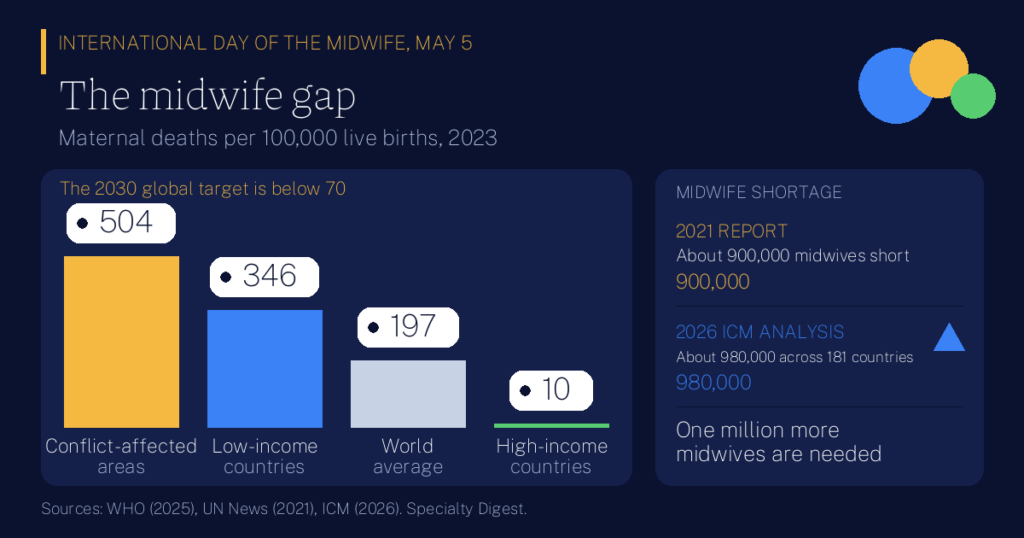
WHO estimates that about 260,000 women died during and following pregnancy and childbirth in 2023, almost one every two minutes. The global maternal mortality ratio, the number of deaths per 100,000 live births, was 197. Progress is real: the ratio fell by about 40 percent between 2000 and 2023. But the burden is lopsided. Sub-Saharan Africa accounted for around 70 percent of maternal deaths, about 182,000, in 2023.
Example 1: what a ratio means. Imagine a region with 100,000 births a year. At a ratio of 400, 400 mothers die. If better care cuts the ratio to 200, 200 mothers survive who otherwise would not. The numbers are round and illustrative, but they show why a change that looks small on paper means hundreds of families.
The global goal, set in Sustainable Development Goal 3, is a maternal mortality ratio below 70 by 2030. WHO says that requires an annual reduction of almost 15 percent. UNFPA notes the current pace is roughly 2 percent a year.
Example 2: seven years of two speeds. Start from the 2023 ratio of 197 and look ahead seven years to 2030. At a 2 percent yearly decline, the ratio would land near 171. At a 15 percent yearly decline, it would reach about 63, below the target. This arithmetic is illustrative, but it shows how large the gap between the current pace and the required pace is.
The missing midwives
The 2021 State of the World’s Midwifery report estimated a global shortage of about 900,000 midwives, projected to fall to 750,000 by 2030 if countries stayed on their current path. ICM’s 2026 analysis, covering 181 countries, estimates a shortage of approximately 980,000, and expects it to remain between 690,000 and 830,000 by 2030. ICM reports that about 46 percent of that shortage is in Africa.
Do not read the two analyses as one trend. They use different methods and years, and the second covers 181 countries. What they share is the message: the gap is large, it is slow to close, and it is concentrated where the risks are highest.
Example 3: counting the gap. Suppose a district sees 10,000 births a year and, in this made-up example, one midwife can attend about 100 births a year while also providing prenatal care. The district would need 100 midwives. If it has 60, it is 40 short, a 40 percent gap, and those births fall to overstretched staff or to no skilled care at all. The numbers are illustrative, not real data.
Who is left behind
The shortage shows up on the delivery floor. According to a 2024 UNICEF and WHO database cited by WHO, about 99 percent of births in high-income and upper-middle-income countries are attended by a trained midwife, doctor or nurse. In lower-middle-income countries the figure is 84 percent, and in low-income countries 73 percent.
Conflict and fragility make everything worse. WHO reports a maternal mortality ratio of 504 in conflict-affected areas and 368 in fragile settings in 2023, compared with 99 in places that are neither. The 2021 UN report projected that fully resourcing midwife-delivered care by 2035 could save about 4.3 million lives a year, counting mothers, newborns and stillbirths. That is a projection, not a measurement, but it explains why the day carries so much weight.
What the 2026 campaign asks
ICM frames the 2026 campaign around concrete asks: invest in midwifery education, employment and retention; allow midwives to work to their full scope of practice; ensure fair pay and safe working conditions; and strengthen midwifery leadership inside health systems. The campaign also launched a petition with a goal of 1 million signatures, to be presented at the ICM Triennial Congress in June 2026.
- 2021Follow the Data, Invest in Midwives
- 2026One Million More Midwives
For readers, the day is also practical. Anyone who is pregnant and notices danger signs such as heavy bleeding, severe headache, blurred vision or reduced baby movement should contact a health worker right away.
Key Takeaways
- Most deaths are preventable. About 260,000 women died of pregnancy and childbirth causes in 2023, and skilled care can avert most such deaths.
- Midwives are the lever. WHO says they can provide about 90 percent of needed care but are under 10 percent of the workforce.
- The shortage is large. Estimates run from about 900,000 (2021) to about 980,000 (2026), from different analyses.
- Risk is uneven. The ratio is 346 in low-income countries and 10 in high-income ones, and 504 in conflict-affected areas.
- The pace is too slow. Reaching the 2030 target needs about 15 percent a year, against roughly 2 percent now.
- Support means investing. Education, fair pay, safe conditions and full scope of practice keep midwives working.
How solid is this? Maternal mortality figures are modeled estimates from the UN maternal mortality group, revised with each round. The shortage numbers come from two different analyses (2021 and 2026) and should not be compared directly. Projections of lives saved are scenarios, not measurements. The three worked examples use round, made-up numbers to show an idea. See also the International Days hub and the International Days Calendar.
More in Health
- International Confederation of Midwives, The Theme for International Day of the Midwife 2026: One Million More Midwives (2026)
- International Confederation of Midwives, International Day of the Midwife 2026 Press Kit (2026)
- World Health Organization, Maternal mortality fact sheet (April 2025)
- UNFPA, Every two minutes a woman dies in pregnancy and childbirth (April 2025)
- UNFPA, The State of the World’s Midwifery 2021
- UN News, UN report sounds alarm on acute global shortage of midwives (May 2021)
- World Health Organization, Midwifery: maternal health