Human trafficking rarely looks like the movies. There is often no kidnapping and no chains, only a job offer that sounds too good, a debt that never shrinks, or a marriage arranged for a child. World Day against Trafficking in Persons, observed every year on July 30, asks the world to look at these hidden crimes and at the people living inside them. This article explains what trafficking is, what the best global numbers say, who is most at risk, and what helps. It is a close relative of the World Day against Child Labour, because many of the same pressures drive both.
From a global treaty to a day on the calendar
The day rests on decades of work. The United Nations adopted the Palermo Protocol, its treaty on trafficking in persons, in 2000, giving countries a shared definition for the first time. Since 2003, the UN Office on Drugs and Crime has collected information on about 225,000 victims detected worldwide. In 2010 the General Assembly adopted the Global Plan of Action to Combat Trafficking in Persons, in resolution 64/293.
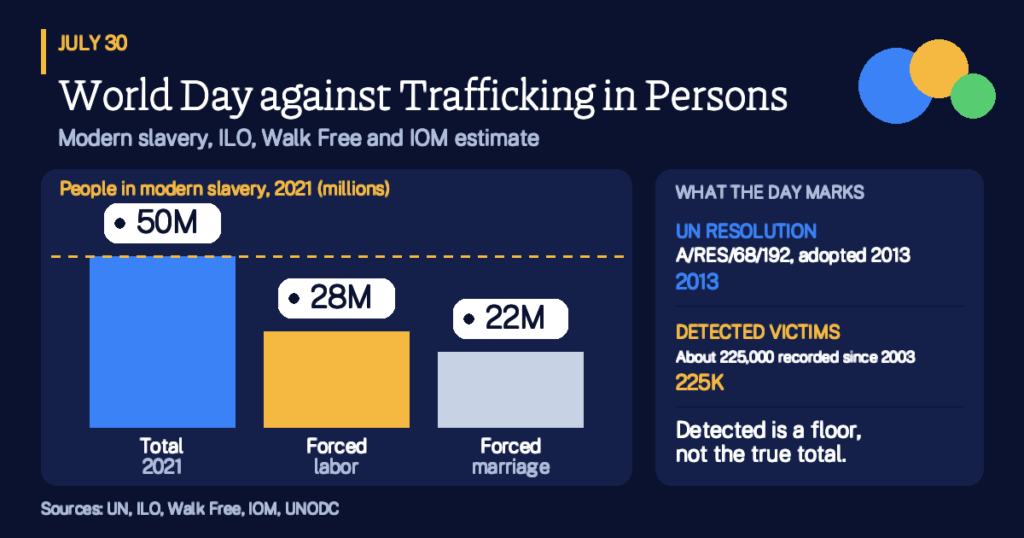
In 2013 the Assembly went further. In resolution A/RES/68/192 it designated July 30 as the World Day against Trafficking in Persons, saying that such a day was necessary to raise awareness of the situation of victims of human trafficking and for the promotion and protection of their rights. Trafficking was later written into the 2030 Agenda for Sustainable Development, adopted in 2015, which commits governments to act against it.
What trafficking actually means
In everyday speech the word is used loosely. In international law it has three parts that must come together: an act, a means and a purpose. Someone is recruited or moved, by force, fraud or deception, in order to be exploited. The exploitation can take many forms, including forced labor, sexual exploitation and forced marriage. Notice what is missing: crossing a border is not required. A person can be trafficked inside their own country, or even their own town.
Example 1: the job that was not a job. Imagine a young man offered a factory position abroad. He pays a recruiter a fee, travels, and on arrival is told the fee is now a debt he must work off, his passport is kept, and his hours are not his own. Each element is present: he was recruited, deceived and held for exploitation. The story is illustrative, but this pattern of debt and deception is what the UN describes again and again.
The numbers behind the day
No one can count a crime built on secrecy, so every figure is an estimate. The most widely cited global measure covers a wider group than trafficking alone. The International Labour Organization, Walk Free and the International Organization for Migration estimated that 50 million people were living in modern slavery in 2021. Of these, 28 million were in forced labor and 22 million were trapped in forced marriage. That is 10 million more than in the 2016 estimates, and forced marriage alone rose by 6.6 million.
The second kind of number is far smaller, because it counts only the people authorities actually found. The roughly 225,000 victims UNODC has recorded since 2003 are those who were detected. The true total is much larger, which is why experts treat detection figures as a floor, never a ceiling.
- 50 millionpeople in modern slavery, 2021
- 28 millionin forced labor, 2021
- 22 millionin forced marriage, 2021
- 3.3 millionchildren in forced labor, 2021
Example 2: why counts differ. Suppose a city of 100,000 people has 500 people in exploitation, but police identify only 50. The detection count says 50, the estimate says 500. Neither number is wrong. They answer different questions, one about cases found and one about the hidden reality. The figures are round and made up for illustration.
Who is affected, and where
The ILO found that most forced labor, 86 percent, occurs in the private sector. Commercial sexual exploitation accounts for 23 percent of all forced labor, and state-imposed forced labor for 14 percent. Almost one in eight people in forced labor is a child, which is 3.3 million children. More than half of forced labor, 52 percent, is found in upper-middle or high-income countries, so this is not only a problem of poorer nations. Migrant workers are more than three times as likely to be in forced labor as other adult workers.
Forced marriage has its own geography. The ILO reports that 65 percent of it is in Asia and the Pacific, while prevalence is highest in the Arab States, at 4.8 people in every 1,000. Among detected victims, UN data show that the vast majority of those trafficked for sexual exploitation, and 35 percent of those trafficked for forced labor, are female.
What helps, and where to find help
Anti-trafficking work is usually described through four tasks: preventing the crime, protecting victims, prosecuting offenders, and partnering across agencies and borders. In practice that means honest recruitment without fees charged to workers, labor inspections that reach farms, boats and homes, and services that treat survivors as people with rights, not as offenders. The Global Plan of Action coordinates this across the UN system.
Example 3: cutting the debt. Imagine a company that hires 1,000 seasonal workers through agents who each charge about $500 in fees. That is $500,000 in debt hanging over the workforce, and debt is a common lever of control. If the company pays the fee itself, the lever disappears. The figures are round and illustrative, but they show why recruitment practices are central to prevention.
On July 30, governments, UN agencies and civil society hold events, and UNODC runs its Blue Heart Campaign to build public awareness. The 2025 observance used the theme that human trafficking is organized crime and called for an end to the exploitation. If you suspect trafficking, contact local emergency services or a national hotline. In the United States, the National Human Trafficking Hotline is 1-888-373-7888.
Key Takeaways
- Trafficking has three parts. An act, a means and a purpose of exploitation must come together, and no border crossing is required.
- The day dates to 2013. General Assembly resolution A/RES/68/192 designated July 30 to raise awareness and protect victims’ rights.
- The scale is vast and uncertain. An estimated 50 million people were in modern slavery in 2021, 10 million more than in 2016.
- Detected is not the same as real. About 225,000 victims recorded since 2003 are only those who were found.
- It is not far away. More than half of forced labor is in upper-middle or high-income countries.
- Children and migrants face higher risk. About 3.3 million children are in forced labor, and migrant workers face over three times the risk.
How solid is this? The 50 million figure is a modeled estimate for 2021 by the ILO, Walk Free and IOM, and it covers forced labor and forced marriage, a wider group than trafficking alone. The 2016 comparison is derived from the reported increase of 10 million. The three worked examples use round, made-up numbers. See also the International Days hub and the International Days Calendar.
More in Society
- United Nations, World Day Against Trafficking in Persons: Background
- United Nations General Assembly, resolution A/RES/68/192 (2013)
- ILO, 50 million people worldwide in modern slavery (September 12, 2022)
- ILO, Walk Free and IOM, Global Estimates of Modern Slavery
- UNODC, World Day against Trafficking in Persons (30 July)