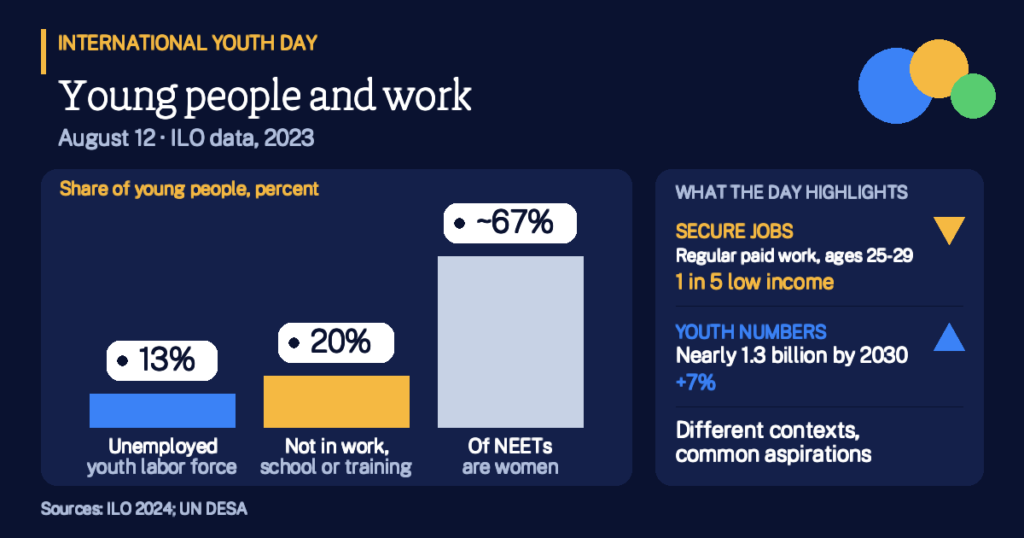
Every generation is told it will inherit the world. International Youth Day, observed each year on August 12, asks a sharper question: what are we doing for young people while they are still young? The United Nations uses the day to look at education, work, health, climate and political voice through the eyes of people aged 15 to 24, a group that makes up roughly one in six people on Earth. It is a natural partner to World Youth Skills Day, which focuses on the training that turns ambition into a livelihood. It also works as a yearly pressure point for accountability: governments, civil society and young people themselves are invited to ask whether commitments made on paper reach the people they were written for.
How August 12 became a global day
The day has a clear paper trail. In 1995 the General Assembly adopted the World Programme of Action for Youth, resolution 50/81, a policy framework for governments. In August 1998 the World Conference of Ministers Responsible for Youth met in Lisbon, from August 8 to 12, and recommended that August 12 be declared International Youth Day. In 1999 the General Assembly endorsed that recommendation in resolution 54/120, and the same resolution asked for public information activities that raise awareness of the World Programme of Action.
What counts as “youth”
There is no single definition. Governments, agencies and national youth laws draw the line in different places. For statistical purposes, the United Nations defines youth as people between 15 and 24 years old, a convention endorsed by General Assembly resolution 36/28 of 1981. The point is comparability: with one agreed band, researchers can set one country beside another and one decade beside the next. The day itself, however, belongs to every young person, and observances often reach younger teenagers and young adults beyond that band.
Example 1: why the band matters. Imagine a country of 10 million people where 2 million are aged 15 to 24. That is 20 percent, above the world’s roughly 16 percent. Such a country needs far more classrooms, first jobs and clinics for young adults per capita than an aging one. The numbers are round and illustrative, but this is the arithmetic planners face.
The numbers behind the day
According to the UN, there are about 1.2 billion young people aged 15 to 24, around 16 percent of the global population. By 2030, the target date for the Sustainable Development Goals, the UN projects that number will grow by 7 percent, to nearly 1.3 billion. The geography is shifting. The UN observance page notes that 59 percent of the world’s youth lived in low-income and lower-middle-income countries in 2025, and that share is projected to reach 69 percent by 2050. Over the same period, the youth population in high-income and upper-middle-income countries is projected to decline by nearly 24 percent.
Work: the central test
For most young people, the transition from school to a livelihood is the defining challenge. The International Labour Organization reports that the global youth unemployment rate stood at 13 percent in 2023, the lowest in 15 years, and that 20 percent of young people were not in employment, education or training, known as NEET. Two in three young NEETs globally are women. A low unemployment rate can hide a lot, because a young person who has stopped looking for work is not counted as unemployed.
Example 2: reading two numbers. Take a town with 1,000 young people. If 20 percent are NEET, that is 200 who are neither working nor studying. If 13 percent of the young labor force is unemployed, that might be 130 of 1,000 people actively seeking work. The two figures count different things, so they are not the same group and should not be added. The numbers are illustrative.
Quality, not just quantity, of jobs
Having a job is not the same as having a secure one. The ILO finds that among young adults aged 25 to 29, 4 in 5 in high-income countries hold regular paid jobs, compared with 1 in 5 in low-income countries. In sub-Saharan Africa, 3 in 4 young people lack secure work. Two in three young adult workers in developing economies hold qualifications that do not match their job well, and 2 in 3 young people say they worry about losing their job.
Example 3: 100 young workers. In a high-income country, about 80 of every 100 young adults would have a regular paid job. In a low-income country, about 20 would, and the other 80 would work informally, on their own account or in unpaid family roles. The groups of 100 are illustrative, scaled from the ILO’s ratios.
Why the future workforce is in Africa
The ILO projects that Africa’s youth labor force will grow by 76 million by 2050, while every other region faces a contraction in young workers. That makes the quality of schools and first jobs on one continent a matter of global importance. The same pattern shows in the population shift above: the next wave of young people will be born mostly where services are thinnest.
Numbers like these are projections, not destiny. Outcomes depend on whether schools, health systems and employers expand as fast as the youth population does. When they do, a large young cohort can power growth. When they do not, the cost shows up as idle talent and frustrated expectations. This is why the UN frames young people as partners in sustainable development rather than as a problem to be managed.
The 2026 theme and how the day is marked
The 2026 theme is “Different Contexts, Common Aspirations.” It focuses on young people in Least Developed Countries, Landlocked Developing Countries and Small Island Developing States, who face overlapping challenges linked to poverty, climate change, geographic isolation, limited economic opportunities and unequal access to digital technologies. The UN described three priorities: Global Solidarity, Shared Challenges and Youth Innovation, with an online campaign inviting young people to share messages of hope, support and collaboration. Recent themes show the range of the agenda.
- 2021Transforming Food Systems: Youth Innovation for Human and Planetary Health
- 2022Intergenerational Solidarity: Creating a World for All Ages
- 2023Green Skills for Youth: Towards a Sustainable World
- 2024From Clicks to Progress: Youth Digital Pathways for Sustainable Development
- 2025Local Youth Actions for the SDGs and Beyond
- 2026Different Contexts, Common Aspirations
The UN notes that injuries account for nearly half of all youth deaths in low-income countries and more than half in upper-middle-income and high-income countries, a reminder that safety and health belong beside jobs and schooling. You can mark the day by asking a young person in your community what they need, by supporting a local apprenticeship or mentoring program, or by backing youth seats on the boards that make decisions about their future.
Key Takeaways
- The day has a clear legal origin. Resolution 54/120 in 1999 endorsed the 1998 Lisbon recommendation for August 12.
- Youth is a statistical band. The UN counts ages 15 to 24, which is about 1.2 billion people.
- The center of gravity is moving. The share of youth in low-income and lower-middle-income countries is projected to rise from 59 to 69 percent by 2050.
- Jobs are the central test. In 2023, 13 percent of the young labor force was unemployed and 20 percent of young people were NEET.
- Gender gaps are stark. Two in three young NEETs are women.
- Security matters as much as employment. Only 1 in 5 young adults in low-income countries has a regular paid job, versus 4 in 5 in high-income ones.
- Listen and invest. Young people are partners in solving shared problems, so back their schools, skills and seats at the table.
How solid is this? The population estimates come from UN pages that give no year for the 1.2 billion figure, so treat it as a rounded, approximate count; one UN page also says “nearly 1.3 billion,” and projections are modeled. Labor figures come from the ILO’s 2024 report and cover 2023. The three worked examples use round, made-up numbers. See also World Youth Skills Day, the International Days hub and the International Days Calendar.
More in Society