Tea is so familiar that it is easy to forget how much work stands behind a single cup. Someone planted the bush, someone plucked the young leaves by hand, and someone dried, rolled and shipped them across the world. International Tea Day, observed every year on May 21, asks us to notice those people. It is a day about farm incomes, rural jobs and food security as much as it is about flavor, and it shows how an ordinary drink can hold up whole communities.
How tea earned a United Nations day
In December 2019, the 74th session of the United Nations General Assembly designated May 21 as International Tea Day and asked the Food and Agriculture Organization (FAO) to lead the observance. The decision recognized tea’s role in rural development, poverty reduction and food security in developing countries. It also acknowledged tea’s links to human health, social life and culture, and it called for greater demand for tea alongside more sustainable production.
One idea in the background stands out. The FAO Intergovernmental Group on Tea, which brings producing and consuming countries together, has found that people in tea-producing countries drink less tea than people elsewhere. Many of the farmers who grow the world’s tea are not its biggest customers, which is why a day devoted to demand and fair returns makes sense.
The world in a teacup
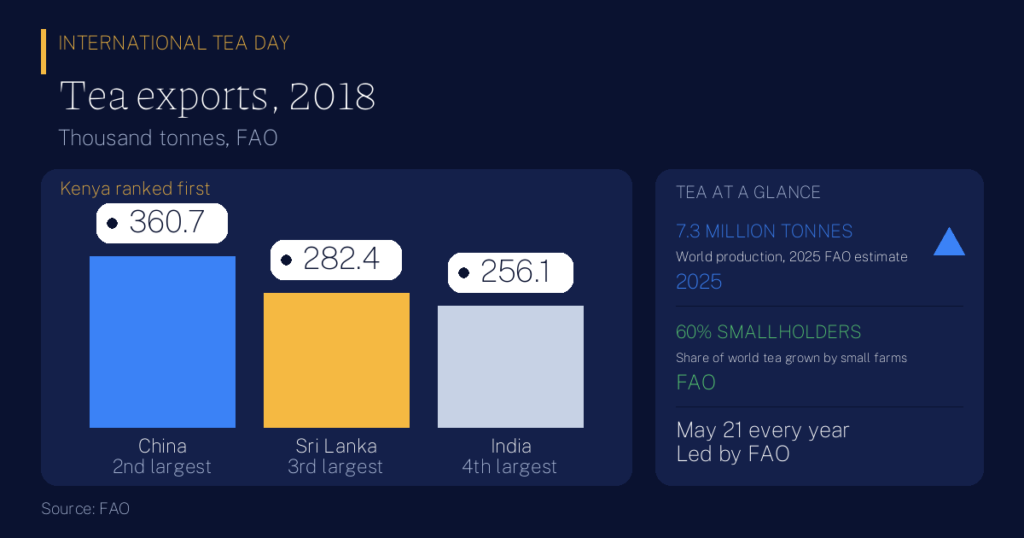
FAO describes tea as the most consumed drink in the world after water. Behind that habit is a large and growing crop. FAO reports that world tea production rose from 4.3 million tonnes to 6.5 million tonnes between 2009 and 2019, and it estimates production in 2025 at around 7.3 million tonnes.
Consumption is rising too. FAO reports that tea consumption per person worldwide increased by 2.1 percent a year over the last decade. FAO puts the value of total tea trade at about USD 9.4 billion a year, and it notes that export earnings help countries pay their food import bills.
- 7.3 milliontonnes of tea produced, 2025 FAO estimate
- 13 millionpeople supported by the tea sector, including smallholders and their households
- USD 9.4 billionestimated annual value of world tea trade
- 2.1%yearly rise in tea consumption per person over the last decade
Example 1: the pace of demand. Suppose one person drinks 100 cups of tea a year. If demand per person grows 2.1 percent every year, that person drinks about 123 cups after ten years. The numbers are round and illustrative, but they show how a modest yearly increase adds up to a large rise in what farms must supply.
Who grows it, and who ships it
Tea is grown in many countries, but a few giants dominate. In 2018, according to FAO, China produced 2.6 million tonnes, which was 43.2 percent of the world total. India is the second largest producer. Sri Lanka ranks fifth. World consumption that year stood at 5.80 million tonnes, with China taking nearly 40 percent and India nearly 20 percent.
The map of exports looks different from the map of production, because countries that grow tea may drink most of it at home. Kenya is the largest exporter in the world and sells 80 percent of the tea it produces abroad, mainly black tea. FAO’s 2018 figures put China second in exports at 360.7 thousand tonnes, Sri Lanka third at 282.4 thousand tonnes and India fourth at 256.1 thousand tonnes.
The small farm behind the cup
The heart of the story is the smallholder. FAO says smallholders are responsible for 60 percent of world tea production, and it describes a sector that supports more than 13 million people, counting farmers and their households. Tea often grows in remote, hilly areas where few other crops pay as well, so the jobs it creates matter far beyond the farm gate.
Country figures show the same pattern. FAO reports about 400,000 smallholders growing tea in Sri Lanka, where the industry supports more than two million people, about one tenth of the population. In India, the industry is described as the second largest employer and provides jobs for over 3.5 million people. These numbers come from FAO’s 2020 feature on tea and carry the years and estimates stated there.
Example 2: a smallholder’s morning. Imagine a family that plucks 100 kilograms of green leaf in a week and sells it to a nearby factory at an illustrative price of $0.30 a kilogram. The week’s income is $30. A rise of just 10 cents a kilogram would add $10, a third more. The figures are round and made up, but they show why fair prices matter so much to families who depend on a single crop.
Heritage, climate and the risks ahead
Tea is also living heritage. FAO has designated six tea cultivation sites as Globally Important Agricultural Heritage Systems, four in China, one in Japan and one in the Republic of Korea. They show farming that has protected landscapes and traditions over many generations.
Tea faces pressure from a changing climate. FAO has noted that rising temperatures, unpredictable rainfall and more frequent extreme weather, such as drought and frost, may strain the industry in countries like Kenya. Tea needs steady rain and mild temperatures, so the same water concerns raised on World Water Day reach the plantation as well as the kitchen tap.
Example 3: a price squeeze. Suppose a cooperative sells 50,000 kilograms of tea a year at an illustrative $2 per kilogram, earning $100,000. A drought cuts output by 20 percent. Even at the same price, income falls to $80,000, a loss of $20,000 that falls on families with few savings. The numbers are made up, but the lesson is real: weather risk lands first on the smallest farms.
How the day is marked
FAO leads the observance each year with events and campaigns. The 2025 theme was Tea for Better Lives, and FAO highlighted the message #FarmedWithCare. The 2026 theme is Sustaining Tea, Supporting Communities, with events held at FAO headquarters on May 21 and at the Palais des Nations in Geneva on May 29. The aim stays the same: more sustainable production, fairer returns for growers and wider appreciation of the people behind the leaf.
- 2025Tea for Better Lives
- 2026Sustaining Tea, Supporting Communities
Key Takeaways
- The day is about people. The UN General Assembly designated May 21 in December 2019 to recognize tea’s role in rural development and food security.
- Tea is a very large crop. FAO estimates world production at around 7.3 million tonnes in 2025, up from 4.3 million tonnes in 2009.
- Small farms carry the sector. FAO says smallholders produce 60 percent of the world’s tea and the sector supports over 13 million people.
- Growing and shipping are different things. Kenya leads exports, and China leads production and consumption.
- Demand is growing. Consumption per person rose 2.1 percent a year over the last decade, which means more farmland and more labor are needed.
- Climate is a threat. Heat, erratic rain, drought and frost can strain producing regions.
- You can help. Choose teas that are traceable and fairly traded, and share the story of the people behind your cup.
How solid is this? Figures come from FAO pages and publications and carry the years stated there, from 2018 to a 2025 estimate. Some FAO statements, such as the smallholder share and the 13 million livelihoods, appear without a stated year, and the 2025 production number is an estimate. The three worked examples use round, made-up numbers to show an idea. See also the International Days hub and the International Days Calendar.
More in Society
- United Nations, International Tea Day, 21 May
- FAO, International Tea Day
- FAO Liaison Office New York, UN adopts resolution showcasing tea (2019)
- FAO, Tea: a love that has stood the test of time (2020)
- FAO Director-General, International Tea Day message (2025)
- FAO Geneva, International Tea Day 2026: Sustaining Tea, Supporting Communities