Few illnesses change how a person moves, speaks, sleeps and thinks all at once. Parkinson disease does, and it is spreading faster than almost any other brain condition. World Parkinson’s Day, marked each April 11, is a moment to look at what the disease is, how many people live with it, and why so many still cannot get the care that works. It sits comfortably beside Universal Health Coverage Day, because the central problem is not a lack of treatment but a lack of access to it.
A condition named in 1817
The disease carries the name of James Parkinson, the British physician who described it in 1817 in his “Essay on the Shaking Palsy.” In June 2017 the Parkinson’s Foundation marked the 200th anniversary of that essay. More than two centuries later the core questions remain open: what triggers the disease is still unknown, and there is still no cure. This article does not retell the history of the awareness day itself, because the organizers’ own records could not be checked for this edition. It sticks to what WHO and peer-reviewed research can confirm.
What Parkinson disease actually is
Parkinson disease is a progressive condition of the brain. WHO lists its movement symptoms as slow movement, tremor, involuntary movement, rigidity, trouble walking and imbalance. Just as important, and far less visible, are the symptoms that do not involve movement at all: cognitive impairment, mental health disorders, dementia, sleep disorders, pain and sensory disturbances. Many families say the second list is harder to live with than the first.
Men are affected more often than women. The cause is unknown, though family history and exposure to air pollution, pesticides and solvents may raise risk. WHO also notes that diagnosis is clinical, and that trained non-specialist health workers can make it, which matters in places with few neurologists.
The numbers behind the day
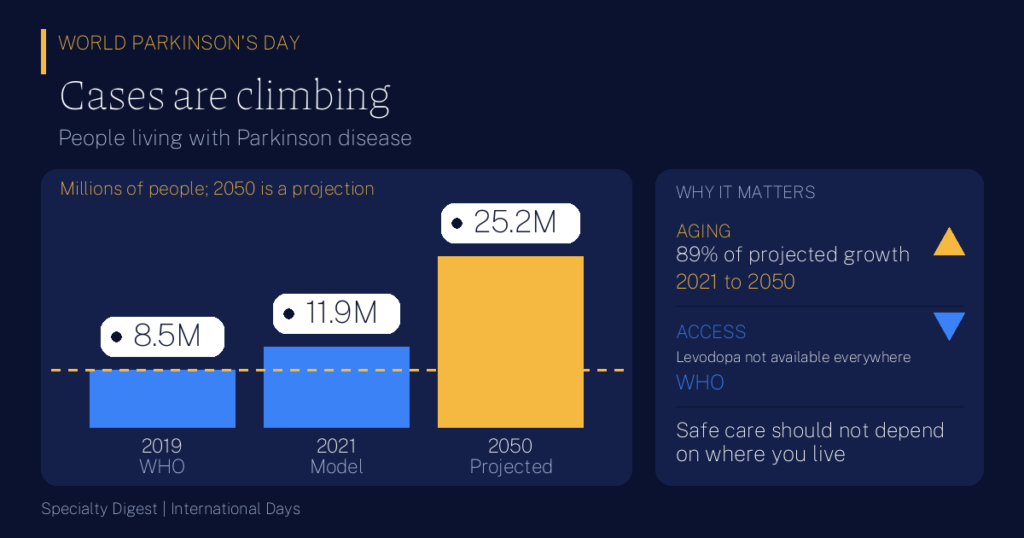
WHO’s global estimates for 2019 showed over 8.5 million people living with the disease. That year it caused 5.8 million disability adjusted life years, up 81 percent since 2000, and 329,000 deaths, an increase of over 100 percent since 2000. WHO adds that prevalence has doubled in the past 25 years. Its 2022 technical brief states that disability and death from Parkinson disease are increasing faster than for any other neurological disorder.
- 8.5 million+people with Parkinson disease worldwide, 2019 (WHO)
- 5.8 milliondisability adjusted life years lost in 2019, up 81% since 2000
- 329,000deaths in 2019, up over 100% since 2000
- 1.46men for every woman in age-standardized prevalence, 2021 (BMJ)
Newer modeling points to a larger and growing count. A 2025 study in the BMJ, built on the Global Burden of Disease Study 2021, estimated about 11.9 million cases in 2021, a prevalence of 152 per 100,000 people. It projected 15.6 million cases in 2030, 20.4 million in 2040 and 25.2 million in 2050, a 112 percent rise from 2021. The two sets of figures differ because they come from different models and years. Both tell the same story.
Example 1: a city’s future caseload. Take an illustrative city of 1,000,000 people. At the 2021 global rate of 152 per 100,000, it would have about 1,520 residents with Parkinson disease. At the projected 2050 rate of 267 per 100,000, the same city would have about 2,670. The numbers are rounded and made up for the example, but the direction is the one the research describes.
Why the count keeps climbing
The main driver is not a sudden new cause. It is age. The BMJ analysis attributes 89 percent of the projected growth from 2021 to 2050 to population ageing, 20 percent to population growth and 3 percent to changes in prevalence rates. The steepest rise is among people aged 80 and older, at 196 percent. The same study projects the male to female ratio of age-standardized prevalence widening from 1.46 in 2021 to 1.64 in 2050.
Example 2: reading the drivers. Imagine a region with 1,000 people with the disease today. A 112 percent rise would bring it to about 2,120 by 2050, or 1,120 added cases. If the global pattern held, roughly 890 of those added cases would trace to an older population. The figures are round and illustrative. The lesson is that planning for an aging society is planning for Parkinson disease.
Treatment exists, access does not
There is no cure, but symptoms can be managed. Levodopa with carbidopa is the most common medicine and is on the WHO Model List of Essential Medicines. Yet WHO states plainly that it is “not accessible, available or affordable everywhere, particularly in low- and middle-income countries.” Other medicines, deep brain stimulation and other therapies can help tremor and reduce the need for drugs, while rehabilitation, including physiotherapy, strength training, gait and balance training and hydrotherapy, can improve functioning and quality of life. These approaches also ease the strain on carers.
Example 3: a medicine that is on the list but not on the shelf. Picture a district clinic that serves 100 people with Parkinson disease but can stock levodopa for only 40 of them. Sixty people then go without the most effective medicine, even though it is officially considered essential. The numbers are invented to show the gap WHO describes between a medicine existing and a medicine reaching the person who needs it.
What the world is doing, and what you can do
In May 2022 the World Health Assembly endorsed the Intersectoral global action plan on epilepsy and other neurological disorders 2022 to 2031, and WHO published a technical brief, “Parkinson disease: a public health approach,” the same year. The brief frames the disease as a public health priority rather than a rare problem of old age. WHO also offers the iSupport program for people who care for relatives with dementia, a common companion of later Parkinson disease.
On April 11, the most useful acts are simple. Learn the early signs, including the non-movement ones. If you or someone close notices persistent tremor, stiffness, slowed movement or changes in balance, see a health professional, since diagnosis is clinical and can begin in primary care. Make space for carers, who carry much of the load. And ask how your own community can make essential medicines and rehabilitation reachable.
Key Takeaways
- The disease has a long history. James Parkinson described it in 1817, and its cause is still unknown.
- It is more than a tremor. Sleep problems, pain, mood changes and dementia are part of the picture.
- The numbers are rising fast. WHO counted over 8.5 million people in 2019, and modeling projects 25.2 million by 2050.
- Aging is the main engine. About 89 percent of the projected growth is tied to older populations.
- Treatment works but is unequally available. Levodopa is essential yet out of reach for many in low- and middle-income countries.
- Rehabilitation matters. Physiotherapy and balance training can improve daily life and ease carers’ burden.
- Early help starts locally. Because diagnosis is clinical, trained primary care workers can begin the process.
How solid is this? The 2019 figures come from WHO’s fact sheet. The 2021 baseline and the 2030 to 2050 projections are modeled estimates from a 2025 BMJ study and use different methods, so they should not be compared line by line. The history of the awareness day itself could not be confirmed against organizers’ pages and is left out. The three worked examples use round, made-up numbers to show an idea. See also the International Days hub and the International Days Calendar.
More in Health