Most people agree that a sick child should see a doctor. Fewer stop to ask who pays, and what happens to a family when the bill arrives. International Universal Health Coverage Day, observed every year on December 12, puts that question on the world calendar. Its promise is easy to say and hard to deliver: everyone, everywhere should be able to get the health care they need without being pushed into hardship by the cost. Health also begins with the basics covered on World Toilet Day, since safe sanitation prevents illness before a clinic is ever needed.
A day born from a unanimous vote
The date looks back to 2012. WHO describes December 12 as the anniversary of the unanimous endorsement of universal health coverage (UHC) by the United Nations in 2012, as an essential priority for international development. Five years later, on December 12, 2017, the General Assembly proclaimed December 12 as International Universal Health Coverage Day. It invited member states to observe the day each year in an appropriate manner and in accordance with national priorities, according to UN News. The Assembly also announced a high-level meeting on UHC for 2019.
UHC is also a target within the Sustainable Development Goals, adopted in 2015, to be reached by 2030. The 2019 high-level meeting reaffirmed its link to sustainable development. In 2025 the UN Statistical Commission approved revised indicators for tracking it: SDG 3.8.1 for service coverage and SDG 3.8.2 for financial hardship.
What “universal” actually means
WHO defines UHC as all people having access to the full range of quality health services they need, when and where they need them, without financial hardship. The range runs from health promotion and prevention to treatment, rehabilitation and palliative care, across the whole life course. Three ideas must hold at once: nobody is left out, the care is good, and paying for it does not ruin a household.
Example 1: two clinics. Picture two towns, each with a clinic that charges nothing at the door. In the first, the clinic has no medicines, so patients buy them from a private shop. In the second, the clinic is stocked and staffed. Only the second town is closer to UHC, because coverage is measured by whether people actually get care and are protected from the bill, not by whether a building exists. The towns are illustrative.
The numbers behind the day
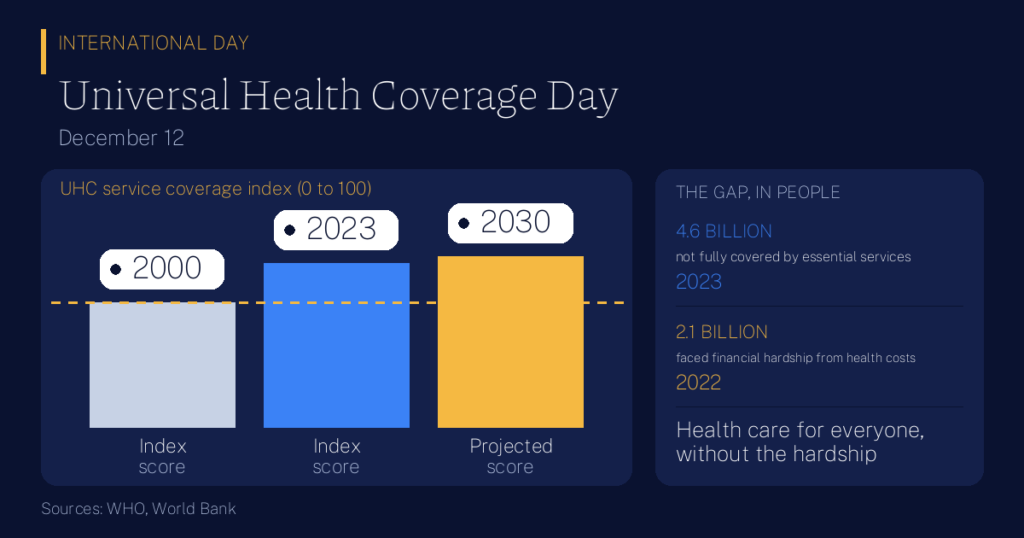
WHO and the World Bank track UHC with two measures. The service coverage index scores access to essential services from 0 to 100. The financial hardship measure counts people in households that spend more than 40 percent of their discretionary budget on out-of-pocket health costs. Both improved in the 2025 Global Monitoring Report, released on December 6, 2025. The coverage index rose from 54 in 2000 to 71 in 2023, and the share of people facing financial hardship fell from 34 percent in 2000 to 26 percent in 2022.
Yet the gap remains large. In 2023, about 4.6 billion people were not fully covered by essential health services. In 2022, 2.1 billion people faced financial hardship, including 1.6 billion who were living in poverty or were pushed deeper into it by out-of-pocket health spending.
- 4.6 billionpeople not fully covered by essential services, 2023
- 2.1 billionpeople facing financial hardship from health costs, 2022
- 26%of people in financial hardship in 2022, down from 34% in 2000
- 74 of 100projected service coverage index in 2030
The projection is the sobering part. On the current trajectory, the global index is projected to reach only 74 out of 100 by 2030, and 24 percent of people would still face financial hardship, nearly 1 in 4. WHO concludes that the world will not achieve UHC by 2030 on this path.
Why progress slowed
The fact sheet reports that the index improved by 1.5 percent a year between 2000 and 2015, then slowed to 0.5 percent a year. For 2015 to 2023, progress dropped to one-third of the annualized rate seen before 2015. Infectious disease control accounts for 52 percent of the index increase since 2000, a sign of what vaccination and disease programs can achieve. But reproductive, maternal, newborn and child health services have stagnated at 72 index points in recent years, and care for noncommunicable diseases reached only 61 points in 2023.
The picture also differs by place. Only one-third of countries improved both coverage and hardship. All WHO regions improved service coverage, but only half of them, Africa, South-East Asia and the Western Pacific, also reduced financial hardship since 2015.
When the bill becomes the illness
Financial hardship is not spread evenly. In 2022, three out of four people among the poorest faced financial hardship from health costs, compared with fewer than 1 in 25 among the richest. A leading driver is medicine: in three-quarters of countries with available data, medicines make up at least 55 percent of out-of-pocket health spending, and among people living in poverty the median is 60 percent.
Example 2: the medicine budget. Suppose a household has $200 a month to spend beyond essentials. If a parent’s diabetes medicine and a child’s clinic visit cost $90 out of pocket, that is 45 percent of the discretionary budget, past the 40 percent line used to define financial hardship. The same bill would barely register for a household with $2,000. The amounts are round and illustrative.
How the day is marked
Each year a global campaign gives the day a theme. The 2025 theme was “Unaffordable health costs? We’re sick of it!” The 2026 theme is “Affordable health care, right here, right now!” and closes a three-year campaign series focused on financial protection, according to WHO. The campaign microsite is powered by UHC2030. Governments, health workers, civil society and ordinary citizens use the day to ask leaders to invest in public health, tackle the cost of medicines and strengthen primary care.
WHO and the World Bank set out six actions in the 2025 report: free essential care at the point of use for poor and vulnerable people, more public investment in health, action on high out-of-pocket spending on medicines, faster growth in essential services for noncommunicable diseases, stronger primary health care, and approaches that reach across sectors.
Example 3: a country’s choice. Imagine a country of 20 million people that extends a free primary care package from half of its population to 60 percent. That brings 2 million more people in. If each of them avoids just $10 a year in out-of-pocket spending, households keep $20 million. The numbers are round and illustrative, but they show how coverage decisions translate into family budgets.
- 2025Unaffordable health costs? We’re sick of it!
- 2026Affordable health care, right here, right now!
Key Takeaways
- UHC has three tests. Everyone is reached, the care is good, and paying does not cause hardship.
- The day is recent but the idea is not. The UN endorsed UHC unanimously in 2012 and proclaimed December 12 as the day in 2017.
- Progress is real. The coverage index rose from 54 to 71 between 2000 and 2023.
- The gap is huge. About 4.6 billion people were not fully covered in 2023, and 2.1 billion faced financial hardship in 2022.
- Progress has slowed. Annual gains fell from 1.5 percent to 0.5 percent after 2015, and WHO says the 2030 goal will be missed on this path.
- Cost hits the poor hardest. Three in four of the poorest faced hardship in 2022, and medicines are a leading driver.
- Ask the local question. Find out what care in your community costs and who is left out.
How solid is this? Coverage and hardship figures are modeled estimates from the WHO and World Bank 2025 monitoring report and are revised as new data arrive. The 2030 numbers are projections, not forecasts of certainty. The three worked examples use round, made-up numbers to show an idea. See also the International Days hub and the International Days Calendar.
More in Health
- UN News, UN Assembly calls on Member States to accelerate progress on goal of universal health coverage (December 12, 2017)
- WHO, Universal health coverage (UHC) fact sheet (December 2025)
- WHO and World Bank, Most countries make progress towards universal health coverage, but major challenges remain (December 6, 2025)
- World Bank, Tracking Universal Health Coverage: 2025 Global Monitoring Report
- WHO, Universal Health Coverage Day 2026
- WHO South-East Asia, Universal Health Coverage Day (December 12, 2025)