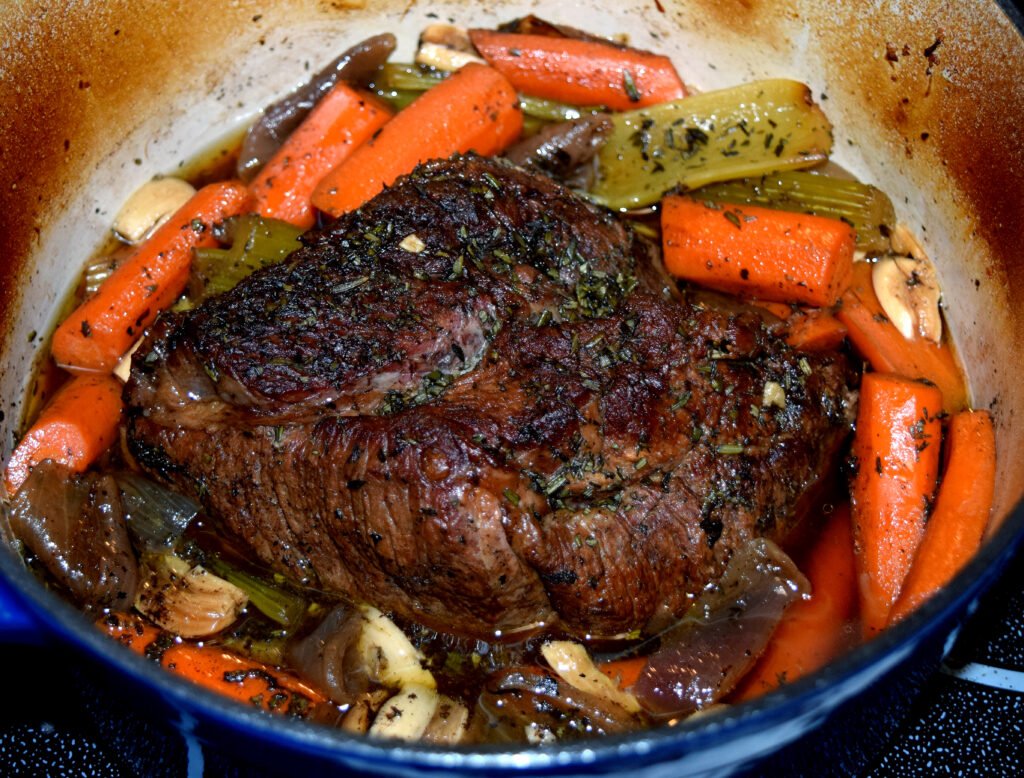
Braising is a combination cooking method that sears food at high heat and then finishes it slowly in a small amount of liquid at low temperature, typically in a covered pot. The technique is especially suited to tough cuts of meat and fibrous vegetables, since prolonged moist heat breaks down connective tissue that dry, quick
Braising Read More »
A cooking method that sears food, then finishes it slowly in liquid at low heat to tenderize tough cuts.
Brand communication strategy ties together how an organization looks, sounds, and behaves so that every interaction reinforces the same underlying identity. Visual Identity and Tone Together A brand strategy typically pairs a visual system, logo, color palette, and typography, with a defined tone of voice, since a polished visual identity undercut by inconsistent or off-brand
Brand Communication Strategy Read More »
Brand communication strategy is the coordinated plan for how an organization visual identity, tone, and messaging work together to build recognition and trust.
Brand equity is the commercial value a brand carries beyond the physical product or service it represents, created entirely by how customers perceive, remember, and feel about it. Two identical products can command very different prices and loyalty simply because one carries stronger brand equity than the other. Aaker’s five assets of brand equity UCLA
Brand Equity Read More »
The commercial value a brand carries beyond its product, created by how customers perceive, remember, and feel about it.
Brand identity is the set of visual and verbal elements, including a name, logo, color palette, typography, and tone of voice, that a company deliberately builds to represent itself and shape how people perceive it. It is distinct from brand image, which is the impression consumers actually form in their own minds, since a company
Brand identity Read More »
The visual and verbal elements a company builds to represent itself, including its logo, colors, typography and tone of voice.
In simple terms Brent crude is a grade of oil from the North Sea. Its price is the reference that much of the world’s crude is sold against. A cargo is rarely priced on its own merits. It is priced as Brent plus or minus a difference that reflects quality and location. How it works
Brent crude Read More »
Brent crude is the North Sea oil grade whose price serves as the main benchmark for crude sold in Europe, Africa and Asia.
In simple terms BRICS is a grouping of major emerging economies that meet to coordinate on trade, finance, security and development. The name began as an investment label. Goldman Sachs coined BRIC in 2001 for Brazil, Russia, India and China. The countries themselves later turned the label into a working forum. How it works South
BRICS Read More »
BRICS is a grouping of major emerging economies, founded by Brazil, Russia, India, China and South Africa and expanded to eleven members.
Broadcast journalism refers to news reporting delivered through television or radio, requiring distinct skills from print reporting, including scripting for spoken delivery, on-camera or on-air presentation, and coordinating with producers and technical staff to assemble a finished segment. It encompasses roles ranging from on-air anchors and field correspondents to behind-the-scenes producers who shape how a
Broadcast Journalism Read More »
News reporting delivered through television or radio broadcast formats.
The Bronze Age is the archaeological period defined by the widespread production and use of bronze, an alloy of copper and tin, for tools, weapons, and other objects. It follows the Stone Age, when tools were made primarily from stone, bone, and wood, and precedes the Iron Age, when iron largely replaced bronze as the
Bronze Age Read More »
The archaeological period defined by the widespread use of bronze tools and weapons, between the Stone Age and the Iron Age.
Brownfield redevelopment is the process of cleaning up and reusing land that is contaminated or perceived to be contaminated from prior industrial, commercial, or waste-disposal use, converting former factory sites, gas stations, rail yards, and similar properties into productive new uses such as housing, parks, retail, or new industrial facilities. The term brownfield distinguishes such
Brownfield Redevelopment Read More »
The process of cleaning up and reusing land contaminated or perceived to be contaminated from prior industrial or commercial use.
In simple terms Brutalism is a mid-20th-century architectural style defined by raw, exposed building materials, most often unfinished concrete, and heavy, blocky forms that make little attempt to hide a building’s structure or soften its appearance. [1] The name comes from the French phrase beton brut, meaning raw concrete. [1] How it works Brutalist buildings
Brutalism Read More »
Brutalism is a mid-20th-century architectural style defined by raw, exposed building materials, most often unfinished concrete, and blocky, heavy-looking forms.