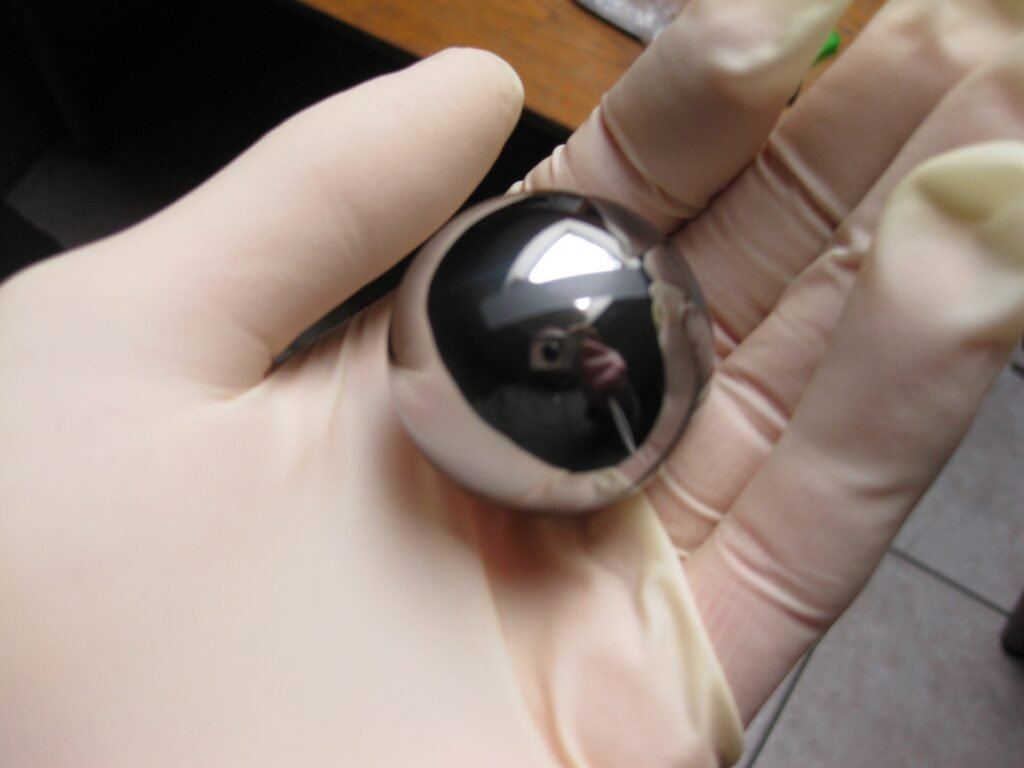
Beryllium is the chemical element with atomic number 4 and the symbol Be. It is a lightweight, silvery-white alkaline earth metal in group 2 of the periodic table, valued for its stiffness, its low density and its transparency to X-rays. It is also toxic, which shapes how it is handled and regulated.
History of beryllium
The gemstones beryl and emerald are both forms of the same mineral, beryllium aluminum silicate. The French mineralogist René-Just Haüy suspected they might hide a new element and asked the chemist Nicolas-Louis Vauquelin to analyze them. Vauquelin concluded that they contained a new metal, and his discovery is dated to 1797, with the announcement at the French Academy following in early 1798.
Vauquelin first called the element glucinium, from the Greek glykys, meaning sweet, because its compounds taste sweet. Others preferred beryllium, after the mineral beryl, and the International Union of Pure and Applied Chemistry (IUPAC) selected that name in 1949. The pure metal was isolated in 1828 by Friedrich Wöhler in Berlin and, independently, by Antoine Bussy in Paris, who each reduced beryllium chloride with potassium. The metal did not become readily available to industry until 1957.
Properties of beryllium
Beryllium has a standard atomic weight of about 9.012 and the electron configuration [He] 2s2, meaning two outer electrons beyond a helium-like core. It is a relatively soft, silvery-white solid with a density of 1.85 grams per cubic centimeter, lighter than aluminum. It melts at 1,287 degrees Celsius and boils at about 2,468 degrees Celsius, high values for a light metal.
Chemically, beryllium forms compounds in which it carries a charge of plus two, and its oxide is amphoteric, which means it can react with both acids and bases. The oxide has a very high melting point, which makes it useful in ceramics and in nuclear work. Few other metals combine such low weight with such stiffness and heat resistance.
PubChem lists further atomic data for beryllium. The atom has a van der Waals radius of 153 picometers and a covalent radius of about 96 picometers, and its first ionization energy is 9.323 electronvolts. The crust holds about 2.8 milligrams of beryllium per kilogram, while seawater contains only a minute trace, on the order of five millionths of a milligram per liter. Beryllium is therefore a scarce element, and its commercial importance comes from the properties of the few minerals that concentrate it.
The gem varieties show how small amounts of other elements change a mineral. Emerald is beryl colored by trace impurities, and aquamarine is another variety. Both were known to ancient civilizations long before anyone understood that they contained a new element, and they were first recognized as the same mineral by Haüy in 1798.
Occurrence and production of beryllium
Beryllium is found in about 30 different minerals. The most important commercially are beryl, a beryllium aluminum silicate, and bertrandite, a beryllium silicate, which supply most of the element and its compounds. Emerald and aquamarine are the precious forms of beryl. Chrysoberyl and phenacite are other beryllium minerals, and the average concentration in the Earth’s crust is only a few milligrams per kilogram.
Most of the metal is now prepared by reducing beryllium fluoride with magnesium metal. The ore must first be processed chemically to extract the beryllium before this step. Because the metal and its dust are hazardous, producing beryllium products requires controlled industrial conditions.
Uses of beryllium
Much of the metal goes into alloys. Mixed with copper, beryllium makes a wear-resistant material known as beryllium bronze, with about 2 percent beryllium, used in gyroscopes and other devices where wear matters. Mixed with nickel or copper, it forms alloys for springs, electrical contacts, spot-welding electrodes and non-sparking tools. Adding beryllium also raises electrical and thermal conductivity.
Beryllium alloys and the metal itself serve as structural materials in high-speed aircraft, missiles, spacecraft and communication satellites, where light weight and stiffness are valuable. The space shuttle used beryllium in components such as brake disks. Beryllium is also relatively transparent to X-rays, so thin beryllium windows are used in X-ray tubes, and ultra-thin foil has found use in X-ray lithography.
In nuclear technology, beryllium reflects or moderates neutrons in reactors, and when it is bombarded with alpha particles, such as those from radium or polonium, it releases neutrons and can be used as a neutron source. Beryllium oxide is used in nuclear work and in ceramic applications.
Beryllium is also valued where metals must stay precise under stress. Aviation engineers use it in gears and cogs, which benefit from a material that is both light and rigid. When beryllium is mixed with copper or nickel, the resulting alloys keep their shape and resist wear, so they are chosen for springs and contacts that flex millions of times. The same stiffness and low density explain its place in satellites and spacecraft, where every kilogram launched is costly.
Isotopes of beryllium
Beryllium has only one stable isotope, beryllium-9, so natural beryllium is a single isotope and its atomic weight is known very precisely at 9.0121831. This is unusual among the lighter elements, many of which have two stable forms. Other beryllium isotopes exist but are radioactive and do not persist in nature in the same way.
Health and environmental effects of beryllium
The Royal Society of Chemistry states that beryllium and its compounds are toxic and carcinogenic. Inhaling beryllium dust or fumes can lead to berylliosis, an incurable inflammation of the lungs. For this reason, occupational exposure to beryllium is controlled by safety regulations in many countries, and anyone handling it professionally follows the guidance of national workplace safety agencies.
The solid metal in finished products is not the main concern, since the risk arises mainly from airborne particles created during machining, grinding or processing. This entry gives general background only and is not advice for any individual situation.
Key facts
- Array
This entry explains a medical term. It is not medical advice. If you are concerned about your health, speak with a qualified health professional.
Quick checkWhat is berylliosis and why is beryllium handled with controls?Show answer
Berylliosis is an incurable inflammation of the lungs that can follow inhaling beryllium dust or fumes. Beryllium and its compounds are toxic and carcinogenic, so industrial handling relies on controlled conditions and workplace safety rules.
Sources
- Array
Editorially reviewed by Specialty Digest Editorial TeamLast reviewed November 4, 2026Researched and drafted with AI assistanceReport an issue