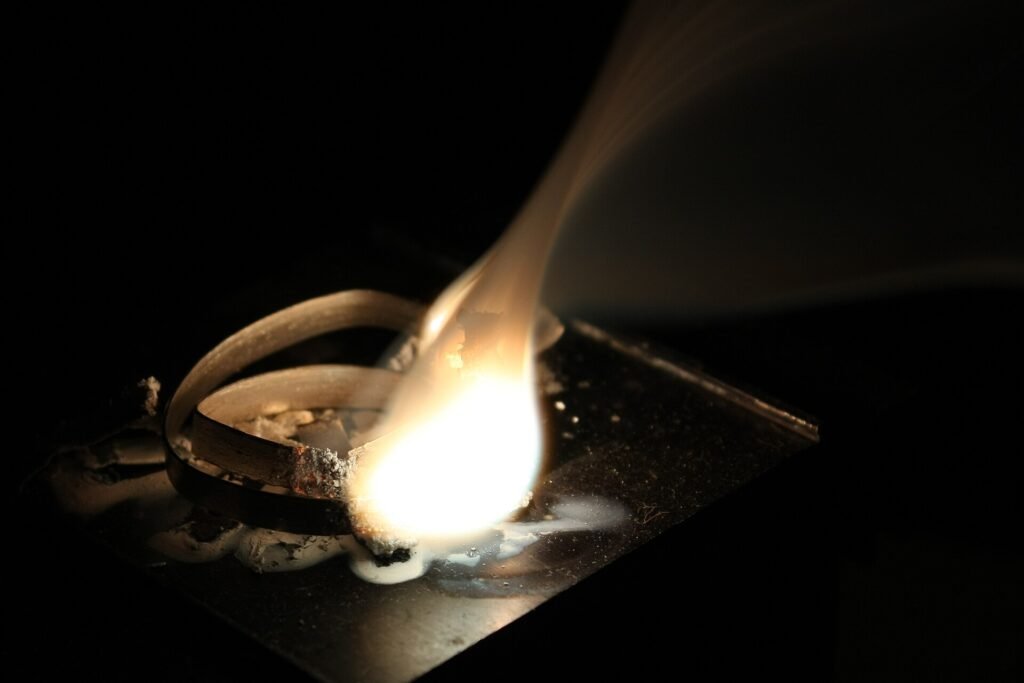
Magnesium is the chemical element with atomic number 12 and the symbol Mg. It is a silvery-white alkaline earth metal in group 2 of the periodic table, light enough to be used in aircraft and electronics, and it burns with a brilliant white light. Magnesium sits at the center of chlorophyll, the green pigment that plants use to capture sunlight, and it is also essential for animals.
History of magnesium
The name of magnesium comes from Magnesia, a district in eastern Thessaly in Greece. The first person to recognize magnesium as an element was Joseph Black at Edinburgh in 1755. He distinguished magnesia, which is magnesium oxide, from lime, which is calcium oxide, although both are produced by heating similar carbonate rocks, magnesite and limestone respectively.
Another magnesium mineral, meerschaum, a magnesium silicate, was reported by Thomas Henry in 1789, who noted that it was used in Turkey to make tobacco pipes. An impure form of the metal was first produced in 1792 by Anton Rupprecht, who heated magnesia with charcoal. Humphry Davy isolated a pure but tiny amount in 1808 by electrolysis of magnesium oxide, and in 1831 the French scientist Antoine Bussy made a sizeable amount by reacting magnesium chloride with potassium and then studied its properties.
Properties of magnesium
Magnesium has a standard atomic weight of about 24.305, given by IUPAC as the interval from 24.304 to 24.307, and the electron configuration [Ne] 3s2. It is a silvery-white solid with a density of 1.74 grams per cubic centimeter, about one-third less than aluminum. It melts at 650 degrees Celsius and boils at about 1,090 degrees Celsius.
The metal ignites easily in air and burns with a bright light, which is the basis of flares and fireworks. In compounds, magnesium nearly always has a charge of plus two, and its oxide is strongly basic. PubChem describes magnesium as the lightest metal that can be used to build things, though its use as a structural material is limited because it burns at relatively low temperatures.
Occurrence and production of magnesium
Magnesium is the eighth most abundant element in the Earth’s crust, making up roughly 2.3 percent, but it does not occur uncombined in nature. It is found in large deposits in minerals such as magnesite and in many silicate rocks, and it is also dissolved in seawater at a concentration of about 1,290 milligrams per liter, so the oceans are a nearly inexhaustible source.
The metal is produced industrially by electrolysis of magnesium chloride, or by heating magnesium oxide with a reducing agent. Because magnesium compounds are plentiful in rock and seawater, the supply of the element is not limited by geology in the way it is for many scarcer metals.
Uses of magnesium
Magnesium is mainly used as an alloying agent. Mixed with aluminum, it improves the mechanical, fabrication and welding qualities of that metal, and the resulting alloys are used in aircraft and car construction. Magnesium alloys also appear in products that benefit from being lightweight, such as car seats, luggage, laptops, cameras and power tools. Magnesium is added to molten iron and steel to remove sulfur.
Because the metal ignites easily and burns with a bright white light, it is used in flares, fireworks, sparklers and, formerly, in photographic flashbulbs. Magnesium compounds have many roles. Magnesium hydroxide is added to plastics to make them fire retardant, and magnesium oxide forms heat-resistant bricks for fireplaces and furnaces and is also added to cattle feed and fertilizers. Magnesium sulfate serves as a mordant for dyes, and Grignard reagents, which are organic magnesium compounds, are important in the chemical industry.
Several magnesium compounds are used in medicine, including magnesium hydroxide (milk of magnesia), magnesium sulfate (Epsom salts), magnesium chloride and magnesium citrate.
Isotopes of magnesium
Magnesium has three stable isotopes. According to IUPAC data, magnesium-24 makes up about 78.99 percent of natural magnesium, magnesium-25 about 10.00 percent and magnesium-26 about 11.01 percent. Variations in these proportions in meteorites and rocks help scientists date events in the early history of the solar system and study how minerals formed.
Chemistry of magnesium
In air, magnesium quickly develops a thin layer of magnesium oxide that protects the metal underneath from further attack, so a piece of magnesium can look dull but stay intact for a long time. Once heated enough to ignite, it burns so fiercely that it keeps burning even in carbon dioxide and nitrogen, the latter forming magnesium nitride. It reacts only slowly with cold water but more quickly with hot water or steam, releasing hydrogen.
In water, magnesium is present as the Mg2+ ion. Along with calcium, dissolved magnesium ions are responsible for the hardness of water, which can leave scale in kettles and pipes and reduce how well soap lathers. Magnesium carbonate and magnesium sulfate are both common in natural waters, and the sulfate gives some mineral springs their bitter taste. Magnesium alloys corrode more readily than aluminum alloys when exposed to salt and moisture, so engineers usually coat or treat them for outdoor use.
Health and environmental effects of magnesium
Magnesium is essential in both plant and animal life. Chlorophyll is a magnesium-centered porphyrin complex, and without magnesium photosynthesis could not take place. In humans, magnesium is needed for hundreds of enzymes. The Royal Society of Chemistry says people take in about 250 to 350 milligrams a day and store about 20 grams in the body, mainly in the bones.
Magnesium metal is a fire hazard, because burning magnesium is hard to extinguish and water can make the fire worse. Recommended intakes and any use of magnesium supplements are matters for health professionals and national guidance, so this entry is background only.
Key facts
- Array
This entry explains a medical term. It is not medical advice. If you are concerned about your health, speak with a qualified health professional.
In the news
Quick checkWhy is magnesium essential to plants?Show answer
A single magnesium atom sits at the center of each chlorophyll molecule, the pigment that captures sunlight for photosynthesis. Without magnesium, plants could not make chlorophyll or carry out photosynthesis.
Sources
- Array
Editorially reviewed by Specialty Digest Editorial TeamLast reviewed November 4, 2026Researched and drafted with AI assistanceReport an issue