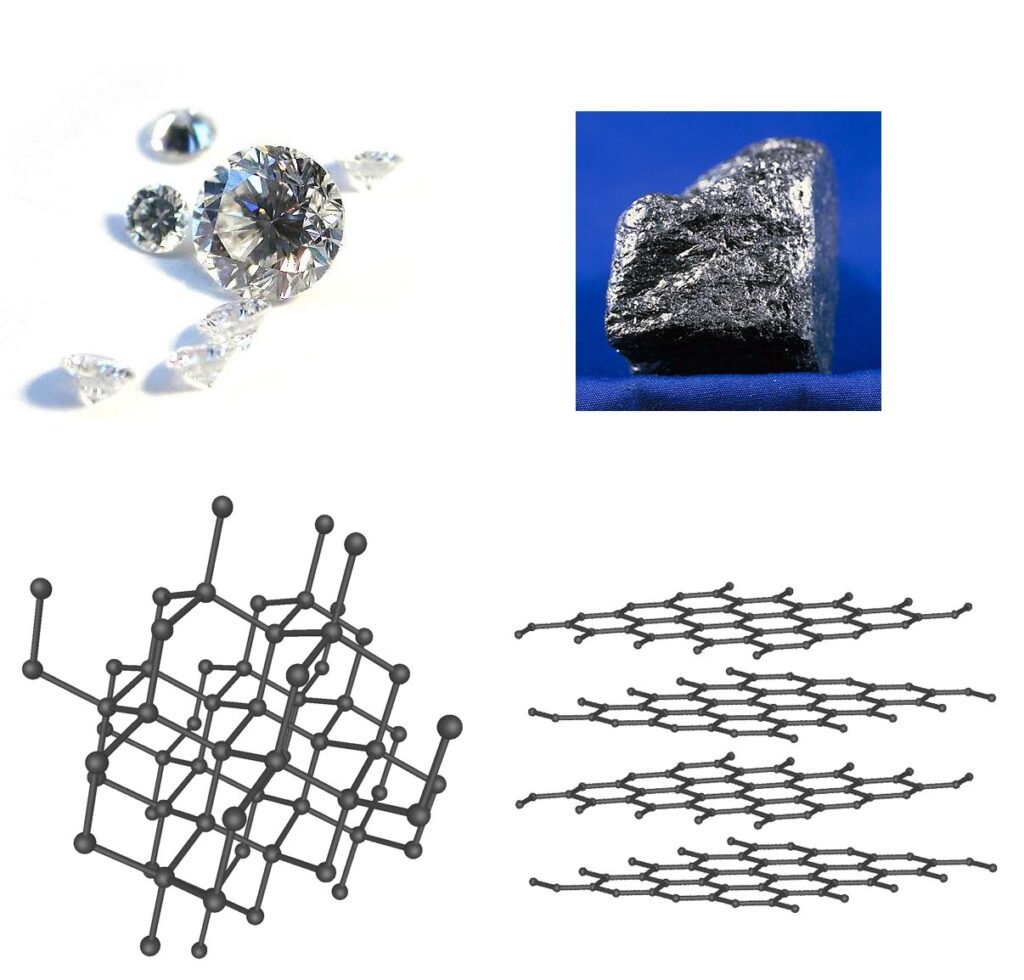
Carbon is the chemical element with atomic number 6 and the symbol C. It is a nonmetal in group 14 of the periodic table, and it is the element on which all known life is built. Carbon occurs in several very different forms, including soft graphite, hard diamond and the nanoscale materials called fullerenes and graphene, and it is found in fuels, plastics, foods and living tissue alike.
History of carbon
Carbon has been known since prehistoric times, in the form of soot and charcoal. Graphite, diamond and coal were recognized as separate materials for a long time before anyone understood that they were related. Diamond posed the greatest puzzle. In 1694 the Florentines Giuseppe Averani and Cipriano Targioni focused sunlight onto a diamond with a large magnifying glass and watched it disappear, showing that diamonds could be destroyed by heat.
The experiment was repeated in 1771 by Pierre-Joseph Macquer and Godefroy de Villetaneuse. In the late 1790s the English chemist Smithson Tennant proved that diamond is a form of carbon by showing that it burns to form only carbon dioxide. Sources date this result to 1796 or 1797. The name carbon comes from the Latin carbo, meaning charcoal.
Properties of carbon
Carbon has a standard atomic weight of about 12.011, given by IUPAC as an interval from 12.0096 to 12.0116, and the electron configuration [He] 2s2 2p2. With four outer electrons, a carbon atom can form four bonds, and it can bond to other carbon atoms in long chains and rings. No other element does this as readily, which is the chemical basis for the huge variety of organic compounds.
The physical properties depend on how the atoms are arranged. Diamond is a colorless, transparent crystal and the hardest known natural material, with a density of 3.513 grams per cubic centimeter. Graphite is black, shiny and soft, with a density near 2.2, because its atoms sit in sheets that slide over one another. Fullerenes and graphene, an atom-thick sheet of carbon, appear as dark, soot-like powders. Carbon does not melt at ordinary pressure but sublimes, changing directly from solid to gas, at about 3,825 degrees Celsius.
PubChem adds that graphite occurs naturally in two crystal forms, alpha and beta, which have identical physical properties but different crystal structures, and that all artificially produced graphite is the alpha type. Carbon also has a first ionization energy of 11.260 electronvolts and covalent radii that shrink as its bonds become double or triple, from about 76 picometers for single bonds to about 69 picometers for triple bonds.
Occurrence and production of carbon
Carbon is the sixth most abundant element in the universe, found in the Sun, stars, comets and the atmospheres of most planets. On Earth it makes up roughly 200 milligrams per kilogram of the crust. It exists as coal, as graphite and diamond deposits, in carbonate rocks, and in the carbon dioxide of air and water.
Most commercial carbon comes in processed forms rather than as pure element. Coal, oil and natural gas supply fuel and chemicals. Graphite is mined, but most commercial graphite is also produced by heating petroleum coke, a tar residue left from refining, in an oxygen-free oven. Carbon black, the fine soot used in inks, paints and rubber, forms when carbon-rich materials burn with too little oxygen for complete combustion.
Uses of carbon
Hydrocarbons, compounds made of carbon and hydrogen, are extracted as fossil fuels and are used mostly as fuels. A smaller but important share becomes feedstock for the petrochemical industry, which makes polymers, fibers, paints, solvents and plastics. Impure carbon in the forms of charcoal and coke is used in metal smelting, and it is especially important in the iron and steel industries.
Graphite is used in pencils, in the brushes of electric motors and in furnace linings. Activated charcoal, which has a very large surface, is used for filtration and purification, including in respirators and kitchen extractor hoods. Carbon fiber is strong yet lightweight and appears in tennis rackets, skis, fishing rods, rockets and aircraft. Industrial diamonds cut rock and drill, and thin diamond films protect surfaces such as razor blades.
Carbon nanotubes, other fullerenes and graphene have opened new possibilities in electronics and nanotechnology. These materials are still being studied and developed, and many applications remain at the research stage.
Isotopes of carbon
Carbon has two stable isotopes. IUPAC data give carbon-12 an abundance of about 98.93 percent and carbon-13 about 1.07 percent. Carbon-12 is the reference for the atomic mass scale, which is why the unified atomic mass unit is defined from it. A third isotope, carbon-14, is radioactive and occurs in only trace amounts. It is the basis of radiocarbon dating, a technique that estimates the age of organic remains.
Carbon in life and the climate
Carbon is essential to life because it forms so many different chains. For a long time chemists thought the carbon compounds of living things could only come from living things, but in 1828 urea was synthesized from inorganic materials, and organic and inorganic chemistry were joined. Living things get nearly all their carbon from carbon dioxide, and photosynthesis in plants and plankton turns it into carbohydrates that feed the rest of the food web.
Carbon dioxide also affects the climate. The Royal Society of Chemistry notes that its concentration in the atmosphere was about 280 parts per million 150 years ago and reached about 390 parts per million in 2013 because of the burning of fossil fuels. Carbon dioxide lets visible light in but holds back some infrared radiation, a natural greenhouse effect that keeps the Earth warm enough for life, and the human-caused rise strengthens that effect.
Key facts
- Array
In the news
- SocietyGlobal Housing Crisis: UN-Habitat Says About 3 Billion People Are Affected
- NaturePennsylvania’s Grand Canyon: NASA Landsat Shows Autumn Color in Pine Creek Gorge
- TechnologyNew Mars Helicopter Blade Design Targets Flights of Nearly 19 Kilometers, NASA Says
- NatureUNEP Emissions Gap Report 2026: Why Warming Projections Point to 2.8°C
- BusinessGraphite in 2025: USGS Shows Why Battery Supply Chains Depend on a Few Countries
Quick checkWhy can carbon form so many different compounds?Show answer
A carbon atom has four outer electrons and can form four bonds, including bonds to other carbon atoms in long chains and rings. This lets carbon build an enormous range of stable molecules, which is why it underlies organic chemistry and living things.
Sources
- Array
Editorially reviewed by Specialty Digest Editorial TeamLast reviewed November 4, 2026Researched and drafted with AI assistanceReport an issue