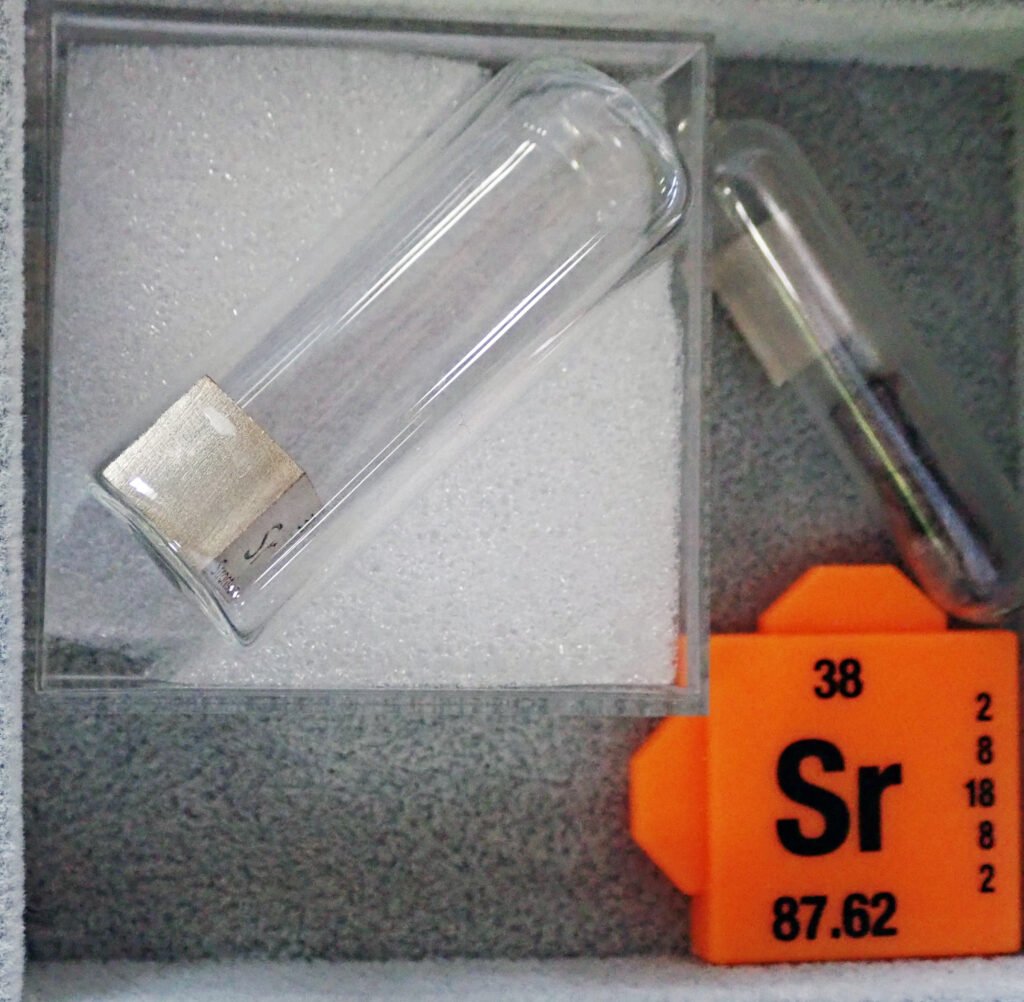
Strontium is the chemical element with atomic number 38 and the symbol Sr. It is a soft, silvery alkaline earth metal in group 2 of the periodic table that burns in air and reacts with water. Strontium salts give fireworks and flares their brilliant red color, and one of its radioactive isotopes is a well-known product of nuclear reactors and weapons tests.
History of strontium
The story starts at a lead mine near the village of Strontian in Scotland, where an unusual rock was found. In 1787 an Edinburgh doctor, Adair Crawford, investigated it and realized that it was a new mineral containing an unknown earth, which he named strontia. In 1791 another Edinburgh man, Thomas Charles Hope, made a fuller investigation and proved that the mineral contained a new element. He also noticed that it made the flame of a candle burn red.
At the same time, Martin Heinrich Klaproth in Germany was studying the same mineral and produced both strontium oxide and strontium hydroxide. The metal itself was first isolated in 1808 at the Royal Institution in London by Humphry Davy. He used electrolysis, the method with which he had already isolated sodium and potassium.
Because the credit spans several years and several chemists, sources give different dates. The Royal Society of Chemistry lists 1790 as the discovery date and names Crawford, while the proof of a new element came in 1791 and the pure metal in 1808. The element takes its name from Strontian.
Properties of strontium
NIST gives the standard atomic weight of strontium as 87.62. The electron configuration is [Kr] 5s2, so the atom has two outer electrons that it gives up easily. PubChem lists an electronegativity of 0.95 and a first ionization energy of 5.695 electronvolts, both low values that mark strontium as a strongly electropositive metal. The common oxidation state is plus 2.
The Royal Society of Chemistry reports successive ionization energies of 549.47 kilojoules per mole for the first electron and 1064.243 for the second. The third, at 4138.26, is almost four times larger. That sharp jump shows why strontium forms ions with a charge of plus 2 and rarely goes further.
Strontium is a solid at 20 degrees Celsius. It melts at 777 degrees Celsius, boils at 1377 degrees Celsius and has a density of 2.64 grams per cubic centimeter. A strontium atom has a covalent radius of 1.90 angstroms and a non-bonded radius of 2.49 angstroms. The US Environmental Protection Agency notes that the metal rapidly turns yellowish in air.
Occurrence and production of strontium
Strontium is found mainly in the minerals celestite and strontianite. The Royal Society of Chemistry names China as the leading producer.
The metal can be prepared in two ways. One is electrolysis of molten strontium chloride mixed with potassium chloride, in which an electric current separates the metal from the salt. The other is reducing strontium oxide with aluminum in a vacuum, so that the aluminum takes the oxygen and leaves strontium behind.
Uses of strontium
Strontium is best known for the brilliant reds its salts give to fireworks and flares. It is also used to produce ferrite magnets and to refine zinc. Modern glow-in-the-dark paints and plastics contain strontium aluminate, which absorbs light during the day and releases it slowly for hours afterward. Strontium chloride hexahydrate is an ingredient in toothpaste for sensitive teeth.
The radioactive isotope strontium-90 has practical uses of its own. The Royal Society of Chemistry describes it as one of the best high-energy beta emitters known, meaning it gives off fast electrons as it decays. It can be used to generate electricity for space vehicles, remote weather stations and navigation buoys. It is also used in thickness gauges and to remove static charges from machinery that handles paper or plastic. The US Environmental Protection Agency notes that strontium-90 is produced commercially by nuclear fission for use in medicine and industry.
Isotopes of strontium
Isotopes are atoms of the same element with different numbers of neutrons. NIST lists four naturally occurring isotopes of strontium: strontium-84 at 0.56 percent, strontium-86 at 9.86 percent, strontium-87 at 7.00 percent and strontium-88 at 82.58 percent. Strontium-88 is by far the most common, and the Royal Society of Chemistry lists the isotopes 86, 87 and 88 as the key ones.
Strontium-90 is not part of this natural mixture. It is a by-product of nuclear reactors and is present in nuclear fallout. It has a half-life of 28 years according to the Royal Society of Chemistry, and the Environmental Protection Agency gives it as 29 years, a small difference between rounded figures. A half-life is the time needed for half of a sample’s atoms to decay, so a quantity of strontium-90 takes several decades to fall noticeably.
Health and environmental effects of strontium
Natural strontium is not radioactive. The Royal Society of Chemistry reports that it has no biological role in humans and is non-toxic. It is incorporated into the shells of some deep-sea creatures and is essential to some stony corals. Because strontium resembles calcium chemically, it can mimic calcium and end up in the bones.
That resemblance is the reason strontium-90 is of concern. According to the Royal Society of Chemistry, it is particularly dangerous because it can be absorbed into the bones of young children, where it can damage bone marrow and cause cancer. The Environmental Protection Agency states that strontium-90 is widely dispersed in the environment and food chain from atmospheric nuclear weapons testing in the 1950s and 1960s, that radioactive decay is the only way its amount decreases, and that current levels from those tests are very low. Everyone is exposed to small amounts. This overview is general background and not advice.
Key facts
- Strontium has atomic number 38, symbol Sr, and sits in group 2 and period 5 of the periodic table.1
- Strontium melts at 777 degrees Celsius, boils at 1377 degrees Celsius and has a density of 2.64 grams per cubic centimeter.1
- Humphry Davy first isolated strontium metal by electrolysis in 1808, after Adair Crawford and Thomas Charles Hope identified the new element.1
- Strontium has four naturally occurring isotopes, and strontium-88 is the most abundant at 82.58 percent.2
- Strontium-90 is a radioactive beta emitter with a half-life of about 28 to 29 years.13
Related concepts
In the news
Quick checkWhere does strontium get its name?Show answer
It is named after Strontian, a small town in Scotland where the mineral that contains it was found in a lead mine.
Sources
- Royal Society of Chemistry, Periodic Table: Strontium, https://periodic-table.rsc.org/element/38/strontium
- National Institute of Standards and Technology, Atomic Weights and Isotopic Compositions for Strontium, https://physics.nist.gov/cgi-bin/Compositions/stand_alone.pl?ele=Sr&ascii=html&isotype=some
- US Environmental Protection Agency, Radionuclide Basics: Strontium-90, https://www.epa.gov/radiation/radionuclide-basics-strontium-90
- National Center for Biotechnology Information, PubChem Periodic Table: Strontium (element 38), https://pubchem.ncbi.nlm.nih.gov/element/38
Editorially reviewed by Specialty Digest Editorial TeamLast reviewed November 4, 2026Researched and drafted with AI assistanceReport an issue