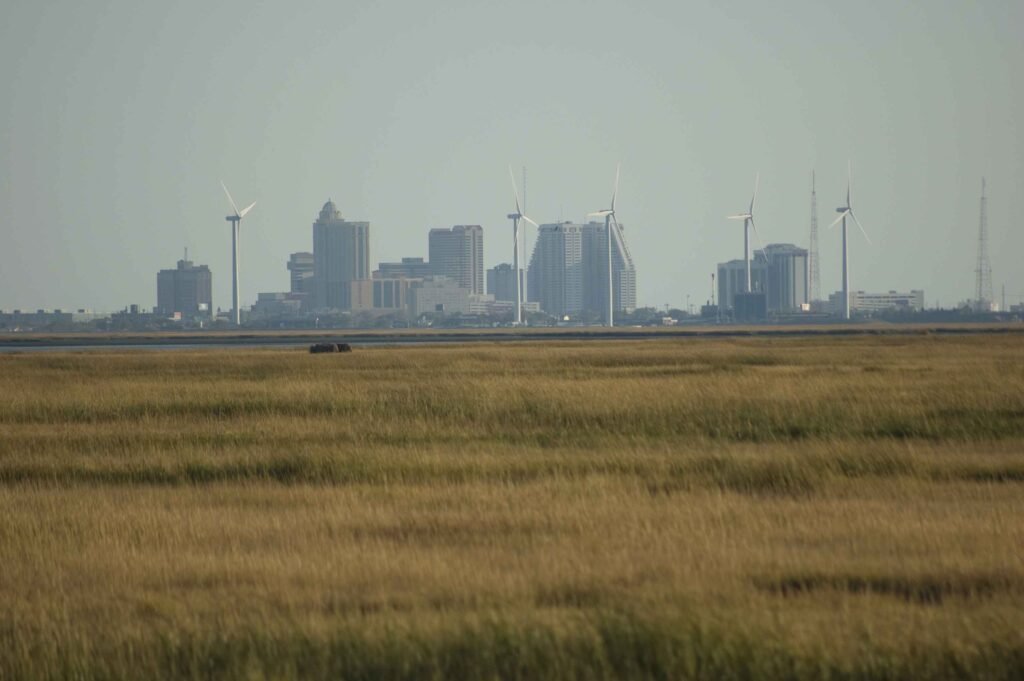
Wind power is the use of moving air to produce mechanical power or electricity, most often with turbines whose blades turn a generator. In 2024 wind supplied about 8.1 percent of the world’s electricity, according to the energy think tank Ember, a larger share than solar power at 6.9 percent.
History of wind power
People have long used wind for sailing and for mechanical work such as grinding grain and pumping water. Electricity from wind came much later. As early as 1888, Charles Brush powered his laboratory in Cleveland, Ohio, with a 12.5 kilowatt direct-current wind generator. In 1933, engineers led by V. N. Krasnovsky built a 100 kilowatt machine on a 25 meter tower at Balaclava in Crimea. It was then the most powerful wind generator in the world and fed the grid for about ten years before it failed and was dismantled during World War II.
In the United States, the engineer Palmer Putnam looked for a windy site and larger machines than the small turbines farmers used. On a Vermont hilltop called Grandpa’s Knob, workers built a 36 meter tower and a turbine with two steel blades, each about 20 meters long. It was designed for 1.5 megawatts, fifteen times the rating of the largest wind generator then in existence. On October 19, 1941, it began supplying power to the lines of the Central Vermont Public Service Corporation.
In 695 operating hours the turbine produced 298,240 kilowatt hours. On March 26, 1943, one blade broke off. Metals were scarce in wartime, so it was not rebuilt, but the control methods Putnam worked out for matching the turbine to the frequency of the grid proved valuable decades later. The U.S. Department of Energy says its joint program with NASA in the 1970s, called the Mod series, came before the modern American wind industry and helped shape a cost-competitive one.
Public and private cooperation later rebuilt confidence in the technology. The Department of Energy says its Wind Turbine Verification Program, established in 1993, introduced electric utilities to emerging turbine designs and helped wind become a mainstream electricity source. Research into airfoils, the cross-sectional shape of a blade, has also improved how turbine blades handle lift, drag and structural stress.
How wind power works
Wind is a form of solar energy. It is caused by the sun heating the atmosphere unevenly, by irregularities in the earth’s surface, and by the rotation of the earth. A wind turbine reverses the logic of a household fan: instead of using electricity to make wind, it uses wind to make electricity.
The blades work like an airplane wing. When wind flows across a blade, the air pressure on one side drops, which creates both lift and drag. Lift is the stronger force, so the rotor spins. The rotor connects to a generator either directly, in a direct drive design, or through a gearbox that speeds up the rotation and allows a physically smaller generator. Winds generally strengthen with height, a pattern called wind shear, which is one reason towers keep getting taller.
Types of wind turbines
The Department of Energy groups most turbines into two types. Horizontal-axis machines are what most people picture. They commonly have three blades and face into the wind on top of a tower. Vertical-axis machines, such as the eggbeater-shaped Darrieus design, accept wind from any direction and do not need to be pointed into it.
Turbines are also sorted by where they stand. Land-based turbines range from 100 kilowatts to several megawatts, and larger ones are grouped into wind plants that supply bulk power to the grid. Turbines can also be built offshore in large bodies of water such as oceans and lakes. Most modern wind turbines belong to the horizontal-axis, utility-scale category.
Applications of wind power
The largest application is generating electricity for the power grid from wind plants. Smaller machines can serve a single site, and mechanical wind power still performs tasks such as pumping water. Hub height, the distance from the ground to the center of the rotor, matters because taller machines capture stronger wind.
Turbines have grown quickly in the United States. According to the Department of Energy, the average hub height of utility-scale land-based turbines rose 83 percent between 1998-1999 and 2023, to about 103 meters. The average rotor diameter of newly installed turbines in 2023 was over 133 meters, and 98 percent had rotors of 115 meters or more, compared with none in 2013. The average new turbine had a capacity of 3.4 megawatts, up 375 percent since 1998-1999. Larger turbines mean fewer machines are needed for the same output, which lowers costs.
Wind power around the world
Ember’s Global Electricity Review 2025 puts wind at 8.1 percent of global electricity in 2024. Wind and solar together overtook hydropower that year, when hydropower supplied 14.3 percent. Nuclear power supplied 9.0 percent, and its share reached a 45-year low. Ember also found that low-carbon sources, meaning renewables plus nuclear, passed 40 percent of world electricity for the first time since the 1940s.
Advantages and disadvantages of wind power
Wind is a low-carbon source, and its fuel is free and widely available. The Department of Energy notes that wind flow patterns and speeds vary greatly by location and are changed by water, vegetation and terrain, so siting matters. Output also changes with the weather, which is why Ember stresses flexible grids and storage such as batteries to keep supply steady as wind and solar grow.
Size brings its own limits. Blades cannot be folded or bent once built, so the routes and turns available to trucks restrict how large land-based blades can be. Tower sections can be too wide to pass under bridges and overpasses. The Department of Energy is funding research on slimmer, more flexible blades and on towers made on site.
Wildlife is another concern. The Department of Energy reports that its wind research has addressed effects on wildlife and the environment for more than 30 years.
Key facts
- Charles Brush powered his Cleveland laboratory with a 12.5 kilowatt direct-current wind generator as early as 1888.2
- The Smith-Putnam turbine in Vermont first fed the grid on October 19, 1941, and made 298,240 kilowatt hours in 695 operating hours.2
- Wind turbines work through lift on the blades, which spins a rotor connected to a generator directly or through a gearbox.1
- In 2023 the average new U.S. land-based turbine had a capacity of 3.4 megawatts and a rotor diameter of over 133 meters.3
- Wind supplied 8.1 percent of global electricity in 2024, ahead of solar at 6.9 percent.4
- Wind and solar together overtook hydropower in global electricity generation in 2024.4
Related concepts
In the news
Quick checkWhy do wind turbine towers keep getting taller?Show answer
Winds generally strengthen with height because there is less friction from trees, buildings and terrain, so taller towers capture more energy.
Sources
- How Do Wind Turbines Work?, U.S. Department of Energy, https://www.energy.gov/eere/wind/how-do-wind-turbines-work
- Palmer Putnam's 1.5 MW Wind Turbine, Engineering and Technology History Wiki, https://ethw.org/Palmer_Putnam%27s_1.5_MW_Wind_Turbine
- Wind Turbines: the Bigger, the Better, U.S. Department of Energy, updated August 2024, https://www.energy.gov/eere/articles/wind-turbines-bigger-better
- Global Electricity Review 2025, Ember, 8 April 2025, https://ember-energy.org/latest-insights/global-electricity-review-2025/
- History of U.S. Wind Energy, U.S. Department of Energy, https://www.energy.gov/eere/wind/history-us-wind-energy
Editorially reviewed by Specialty Digest Editorial TeamLast reviewed November 4, 2026Researched and drafted with AI assistanceReport an issue