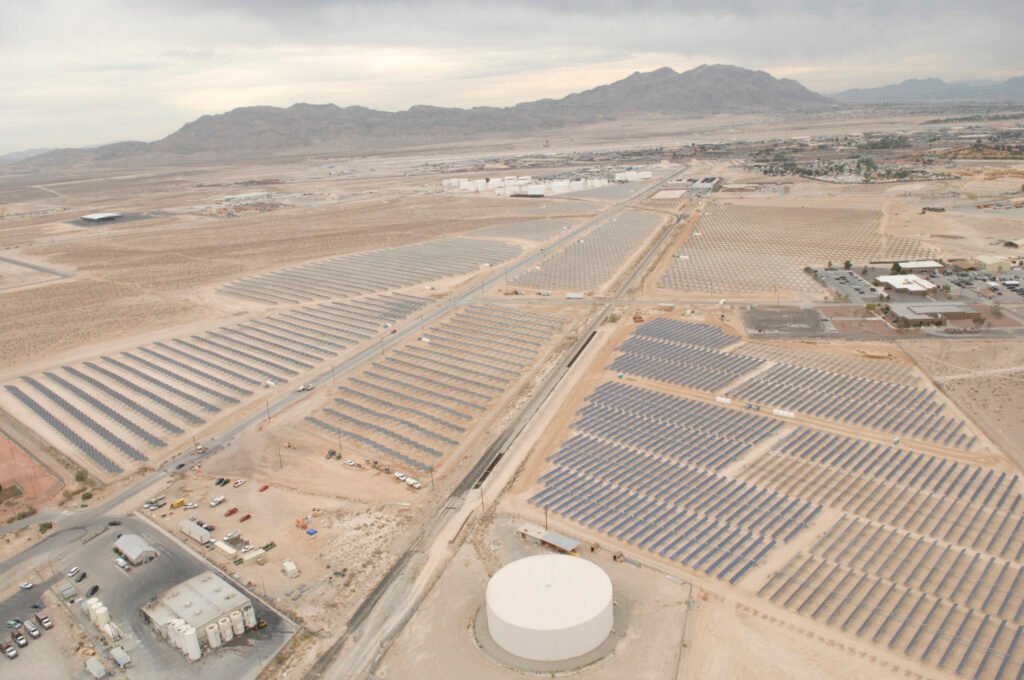
Solar power is electricity or heat produced from sunlight. Most of it comes from photovoltaic cells, which turn light directly into electric current, while a smaller share comes from concentrating solar-thermal plants that use mirrors to make heat for a turbine. Solar was the largest source of new electricity worldwide for the third year running in 2024, yet it still supplied only about 7 percent of global generation.
History of solar power
The photovoltaic effect was first noticed in 1839 by the French physicist Alexandre-Edmond Becquerel. He saw small electric currents when metal electrodes in a liquid were exposed to light, but he could not explain them. In 1883 the American inventor Charles Fritts built cells from selenium, although they converted less than 1 percent of sunlight into electricity and could not compete with coal-fired power plants.
The next advance came in 1940, when Russell Ohl of Bell Laboratories found that a cracked silicon sample passed current in the light. The crack marked a boundary between regions with different impurities, an accidental p-n junction. That is the meeting of two differently treated layers of semiconductor, and it creates the internal electric field a solar cell depends on. Ohl’s cell was also about 1 percent efficient.
In 1953 the engineer Daryl Chapin was looking for a way to power telephone equipment in remote, humid places where dry batteries failed quickly. Working with the chemist Calvin Fuller and the physicist Gerald Pearson, he moved from selenium to silicon. Bell Laboratories announced the first practical silicon solar cell on April 25, 1954. It converted about 6 percent of sunlight into electricity and ran a toy Ferris wheel and a small radio transmitter in the demonstration. The cells were expensive at first, but within a few years they were powering satellites.
How solar power works
A photovoltaic cell is made of a semiconductor, a material whose ability to carry current can be controlled. When sunlight is absorbed in the cell, its energy creates electrical charges that move in response to the cell’s internal electric field, and that movement is an electric current. The U.S. Department of Energy says a single cell typically produces about 1 or 2 watts, so cells are wired into chains to form modules, usually called solar panels, and modules are joined into arrays.
A complete system adds mounting structures that point the panels toward the sun and inverters, which convert the direct current from the modules into the alternating current that homes and the grid use. Because of this modular design, a system can be sized for almost any need, from a single rooftop to a large power station.
Efficiency is the share of incoming sunlight that becomes usable electricity, and most sunlight is lost. Some photons reflect off the surface, some pass straight through, and some give up their energy as heat. Untreated silicon reflects more than 30 percent of incident light, which is why cells carry anti-reflection coatings and textured surfaces. Cells also work best when cool, because higher temperatures reduce voltage far more than they raise current.
Types of solar power
The Department of Energy names two main families of solar technology. Photovoltaics are the familiar panels on roofs and in solar farms. Concentrating solar-thermal power, or CSP, uses mirrors to reflect and concentrate sunlight onto a receiver, where it heats a high-temperature fluid. That heat can spin a turbine to make electricity, or it can serve industrial uses such as water desalination, food processing and chemical production.
CSP is generally built at utility scale. Power tower systems ring a central receiver with sun-tracking mirrors, and linear systems focus light on parallel tubes. Smaller dish and engine units produce 5 to 25 kilowatts each. CSP plants can also use thermal energy storage, which holds heat so output can continue when the sun sets or clouds block it.
Applications of solar power
Solar cells now run devices from handheld calculators to rooftop systems, and they became a standard source of power for satellites soon after the 1954 demonstration. On the ground, photovoltaic systems connect to the electrical grid as part of a complete installation, and the same technology is built at scales from a single home to a utility-scale solar farm. CSP plants supply bulk electricity, and their heat can also feed factories.
Solar power around the world
Ember, an energy think tank, reports that solar generation passed 2,000 terawatt-hours in 2024, double its level three years earlier. It grew 29 percent that year, making solar the fastest growing source of electricity for the 20th year in a row, and it added 474 terawatt-hours, more than any other source. China accounted for 53 percent of the 2024 increase.
Solar supplied 6.9 percent of global electricity in 2024, compared with 8.1 percent for wind, and the two together overtook hydropower that year. Installed solar capacity reached 1 terawatt in 2022 after decades of growth, and it reached 2 terawatts just two years later, in 2024.
Advantages and disadvantages of solar power
Ember counts solar among the low-carbon sources, along with other renewables and nuclear power, which together supplied 40.9 percent of global electricity in 2024. The modular design allows projects of nearly any size, and industry commentary published with the Ember report points to falling costs for solar and battery storage as a driver of adoption.
The main limit is that output falls when the sun sets or clouds block it. For that reason Ember describes solar as strongest when paired with energy storage and flexible grids that shift supply and demand. Heat is a second constraint, since hot cells lose efficiency, and most of the sunlight reaching any cell is still lost rather than converted.
Key facts
- Bell Laboratories announced the first practical silicon solar cell on April 25, 1954, and it converted about 6 percent of sunlight into electricity.5
- A single photovoltaic cell typically produces about 1 or 2 watts, so cells are joined into modules and arrays.2
- Untreated silicon reflects more than 30 percent of incident light, so cells use anti-reflection coatings and textured surfaces.3
- Concentrating solar-thermal plants use mirrors to heat a fluid, and dish and engine units produce 5 to 25 kilowatts each.4
- Global solar generation passed 2,000 terawatt-hours in 2024 and supplied 6.9 percent of world electricity.6
- Installed solar capacity reached 1 terawatt in 2022 and 2 terawatts in 2024.6
Related concepts
In the news
- ScienceTRACERS First Results: 149 Cusp Encounters Cataloged by One Spacecraft
- BusinessWorld Energy Investment 2026: IEA Estimates USD 3.4 Trillion and a Tenfold Rise in Solar Additions
- SciencePsyche Mission: NASA’s Metal Asteroid Probe Passes Mars on the Way to 2029 Arrival
- ScienceRenewable Energy in 2025: A Record 692 Gigawatts Added
Quick checkWhat happens to most of the sunlight that reaches a solar cell?Show answer
Most of it is lost. Some photons reflect off the surface, some pass through, and some give up their energy as heat, leaving only the remainder to free electrons and produce current.
Sources
- How Does Solar Energy Work?, U.S. Department of Energy, https://www.energy.gov/eere/solar/how-does-solar-work
- Solar Photovoltaic Technology Basics, U.S. Department of Energy, https://www.energy.gov/eere/solar/solar-photovoltaic-technology-basics
- Solar Photovoltaic Performance and Efficiency Basics, U.S. Department of Energy, https://www.energy.gov/eere/solar/solar-performance-and-efficiency
- Concentrating Solar-Thermal Power Basics, U.S. Department of Energy, https://www.energy.gov/eere/solar/concentrating-solar-thermal-power-basics
- First Practical Silicon Solar Cell, APS News, American Physical Society, April 2009, https://www.aps.org/publications/apsnews/200904/physicshistory.cfm
- Global Electricity Review 2025, Ember, 8 April 2025, https://ember-energy.org/latest-insights/global-electricity-review-2025/
Editorially reviewed by Specialty Digest Editorial TeamLast reviewed November 4, 2026Researched and drafted with AI assistanceReport an issue