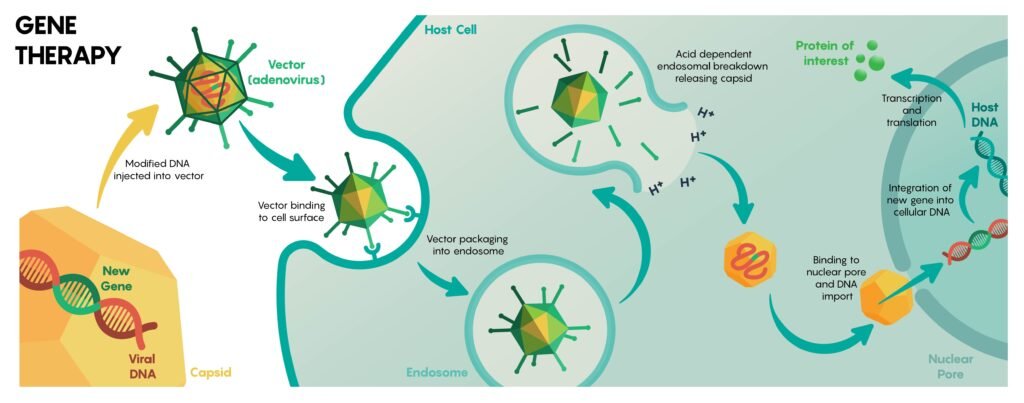
Gene therapy is a medical approach that treats or prevents disease by correcting the underlying genetic problem. Instead of relying only on drugs or surgery, it alters a person’s genetic makeup, for example by adding a working copy of a faulty gene or by editing DNA inside cells. The information here is general background, not medical advice.
History of gene therapy
The first gene therapy trial took place more than thirty years ago, according to MedlinePlus Genetics. Those earliest studies showed that the approach could carry serious health risks, including toxicity, inflammation and cancer.
Researchers then studied the mechanisms behind those problems and developed techniques less likely to trigger dangerous immune reactions or cancer. The earliest method, often called gene transfer or gene addition, introduced a new gene into cells or supplied a non-faulty copy to stand in for an altered one. Later work produced genome editing, which changes DNA that is already in the cell.
Gene therapies are now used for a small number of diseases. MedlinePlus lists an eye disorder called Leber congenital amaurosis and a muscle disorder called spinal muscular atrophy as examples, and it says many more therapies are in research to test their safety and effectiveness.
How gene therapy works
Genes carry the instructions for making proteins, which do most of the work in cells. When a variant stops a protein from being made or from working properly, gene therapy tries to restore that protein’s function. Understanding how a gene controls a protein is the starting point for every approach.
Genetic material usually cannot enter a cell on its own, so it is packaged in a carrier called a vector. Certain viruses are engineered for this role because they can deliver material by infecting a cell, and they are modified so they cannot cause disease. Some, such as retroviruses, insert their genetic material into a chromosome of the human cell. Others, such as adenoviruses, deliver DNA to the nucleus without integrating it into a chromosome.
Delivery takes two broad forms. In one, the vector is injected or given intravenously into a specific tissue. In the other, a sample of the patient’s cells is removed, exposed to the vector in a laboratory, and then returned to the patient.
Types of gene therapy
The US Food and Drug Administration (FDA) describes several kinds of gene therapy product. Plasmid DNA products use circular DNA molecules engineered to carry therapeutic genes into human cells. Viral vector products use viruses stripped of their ability to cause infection, and bacterial vector products do the same with modified bacteria.
Human gene editing products aim to disrupt harmful genes or repair mutated ones. Patient-derived cellular gene therapy products involve cells that are removed, genetically modified, often with a viral vector, and put back.
The FDA also lists three basic mechanisms: replacing a disease-causing gene with a healthy copy, inactivating a disease-causing gene that is not working properly, and introducing a new or modified gene to help treat a disease.
A further division concerns which cells are changed. Current research has focused on body cells, such as bone marrow or blood cells, and those changes cannot be passed to a person’s children. Altering egg or sperm cells would make changes heritable, an approach called germline gene therapy.
Applications of gene therapy
The National Human Genome Research Institute notes that both inherited disorders, such as hemophilia and sickle cell disease, and acquired disorders, such as leukemia, have been treated with gene therapy. The FDA says gene therapy products are being studied for cancer, genetic diseases and infectious diseases.
The FDA’s Center for Biologics Evaluation and Research regulates these products and has approved both cellular and gene therapy products. A company must submit an investigational new drug application before human studies begin in the United States, and it needs an approved biologics license application to market a product.
Gene therapy vs. genome editing
The two terms overlap but are not identical. Gene addition brings in new genetic material, while genome editing brings in molecular tools that change the existing DNA. MedlinePlus names CRISPR-Cas9 as a well-known genome editing method.
Editing tools are being studied to fix an alteration so a gene can work properly, to turn a helpful gene on, to turn a malfunctioning gene off, and to remove a piece of DNA that impairs a gene’s function. MedlinePlus describes genome editing as a promising technique still under study for treating disorders.
Advantages and disadvantages of gene therapy
The central advantage is that gene therapy addresses a cause of disease rather than only its symptoms. NHGRI describes it as a direct way to treat genetic conditions, and it can reach disorders for which drugs or surgery offer little.
The risks are real. MedlinePlus says viral vectors have been successful but carry some risk, because a virus can trigger a dangerous immune response. It adds that because the techniques are relatively new, some risks may be unpredictable. The FDA can reject or suspend a trial it suspects is unsafe, and the National Institutes of Health provides guidelines for institutions that conduct this research.
Ethical questions are part of the picture. MedlinePlus lists concerns such as how to separate good from bad uses of the technology, who decides what counts as a disorder, whether high costs will limit access to wealthy patients, and whether people should use it to enhance traits such as height or intelligence.
Germline therapy is the most contested form. It could spare future generations a disorder, but it might affect fetal development in unexpected ways, and the people affected cannot consent. The US government does not allow federal funds for research on germline gene therapy in people.
Key facts
- Gene therapy treats or prevents disease by correcting the underlying genetic problem, altering a person's genetic makeup instead of relying only on drugs or surgery.1
- The first gene therapy trial was run more than thirty years ago, and the earliest studies showed risks including toxicity, inflammation and cancer.1
- The FDA lists plasmid DNA, viral vectors, bacterial vectors, human gene editing and patient-derived cellular products as types of gene therapy product.2
- The FDA's Center for Biologics Evaluation and Research regulates gene therapy, and marketing a product requires an approved biologics license application.2
- Current gene therapy research targets body cells, so the changes cannot be passed to a person's children.1
This entry explains a medical term. It is not medical advice. If you are concerned about your health, speak with a qualified health professional.
Related concepts
Quick checkHow is gene therapy different from genome editing?Show answer
Gene addition introduces new genetic material into cells, while genome editing introduces molecular tools that change the DNA already in the cell. Genome editing is a newer approach that may also be used for gene therapy.
Sources
- MedlinePlus Genetics (National Library of Medicine), What is gene therapy?, How does gene therapy work?, Is gene therapy safe?, What are the ethical issues surrounding gene therapy?, https://medlineplus.gov/genetics/understanding/therapy/genetherapy/
- U.S. Food and Drug Administration, What is Gene Therapy?, https://www.fda.gov/vaccines-blood-biologics/cellular-gene-therapy-products/what-gene-therapy
- U.S. Food and Drug Administration, Cellular and Gene Therapy Products, https://www.fda.gov/vaccines-blood-biologics/cellular-gene-therapy-products
- National Human Genome Research Institute, Gene Therapy (Talking Glossary of Genomic and Genetic Terms), https://www.genome.gov/genetics-glossary/Gene-Therapy
Editorially reviewed by Specialty Digest Editorial TeamLast reviewed November 4, 2026Researched and drafted with AI assistanceReport an issue