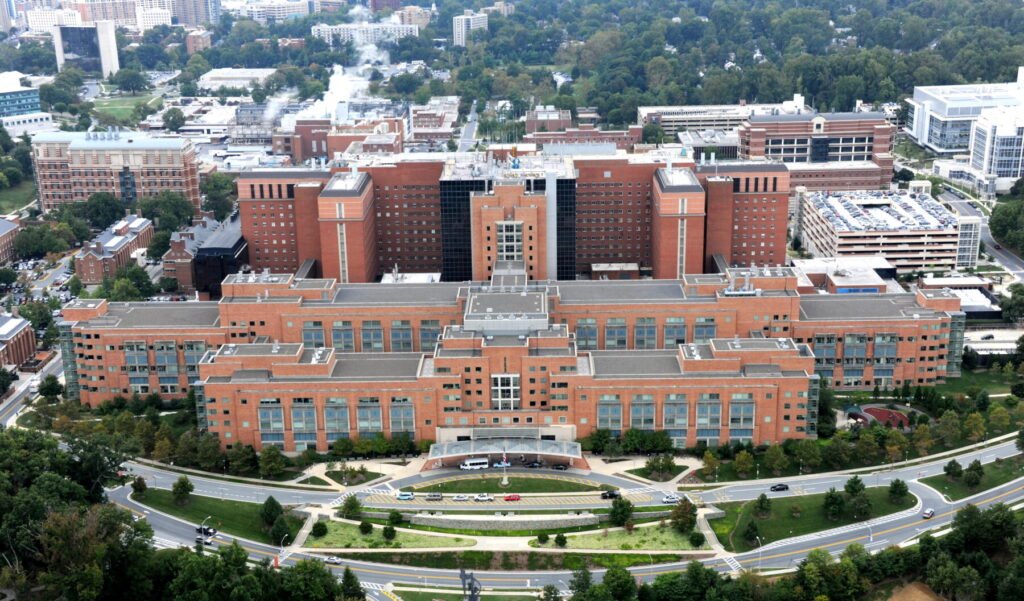
The National Institutes of Health (NIH) is the United States federal agency for medical and behavioral research. Based in Bethesda, Maryland, it is part of the Department of Health and Human Services and today includes 27 institutes and centers that carry out research directly and fund it at universities and hospitals around the country.
History of the National Institutes of Health
NIH began in 1887 as a one-room Laboratory of Hygiene in a Marine Hospital on Staten Island, New York. The Marine Hospital Service, formed in 1798 to provide hospital care for seamen and the founding body of the US Public Health Service, ran the laboratory. The facility was called the Hygienic Laboratory, and it moved to Washington, D.C., in 1891. Early work examined sanitation and diseases such as anthrax, smallpox, tetanus and influenza.
The Ransdell Act of 1930 established the National Institute of Health and began the practice of setting aside public money for medical research, including fellowships for basic research. The National Cancer Institute followed in 1937. Between 1946 and 1949, Congress created additional institutes for mental health, dental disease and heart disease.
The National Heart Act of 1948 turned a single institute into the plural National Institutes of Health, with the cancer institute as one member among several. The Public Health Service Act of 1944 had provided funding for the Warren Grant Magnuson Clinical Center, a hospital devoted to clinical research, which opened in 1953. By 1960 there were ten institutes, and by the mid-2020s there were 27.
Structure and mission of NIH
NIH describes its mission as seeking fundamental knowledge about the nature and behavior of living systems and applying that knowledge to improve health, lengthen life and reduce illness and disability. Its stated goals include fostering creative discoveries, renewing the scientific human and physical resources needed to prevent disease, and upholding scientific integrity, public accountability and social responsibility.
The agency is made up of 27 institutes and centers, each with a specific research agenda that often centers on particular diseases or body systems. They include the National Cancer Institute, the National Eye Institute, the National Heart, Lung, and Blood Institute, the National Human Genome Research Institute and the National Institute on Aging. The NIH Clinical Center is described as America’s research hospital.
An Office of the Director sets policy and plans, manages and coordinates programs across the institutes. NIH also supports medical libraries and the training of medical librarians, as part of directing programs for collecting and sharing information in medicine and health.
What NIH does
NIH carries out research in two ways. Intramural research is done directly by NIH scientists and is coordinated by the Office of Intramural Research. Extramural research is conducted outside NIH, and the Office of Extramural Research guides the research and training that NIH supports.
The extramural share is the larger one. NIH reports that nearly 82 percent of its funding goes to extramural research, largely through almost 50,000 competitive grants. Much of the research NIH pays for is therefore done by scientists at other institutions rather than inside its own laboratories. NIH’s RePORT data site groups extramural awards into research grants, research centers, small business research awards, career development awards, and training grants and fellowships.
Its research areas cover the causes, diagnosis, prevention and cure of human diseases, the processes of human growth and development, the biological effects of environmental contaminants, and the understanding of mental, addictive and physical disorders. NIH websites also point members of the public to clinical trials that NIH funds and explain how people can take part.
Funding and governance of NIH
NIH is an agency of the Department of Health and Human Services, and its money comes mainly from congressional appropriations. NIH publishes a historical table of appropriations by institute that runs from 1938 and, in its latest version reviewed in July 2025, covers the 2024 appropriations acts.
An NIH budget page that draws on fiscal 2022 spending and the Consolidated Appropriations Act of 2023 gives a total of about 47.7 billion dollars. Of that, slightly over 46.1 billion dollars was discretionary budget authority. The rest came from financing derived from Public Health Service evaluation funds, mandatory funding for a special type 1 diabetes account and allocations under the 21st Century Cures Act. The figure leaves out funds for the separate Advanced Research Projects Agency for Health.
NIH describes its budget as invested mostly in medical research for the American people, and it presents the nearly 48 billion dollar total as the amount the agency manages each year in that work.
These numbers reflect that period and change with each year’s appropriation, so anyone needing a current total should check NIH’s latest budget documents. Within NIH, a separate office handles budget management, planning and analysis, and another leads financial management.
Impact and legacy of NIH
Reference sources credit NIH-supported work with more than 80 Nobel Prizes. The same summary points to the mapping of the human genome, which set the stage for genetic testing and gene therapies, and to a larger set of vaccines against infectious diseases than ever before. It also notes substantial falls in death rates from heart disease and stroke over time, though these gains came from many contributors beyond NIH.
Because the institutes grew one at a time as Congress responded to particular diseases, the NIH of today reflects the shifting health priorities of the twentieth century. Cancer, heart disease and mental health each gained their own institute in this way, and the institutes today also include ones for aging and for genome research.
Its role as both a laboratory and a funder makes NIH a central part of the biomedical research system in the United States. This article is a general description of an organization and does not offer medical guidance.
More in Medicine
Key facts
- NIH began in 1887 as a one-room Laboratory of Hygiene in a Marine Hospital on Staten Island, New York.1
- The Ransdell Act of 1930 established the National Institute of Health.3
- NIH comprises 27 Institutes and Centers.4
- NIH is an agency of the Department of Health and Human Services.1
- Nearly 82 percent of NIH funding goes to extramural research, according to NIH.5
- An NIH budget page based on fiscal 2022 spending and the 2023 appropriation gives a total of about 47.7 billion dollars.5
- NIH groups its extramural awards into research grants, research centers, small business research, career development awards and training grants and fellowships.7
This entry explains a medical term. It is not medical advice. If you are concerned about your health, speak with a qualified health professional.
Related concepts
In the news
Quick checkWhat is the difference between intramural and extramural research at NIH?Show answer
Intramural research is done directly by NIH scientists, while extramural research is conducted outside NIH at other institutions with NIH funding and guidance.
Sources
- National Institutes of Health. About the NIH (NIH Almanac). Last reviewed 7 July 2015 (accessed 4 November 2026)
- National Institutes of Health. Mission and Goals. Last reviewed 10 January 2025 (accessed 4 November 2026)
- EBSCO Research Starters. National Institutes of Health (NIH). Undated (accessed 4 November 2026)
- National Institutes of Health. Institutes at NIH. Undated (accessed 4 November 2026)
- National Institutes of Health. Budget. Undated (accessed 4 November 2026)
- National Institutes of Health. Historical Budget Information, Appropriations Section 1. Last reviewed 31 July 2025 (accessed 4 November 2026)
- National Institutes of Health. RePORT, Budget and Spending. Undated (accessed 4 November 2026)
Editorially reviewed by Specialty Digest Editorial TeamLast reviewed November 4, 2026Researched and drafted with AI assistanceReport an issue