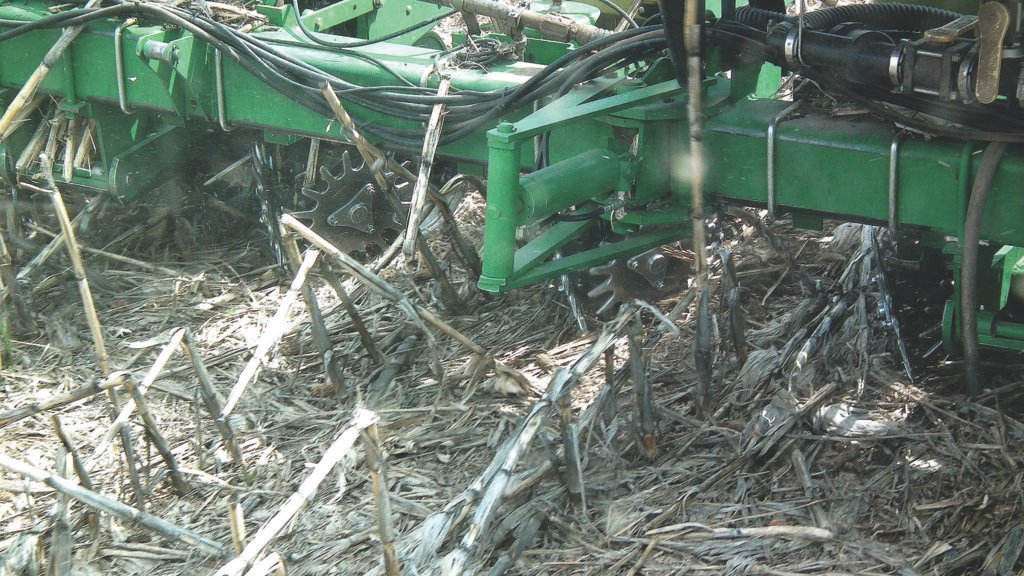
No-till farming is a method of growing crops that skips the traditional step of plowing or tilling the soil before planting. Instead of turning the soil over to bury old crop residue and loosen it for seeding, a no-till farmer plants new seeds directly into the undisturbed ground, often through the dead stalks and stubble left over from the previous harvest.
How It Differs From Conventional Tillage
Conventional tillage breaks up and inverts the top layer of soil using a plow or disc harrow, which kills weeds, aerates compacted ground, and creates a smooth, loose seedbed. No-till farming instead uses specialized seed drills that can cut a narrow slot directly through plant residue and compacted soil, dropping seed in without disturbing the surrounding ground. Weed control, which plowing would otherwise handle by burying weed seeds and seedlings, is typically managed instead through herbicides, cover crops that crowd out weeds, or crop rotation.
Effects on Soil
Leaving soil undisturbed year after year lets it build structure that plowing would otherwise destroy: earthworms and other soil organisms create channels that improve drainage, organic matter accumulates near the surface instead of being buried and oxidized, and a network of fungal threads called mycorrhizae, which helps plants take up nutrients, stays intact rather than being severed. Because the soil surface stays covered by crop residue rather than being left bare after plowing, no-till fields also lose far less topsoil to wind and water erosion, and they hold moisture better during dry spells since residue shades the surface and slows evaporation.
Trade-Offs and Adoption
No-till is not free of downsides. Because weeds are no longer controlled by burying them, no-till systems have historically depended more heavily on herbicides, which has raised concerns about herbicide-resistant weeds developing over time, a concern that has pushed many no-till farmers toward adding cover crops and more diverse rotations to suppress weeds without relying on chemicals alone. No-till fields can also stay cooler and wetter in spring because residue blocks sunlight from warming the soil, which can delay planting in cooler climates. Despite these trade-offs, no-till and reduced-till practices have spread rapidly since the 1990s, especially across the row-crop regions of the United States, Brazil, and Argentina, driven largely by fuel and labor savings from skipping the plowing pass and by the soil-conservation benefits.
Climate and Policy Relevance
Because undisturbed soil holds more organic carbon than repeatedly tilled soil, no-till farming is widely promoted as a climate-friendly practice, and many governments now offer payments or carbon-credit programs to farmers who adopt or maintain it. Researchers note, however, that the carbon benefit is sometimes smaller or more fragile than early estimates suggested, since switching back to tillage even once can release much of the carbon that had accumulated near the surface, and the depth at which soil samples are taken can change how big the measured benefit appears.
FAQs
Does no-till farming use more herbicide than conventional farming? Often yes, at least initially, since herbicides typically replace the weed control that plowing used to provide, though many no-till farmers reduce herbicide use over time by adding cover crops and diverse rotations.
Can any crop be grown with no-till methods? Most major row crops, including corn, soybeans, and wheat, can be grown no-till, but some root and tuber crops, such as potatoes, are much harder to harvest without disturbing the soil and are rarely grown this way.
Global Spread and Regional Patterns
Brazil and Argentina adopted no-till farming especially aggressively from the 1990s onward, aided by the development of herbicide-tolerant soybean varieties that let farmers manage weeds chemically without needing to till, and today a large majority of South America’s soybean acreage is farmed no-till. Adoption has been slower in parts of Europe, Africa, and Asia, where smaller farm sizes, the cost of specialized no-till seed drills, and in some regions a reliance on crop residue as livestock feed or cooking fuel rather than ground cover have all limited how widely the practice has spread.
Agricultural economists note that no-till adoption has also been shaped heavily by government policy: direct payments, reduced-tillage requirements tied to crop-insurance eligibility, and, more recently, carbon-market payments that reward farmers for keeping soil carbon in the ground have all pushed adoption rates higher in the countries and regions that have offered them, suggesting that the practice’s spread depends as much on economic incentives as on the underlying agronomic benefits.
Measuring the Soil Benefit
Long-term field trials comparing tilled and no-till plots on the same farm over ten or more years generally show no-till soil holding more organic carbon and water in its top several inches, along with higher earthworm counts and better infiltration during heavy rain. The size of the benefit varies a great deal by soil type and climate, however, and some trials in already well-drained, sandy soils have found only a modest difference, while trials on heavier clay soils prone to compaction and erosion have found much larger gains, which is part of why agronomists recommend no-till as a strong general practice rather than a universal fix that performs identically everywhere.
Some researchers have also begun combining no-till with cover cropping and diverse rotations into a broader bundle sometimes called regenerative agriculture, arguing that no-till alone captures only part of the soil-health benefit available when several conservation practices are layered together on the same field.
Equipment cost is another real barrier, since a no-till seed drill able to cut through thick residue can cost considerably more than a conventional planter, which slows adoption among smaller farms with tighter capital budgets.
More in Agriculture & Food
Related concepts
Editorially reviewed by Specialty Digest Editorial TeamLast reviewed November 4, 2026Researched and drafted with AI assistanceReport an issue