Television is a system that transmits moving images and sound to distant screens by electrical or radio signals. Its development took about sixty years, moved from spinning-disc mechanical systems to all-electronic ones, and involved many inventors in several countries. Credit for the invention is shared and has even been contested in court.
History of television
The first designs were mechanical. In 1884 the German inventor Paul Nipkow received what the Engineering and Technology History Wiki (ETHW) calls the first patent for a television-like machine. It used a large spinning disc with holes in it to break a picture into pieces and reassemble the pieces on a receiver.
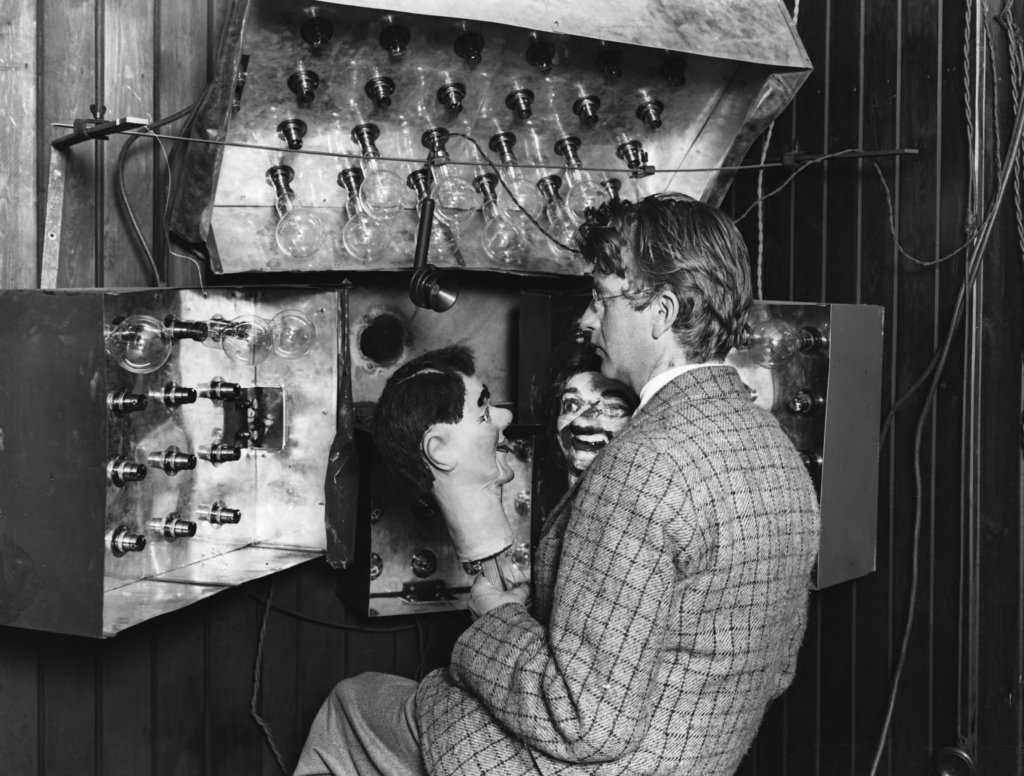
John Logie Baird, a Scottish engineer, built a better mechanical system from Nipkow discs. According to ETHW, he transmitted the outline of objects in 1924 and recognizable faces in 1925. On 26 January 1926 he showed live moving images to members of the Royal Institution at 22 Frith Street in London, which the Institute of Electrical and Electronics Engineers (IEEE) recognizes as the first public demonstration of television.
The BBC adopted Baird’s system for its first television broadcast service in 1930. By the mid-1930s, however, engineers including Baird understood that mechanical television could not compete with the electronic systems that were emerging.
An important feature of the Baird system was that it sent its signal by wireless, which made mass distribution of televised images seem possible for the first time. ETHW also credits Baird with the first video recording system, and in 1926 he built the noctovisor, a device that used infrared light to make objects visible in the dark or through fog.
Electronic television replaces moving parts with a camera tube and a picture tube. The Russian-born engineer Vladimir Zworykin created the iconoscope, an all-electronic camera tube, in 1924, and the kinescope, a picture tube, in 1929. He joined the Radio Corporation of America (RCA) in 1929, where company head David Sarnoff supported his work, and RCA introduced its electronic system to the public at the 1939 New York World’s Fair.
World War II slowed development. By the early 1950s, however, programs such as sports, game shows and dramas had taken hold of public attention and changed how people received information.
Inventor and origins of television
No one person invented television. Nipkow supplied the scanning idea, Baird showed that moving images could be transmitted live, and Zworykin and Philo Farnsworth worked on the electronic cameras and displays that replaced mechanical scanning.
Farnsworth’s patent claims directly challenged the work of Zworykin and RCA. ETHW reports that Farnsworth won a major patent suit against RCA in 1939, so Zworykin’s designs were not considered the first electronic television. Zworykin himself said that television was the creation of hundreds of inventors and researchers.
Because the work overlapped, the answer to who made the first television depends on the definition used. Baird gave the first public demonstration of live mechanical television, while the all-electronic approach that became the standard came from Zworykin, Farnsworth and others.
How television works
Electronic television builds moving pictures from a fast stream of still pictures, each one slightly different from the one before. A television camera breaks each picture into tiny pieces, and a transmitter sends those pieces as a signal. The sound is carried along with the picture as part of the same broadcast.
A receiver picks up the signal and uses it to control an electron gun inside a picture tube. The gun shoots electrons at a screen coated with phosphors, which glow where the electrons strike. It sweeps across the screen row after row, and this happens so fast that the eye sees one continuous picture.
Later displays replaced the picture tube with flat panels, and modern screens and the chips that decode digital signals rely on semiconductor devices. The basic principle remained the same, which is to build an image from lines or dots and refresh it many times each second.
Over-the-air television uses the radio spectrum, as radio does. The International Telecommunication Union lists broadcasting among the services whose use of radio frequencies it coordinates internationally.
Types of television
Early mechanical television used spinning discs and produced small, coarse images. Electronic television replaced it with tubes in the 1930s and made larger, sharper pictures possible.
Color television was developed in the 1950s, although it did not become common in the United States until the late 1960s. The basic design of the system stayed much the same until the late 1990s.
High-definition television, or HDTV, was introduced in that decade. ETHW notes that HDTV broadcasts were technically possible in the 1980s, that several companies agreed on technical standards in 1993, and that the first experimental broadcast followed in 1994. By then, all-digital television delivered over the internet was already being discussed as another form.
Digital broadcasting later replaced analog signals, sending picture and sound as data that can be compressed and checked for errors, which allowed sharper pictures and more channels in the same slice of spectrum.
Impact of television
Television reached the public in stages. RCA’s network, the National Broadcasting Company, held its first broadcast at the 1939 World’s Fair, and the public was intrigued. After the war, television programming borrowed heavily from radio, which in the 1940s had already offered news, sports, dramas, comedy shows and commercials.
By the early 1950s television was a leading way for people to learn about events. It changed habits at home, because families that once gathered around a radio in the evening now gathered around a screen.
Uses of television today
Television is still a major medium for news, sports, entertainment and education. Programs now reach viewers by over-the-air broadcast, cable, satellite and the internet, and the digital formats that engineers began to discuss in the 1990s are now ordinary.
More in Networks & Telecommunications
Key facts
- Paul Nipkow received the first patent for a television-like machine in 1884, using a spinning scanning disc.1
- John Logie Baird gave the first public demonstration of live television on 26 January 1926 in London.2
- The BBC adopted Baird's system for its first television broadcast service in 1930.2
- Vladimir Zworykin created the iconoscope camera tube in 1924 and the kinescope picture tube in 1929.3
- Philo Farnsworth won a major patent suit against RCA in 1939, and Zworykin said television was the creation of hundreds of inventors.3
Related concepts
In the news
Quick checkWho invented television?Show answer
No single person did. Paul Nipkow patented a scanning disc in 1884, John Logie Baird demonstrated live mechanical television in 1926, and Vladimir Zworykin and Philo Farnsworth developed the electronic systems that replaced it.
Sources
- Engineering and Technology History Wiki, Television, https://ethw.org/Television
- Engineering and Technology History Wiki, Milestones: First Public Demonstration of Television, 1926, https://ethw.org/Milestones:First_Public_Demonstration_of_Television,_1926
- Engineering and Technology History Wiki, Vladimir Zworykin, https://ethw.org/Vladimir_Zworykin
- Engineering and Technology History Wiki, John Logie Baird, https://ethw.org/John_Logie_Baird
Editorially reviewed by Specialty Digest Editorial TeamLast reviewed November 4, 2026Researched and drafted with AI assistanceReport an issue