Eyeglasses, also called spectacles, are lenses mounted in a frame and worn in front of the eyes to improve sight. The first spectacles with convex lenses were most likely made in Pisa, Italy, around 1286, and the name of their maker has not survived.
History of eyeglasses
Historians have found no firm evidence that people in the ancient world wore lenses to correct vision. There are reports of Chinese tinted eyeglasses about 2,000 years ago, but these were supposedly meant to shield the eyes from bright light rather than to bend it. The playwright Aristophanes mentioned burning glasses, used to start fires, as early as 424 BC, and in the first century BC the Greeks used a water-filled glass ball as a magnifier. The authors of a 2026 history in The Ophthalmologist, a magazine for eye specialists, judge that ancient lenses were probably too poor in optical quality to give a useful image.
By the 11th century, glass “reading stones” were laid directly on a page as magnifiers. The Italian art magazine Finestre sull’Arte adds that the optical studies of the Arab scientist known in Europe as Alhazen, around the year 1000, made later lens making possible.
The first spectacles with convex lenses date to about 1286 in Pisa. They had two lenses held in rings of wood or horn and fixed together with a rivet, and the wearer held them up or balanced them on the bridge of the nose. The lenses were often cut from clear quartz or from beryl glass. They helped with presbyopia, the loss of near focus that comes with age, which troubled readers and scribes such as monks.
The date comes from a sermon preached in Florence in 1305 or 1306. The Ophthalmologist attributes it to Friar Giordano da Rivalto in 1305, while Finestre sull’Arte names the Dominican friar Guglielmo da Pisa and the year 1306, so the sources differ on the preacher and the year. All agree on the content: the friar said it was not yet twenty years since the art of making eyeglasses had been found, and that it was among the best and most needed arts in the world. The sermon is also the earliest known use of the Italian word occhiali.
Venice may also have produced early lenses. A Venetian guild rule of 1300 banned the sale of fake glass objects passed off as quartz, and it named “disks for eyes” among them. Because the documents do not settle the dates, it is uncertain whether Venice or Pisa came first, and both cities had flourishing glass industries.
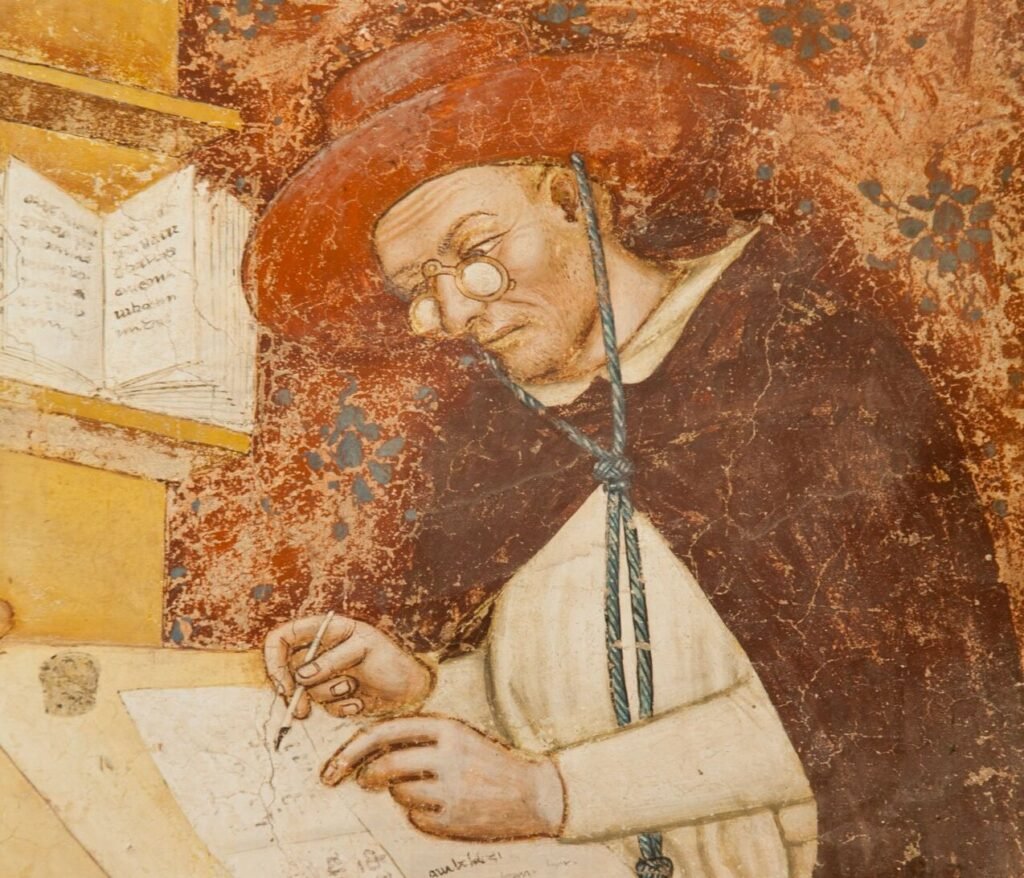
Spectacles soon appeared in art. The oldest known illustration of them is a fresco of Cardinal Hugh of Saint-Cher painted by Tommaso da Modena in 1352. The cardinal died in 1263, before spectacles existed, so the picture is anachronistic. The first documentation of spectacles in the New World appears to be two portraits of Luis de Velasco the younger, viceroy of New Spain, about 1590. Modern spectacles, with two lenses joined by a bridge that rests on the nose and temple pieces that rest over the ears, most likely developed in England during the 18th and 19th centuries.
Inventor and origins of eyeglasses
The inventor is unknown. The Ophthalmologist states that the name of the Pisan inventor has not been recorded. A chronicle of the Dominican monastery of Santa Caterina in Pisa describes Friar Alessandro della Spina, who died in 1313. It says that when another person had invented eyeglasses and refused to share the secret, Alessandro worked out how to make them and gave them freely to everyone. That makes him a spreader of the invention, not its inventor.
A second candidate, Salvino d’Armato of Florence, rests on an epitaph dated 1317 in the church of Santa Maria Maggiore, which calls him the inventor of spectacles. Modern historians reject this claim. The church has been renovated many times, and the epitaph now in place dates from 1841. It uses the word “inventor,” which was not used in 14th-century Italian.
How eyeglasses work
A convex lens is thicker in the middle than at the edge, and it bends light rays toward one another. For a reader with presbyopia, the extra focusing power brings small print into focus. Early makers needed clear material for this, which is why the cities that made glass and cut quartz and beryl were the first centers of lens making. Glass itself is described in the entry on glass.
The frame matters as much as the lens. The riveted pair of rings kept two lenses side by side, but a user still had to hold them or pinch them on the nose. The bridge and temple pieces of later centuries let the lenses sit in front of the eyes without the hands. This entry is background information, not advice on choosing or using lenses, which is a matter for eye care professionals.
Types and variants of eyeglasses
The earliest relatives of the spectacle were not worn at all. Reading stones were glass segments placed on the text, and burning glasses were lenses used to focus sunlight. The first true spectacles were rivet spectacles with two convex lenses, often hand-held. These were followed by frames that rested on the nose, and eventually by the modern pattern of a bridge and two temple pieces.
Tinted eyewear is a separate line. The reports of Chinese tinted eyeglasses, if accurate, describe protection from glare and not correction of vision. Related optical devices are covered in the entries on contact lenses, the telescope and the microscope.
Impact of eyeglasses
The friar who preached about spectacles in about 1305 thought them one of the best and most necessary arts in the world. People whose work depended on fine detail or on reading and writing had to stop when their near vision declined, and spectacles gave them back that ability. Finestre sull’Arte notes that monks were among those most affected and that the idea of a remedy first took hold in this circle of readers.
Eyeglasses also entered art history. Painters depicted figures wearing them from the 14th century onward, and Finestre sull’Arte traces the motif from Tommaso da Modena to Caravaggio and El Greco. The glass trades of Pisa and Venice also gained a new product.
Uses today
Eyeglasses are worn every day around the world to correct vision, to protect the eyes and as fashion items. Lens choice, prescriptions and fitting belong to optometrists and ophthalmologists. Venice remains linked to glassmaking, as the entry on Venice explains, but the historical record of eyeglasses begins with the sermons, chronicles and portraits of medieval Italy.
More in Medicine
Key facts
- The first spectacles with convex lenses were most likely made in Pisa around 1286.1
- A sermon preached in Florence in 1305 or 1306 says eyeglasses had been found less than twenty years earlier.12
- The name of the inventor is unknown, and the claim for Salvino d'Armato rests on an epitaph that dates from 1841.1
- The oldest known illustration of spectacles is a 1352 fresco of Cardinal Hugh of Saint-Cher by Tommaso da Modena.12
- Modern spectacles with a nose bridge and temple pieces most likely developed in England in the 18th and 19th centuries.1
This entry explains a medical term. It is not medical advice. If you are concerned about your health, speak with a qualified health professional.
Related concepts
In the news
Quick checkWho invented eyeglasses?Show answer
The inventor is unknown. Spectacles were most likely first made in Pisa around 1286, and the friar Alessandro della Spina is recorded as sharing the secret.
Sources
- Schwartz SG, Letocha CE, Leffler CT, Grzybowski A, The Ophthalmologist's Time Machine: Chapter 36, The Spectacular Invention of Spectacles, The Ophthalmologist (January 28, 2026), https://theophthalmologist.com/issues/2026/articles/january/the-ophthalmologists-time-machine-chapter-36/
- Gigli FA, Gli occhiali nella storia dell'arte, dalle origini al Seicento, Finestre sull'Arte (July 30, 2022), https://www.finestresullarte.info/opere-e-artisti/gli-occhiali-nella-storia-dell-arte
Editorially reviewed by Specialty Digest Editorial TeamLast reviewed November 4, 2026Researched and drafted with AI assistanceReport an issue