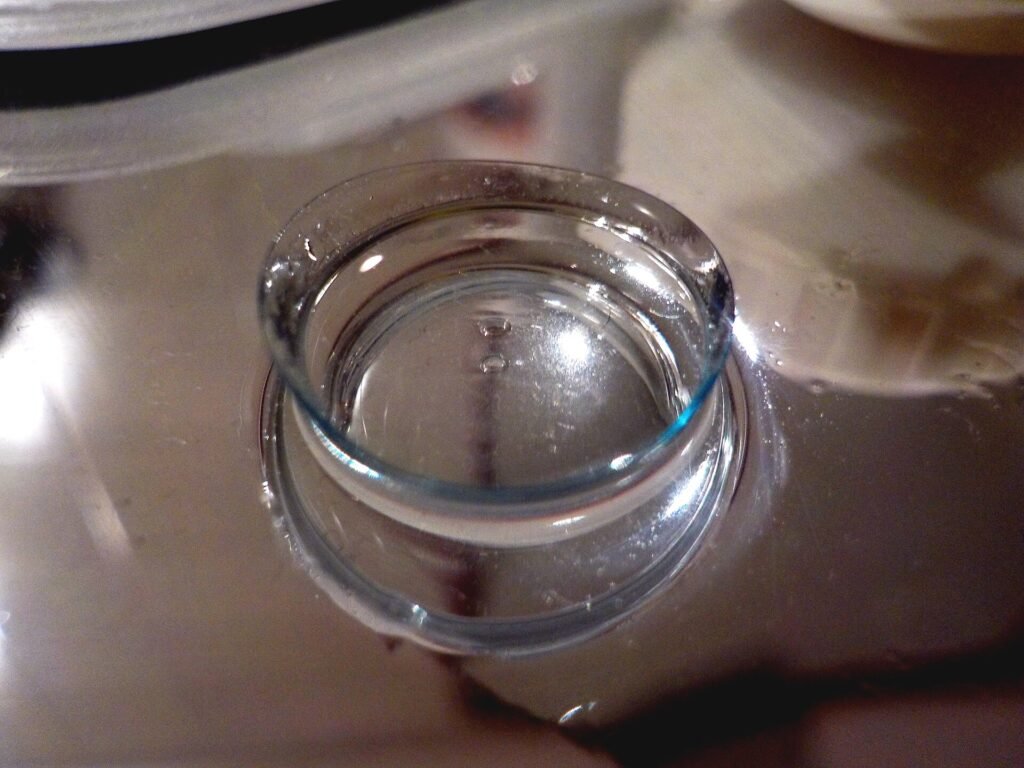
A contact lens is a thin lens worn on the eye to correct vision, and the Czech chemist Otto Wichterle is credited with the soft hydrogel lens that most wearers use today. The U.S. Food and Drug Administration (FDA) groups lenses into two general categories, soft and rigid gas permeable. The history involves several earlier inventors who built hard lenses.
History of the contact lens
The first principles of the contact lens appear in the optics drawings of Leonardo da Vinci from 1506. Practical lenses came much later. In 1936 William Feinbloom experimented with lenses made of polymethyl methacrylate (PMMA), a hard plastic, but his scleral design, which rests on the white of the eye, blocked oxygen to the eye.
About 1946, the California optician Kevin Tuohy accidentally cut a scleral lens too far and produced the first corneal lens. Edward S. Bennett later noted that corneal lenses were easier to make and wear and allowed some oxygen from tears to reach the eye.
The soft lens came from Czechoslovakia. In 1952 Wichterle and Drahoslav Lim synthesized pHEMA, a hydrophilic plastic. About five years later they molded the first soft lenses, and in 1960 the two chemists published their work in the journal Nature.
In early 1961 Wichterle conceived spin-casting, a way to form lenses in a rotating mold, after noticing how liquid climbs the edge of a cup while he stirred cream into coffee. On Christmas Eve 1961 he built a spin-casting machine from a children’s Merkur construction set and a bicycle light generator. On Christmas Day he and his family made the first four spun-cast lenses at their kitchen table, and on December 26 Dr. Maximilian Dreifus at a Prague clinic evaluated them and found them comfortable.
Inventor and origins of the contact lens
No single person invented the contact lens. Leonardo’s drawing offered the idea, Feinbloom and Tuohy made hard lenses, and Wichterle and Lim produced the soft hydrogel material. Wichterle’s patents were later acquired by Bausch + Lomb, which refined the technology and introduced the first hydrogel contact lens in 1971.
The dates of the soft lens vary by account. One source says the first soft lenses were molded around 1957, while another describes Wichterle’s home-built device in 1961 as the point when he produced about 5,200 lenses. The FDA approval of the Bausch + Lomb lens came on March 17, 1971, and the company held exclusivity in the U.S. market until 1974.
How a contact lens works
The National Eye Institute explains that refractive errors happen when the shape of the eye keeps light from focusing correctly on the retina. The cornea and lens of the eye bend light rays, and when their shape changes, vision blurs. Conventional contact lenses correct vision in the same way glasses do, but they sit in contact with the eye. Common refractive errors include nearsightedness, farsightedness, astigmatism and presbyopia. They can be caused by the length of the eyeball, the shape of the cornea or aging of the lens. Nearsightedness usually starts in childhood, while presbyopia is common in adults aged 45 and older.
Types of contact lenses
Soft lenses are made of soft, flexible plastics that allow oxygen to pass through to the cornea, and newer soft materials include silicone hydrogels that provide more oxygen. Rigid gas permeable lenses are more durable and resistant to deposit buildup and generally give clearer, crisper vision, although they are not as comfortable at first, and it may take a few weeks to get used to them compared with several days for soft lenses.
Extended wear lenses are made for overnight or continuous wear ranging from one to six nights or up to 30 days, and they are usually soft lenses. By the FDA definition, a disposable lens is used once and discarded, but many lenses sold as disposable are really for frequent or planned replacement. The majority of soft lens wearers are prescribed some type of frequent replacement schedule.
Rigid gas permeable lenses also tend to cost less over their life because they last longer than soft lenses, and they are easier to handle and less likely to tear. Orthokeratology uses specially designed rigid gas permeable lenses to change the curvature of the cornea temporarily, mainly to correct nearsightedness. Overnight Ortho-K lenses are commonly prescribed for at least eight hours of wear while sleeping, and the effect is temporary: if the treatment stops, the corneas return to their original curvature. The FDA requires eye care professionals to be trained and certified before using overnight Ortho-K lenses in their practice. Decorative lenses without a vision correction are a separate group. All contact lenses require a valid prescription in the United States.
Impact of the contact lens
A Bausch + Lomb official called the change brought by the 1971 hydrogel lens a transformation. In 1980 Wichterle suggested that lenses could be replaced instead of cleaned if they became cheap enough, and daily disposables later replaced lenses worn for multiple days. The soft lens differed from earlier hard PMMA lenses, which in scleral form blocked oxygen to the eye and in corneal form allowed only some oxygen from tears. Wichterle’s lens was made from a hydrophilic polymer, the pHEMA plastic that he and Lim had synthesized.
Uses of contact lenses today
More than 150 million Americans have a refractive error, according to the National Eye Institute, and eyeglasses and contact lenses are two standard ways to correct it. The choice of lens type is made with an eye care professional, who also decides on wearing schedules. This article is general background and not advice for any person’s eyes.
Key facts
- Leonardo da Vinci's 1506 optics drawings contain the first principles of the contact lens.2
- Otto Wichterle and Drahoslav Lim synthesized pHEMA in 1952.1
- Wichterle made the first spin-cast soft lenses at home on Christmas Day 1961.1
- Bausch + Lomb received FDA approval for its soft lenses on March 17, 1971.2
- The FDA groups lenses into two general categories, soft and rigid gas permeable.4
This entry explains a medical term. It is not medical advice. If you are concerned about your health, speak with a qualified health professional.
Related concepts
Quick checkWho invented the soft contact lens?Show answer
The Czech chemist Otto Wichterle, working with Drahoslav Lim, developed the hydrogel soft lens, and Bausch + Lomb introduced the first soft contact lens in the United States in 1971. Hard lenses by Feinbloom and Tuohy came earlier.
Sources
- Contact Lens Spectrum, History of Contact Lenses (June 2021), https://www.clspectrum.com/issues/2021/june/history-of-contact-lenses/
- Hindsight (Indiana University), contact lens history article, https://scholarworks.iu.edu/journals/index.php/hindsight/article/download/33210/36947/84153
- Optometry Times, B + L marks 40th anniversary of soft contact lenses, https://optometrytimes.com/view/b-l-marks-40th-anniversary-soft-contact-lenses
- U.S. Food and Drug Administration, Types of Contact Lenses, https://www.fda.gov/medical-devices/contact-lenses/types-contact-lenses
- National Eye Institute, Refractive Errors, https://www.nei.nih.gov/learn-about-eye-health/eye-conditions-and-diseases/refractive-errors
Editorially reviewed by Specialty Digest Editorial TeamLast reviewed November 4, 2026Researched and drafted with AI assistanceReport an issue