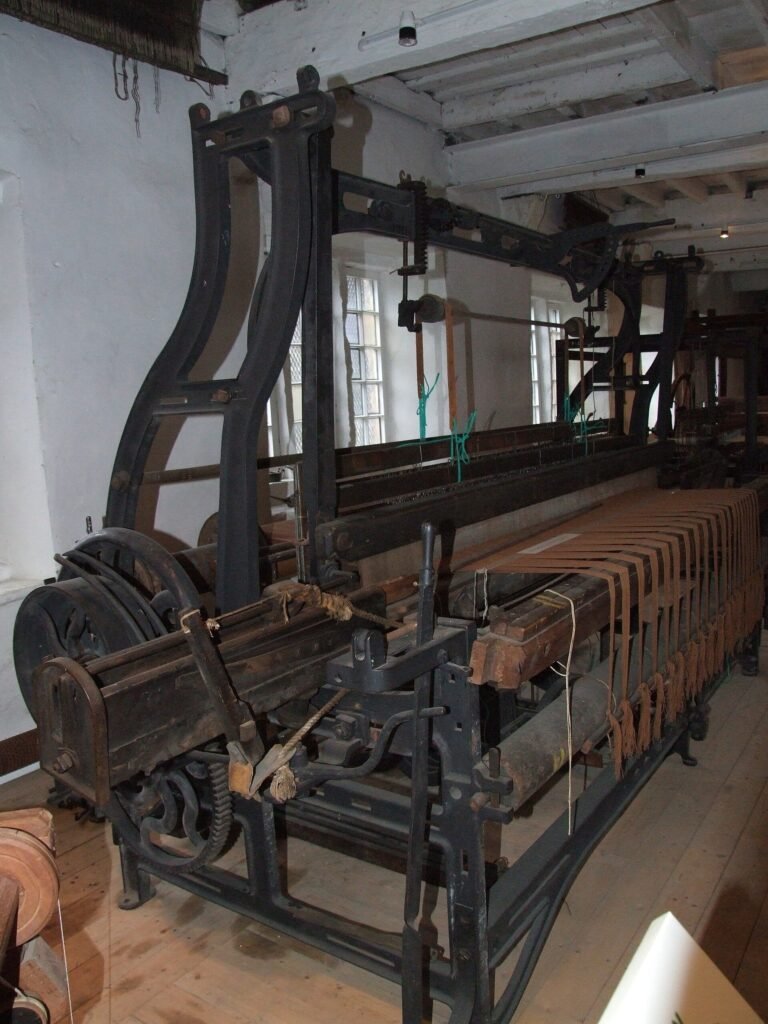
A power loom is a weaving machine driven by mechanical power, such as water or steam, instead of by the weaver’s muscles. The English clergyman Edmund Cartwright patented the first one in 1785, and later looms made large-scale cloth production possible.
History of the power loom
People have woven cloth for thousands of years. A loom makes fabric by interlacing lengthwise threads, called the warp, with a crosswise thread, called the weft, which a shuttle carries back and forth. For most of history, weavers worked hand looms at home. John Kay’s flying shuttle, patented in 1733, sped up the job, and Richard Arkwright’s spinning frame later made cotton thread cheaper than ever.
In early 1785 Cartwright, who had no connection with textiles, was dining with friends near the Lancashire cotton district. They worried that cheap thread would be exported to the Continent, where wages were lower, and that English weavers would suffer. Mill owners proposed asking Parliament to ban the export of cotton thread. Cartwright suggested mechanizing weaving instead, and the mill owners doubted that so skilled a task could be done by a machine.
He went home to his parsonage in Leicestershire and, working with a local blacksmith, built a loom that ran on power. He patented it in April 1785. The first model was clumsy. It was worked by a hand crank and needed the strength of two men to operate, so it saved little labor.
Improvement came slowly. Power looms did not come into general use in England until after 1822, and a practical machine appeared around that year. Cartwright’s original model still paved the way for later refinements, and its basic design remained largely unchanged until the middle of the twentieth century.
Who invented the power loom?
Cartwright is usually named as the inventor, and his 1785 patent is the earliest in this story. The credit comes with an important qualification. His loom did not work well enough for factories, and the sources describe a practical power loom only decades later. EBSCO’s account lists the mill owner and inventor William Radcliffe among the key figures in that later work.
The United States has its own claim. Francis Cabot Lowell built the first successful American power loom at Waltham, Massachusetts, in 1814. He copied successful English power looms and added improvements of his own, as well as other related devices. Credit for the power loom is therefore spread across inventors and countries, not held by one person.
How a power loom works
A power loom repeats the same cycle that a hand weaver performs. The warp threads are separated, the shuttle passes the weft through the gap, and the weft is pressed tight against the cloth already woven. A hand loom relies on the weaver’s arms and legs for each step. A power loom drives the steps from a shaft turned by an outside power source, so the cycle repeats quickly and steadily.
Lowell first used water power for his machines, and he built his factory on the Charles River at Waltham. His improvements changed the organization of the technical processes by which cloth was made, according to Gale’s reference history, and they made mass production of finished textile products possible for the first time.
Types of power looms
Early power looms differed mainly in how they were driven. Cartwright’s first loom was turned by hand cranks. Lowell’s looms used the power of a river, and later looms ran on steam. The change in power source mattered because it freed weaving from the limits of human strength and let one mill run many looms together.
Power loom vs. hand loom
A hand loom is a hand-powered machine that interweaves yarns into fabric. In the Middle Ages and for long afterward, people wove on hand looms at home. As Gale notes, factories had begun to replace this domestic, or cottage, system by the early eighteenth century and became the standard way to make cloth in industrial countries.
The power loom accelerated that shift. A hand weaver could be highly skilled but was limited by speed and stamina, while a power loom drew on an outside source of power. Because the power loom made cloth faster and more cheaply, skilled hand-loom weavers lost income and security, and the contrast between the two methods drove much of the labor conflict of the period.
Impact of the power loom
The power loom moved weaving from homes into factories and raised output sharply. It increased the production rate of cotton cloth and strengthened Britain’s lead in making it. It also displaced skilled hand-loom weavers, whose wages and job security fell, and it contributed to labor unrest. EBSCO treats the loom as an example of technical progress that arrived with social upheaval.
At Waltham, Lowell and his brother-in-law Patrick Tracy Jackson incorporated their business in 1814 with one brick building six stories tall, then added a second mill in 1818 and a third in 1820. Gale describes it as the first mill where the entire process of turning raw cotton into cloth was gathered under one roof. The earlier spinning jenny had increased the supply of yarn, and the power loom completed the mechanization of cloth, helping to define the Industrial Revolution.
Working conditions in the early factories could be harsh. Gale notes that children, some as young as nine, were often used for tasks that suited their small size, and that hours were long and conditions poor.
Legacy of the power loom
The power loom is part of a wider story in which cotton towns such as Manchester became the center of factory production. Its design lasted well over a century, and it remains a standard case in the study of how technology reshapes work.
More in Mechanical Engineering
Key facts
- Array
Related concepts
Quick checkWho invented the power loom?Show answer
Edmund Cartwright patented the first power loom in 1785, but it was impractical, and later engineers and mill owners made it work, including Francis Cabot Lowell in the United States in 1814.
Sources
- Array
Editorially reviewed by Specialty Digest Editorial TeamLast reviewed November 4, 2026Researched and drafted with AI assistanceReport an issue