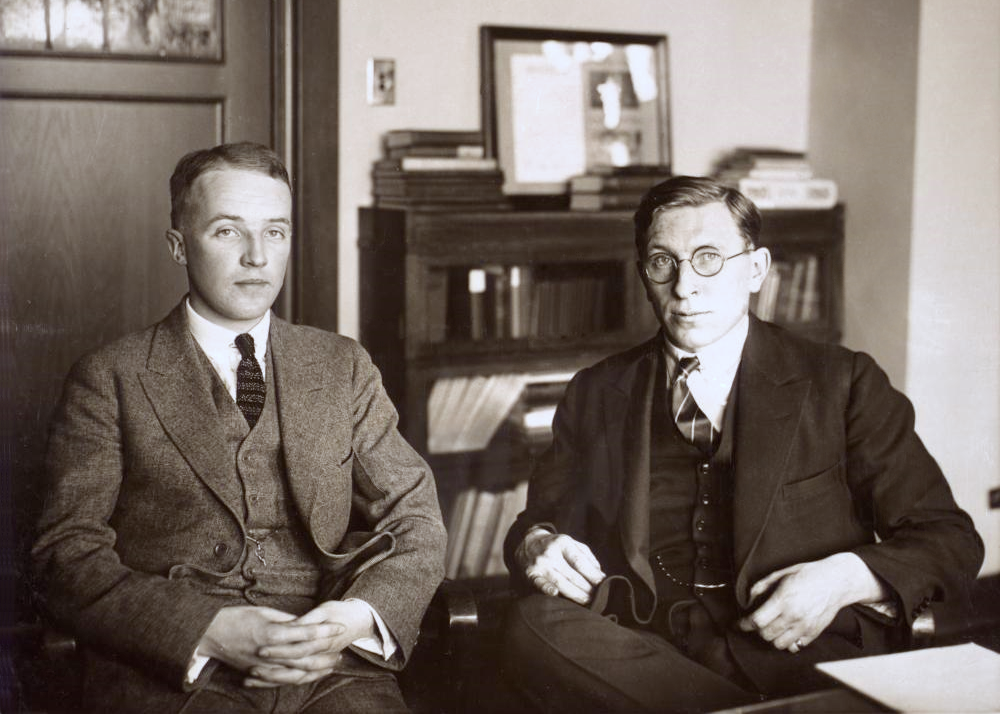
The discovery of insulin was the work done at the University of Toronto in 1921 and 1922 by Frederick Banting, Charles Best, John Macleod and James Collip. It produced a pancreatic extract that lowered blood sugar first in diabetic dogs and then in a human patient. The result turned type 1 diabetes from a fatal disease into a treatable one and earned the 1923 Nobel Prize in Physiology or Medicine.
Background
Diabetes was recognized in antiquity. In the first century, the writers Celsus and Aretaeus described an illness marked by heavy urine, unquenchable thirst and loss of flesh. In the 17th century the English physician Thomas Willis noted that the urine contained a sugar-like substance.
The link to the pancreas came in the 19th century. In 1889 two German investigators, von Mering and Minkowski, removed the pancreas from dogs. The animals developed a lasting disease that closely resembled severe human diabetes. When a piece of the gland was left in place or sewn under the skin, diabetes did not develop, which showed that the pancreas supplied something beyond its digestive juice.
That something was a hormone, a chemical messenger carried in the blood. Historians credit the Belgian Jean de Meyer around 1909 and 1910, and the physiologist Edward Sharpey-Schafer in 1916, with proposing the name insulin. Nobody, however, had yet extracted it in usable form.
Early attempts failed because crude pancreatic extracts were weak and often toxic. Researchers also believed that digestive enzymes such as trypsin, made in the same organ, destroyed the hormone during extraction. In 1908 Zuelzer reported favorable results with an alcoholic extract in a few patients, but the results were not dependable and the work was abandoned.
The discovery
Banting, a Canadian surgeon, became interested in the problem in 1920. On 30 October of that year he read an article by Moses Baron describing how blocking the pancreatic duct made the enzyme-producing cells degenerate. Banting reasoned that once those cells had wasted away, an extract of the remaining islet cells might be free of the destroying enzymes.
He took the idea to Macleod, professor of physiology at the University of Toronto, who provided laboratory space. Best, then a medical student, was assigned as his assistant, and the experiments began on 14 April 1921.
The team tied the pancreatic ducts of several dogs and waited seven weeks. The glands had shrunk and hardened, with no healthy enzyme-producing cells left. The researchers ground the tissue, extracted it with saline and injected it into dogs whose own pancreas had been removed. Blood sugar fell to normal or below, the urine lost its sugar, and the animals grew stronger and lived longer.
The first human injection came on 11 January 1922 at Toronto General Hospital. The patient, Leonard Thompson, was 14 years old. The crude extract barely changed his blood sugar and caused a sterile abscess.
Collip, a biochemist, then developed a better purification method using alcohol extracts of ox and pig pancreas. When injections resumed on 23 January, Thompson’s blood glucose fell from 520 to 120 milligrams per deciliter, and the ketones in his urine disappeared.
How it was confirmed
By February 1922 Macleod had set aside his other research and turned his whole laboratory staff to the study of the extract. Collip refined it by fractional precipitation with 70 to 95 percent alcohol, but his method could not be scaled up. Best took charge of large-scale production at the Connaught Laboratories in Toronto and helped establish the principles of insulin manufacture and purification.
More patients were treated, and early batches varied in strength. In his Nobel lecture, Banting described one patient who needed about 120 units a day in the first months and only about 20 units years later, as the quality of the product improved.
In 1923 the Toronto Insulin Committee licensed manufacture. Production began that year in Germany, Denmark and Austria, and in 1924 in Hungary, Australia and Argentina.
Disputes over credit
The 1923 Nobel Prize in Physiology or Medicine went to Banting and Macleod “for the discovery of insulin.” The decision was debated because Best and Collip were left out. Banting then shared his prize money with Best, and Macleod shared his with Collip.
Another claimant was the Romanian physiologist Nicolae Paulescu. After pancreatectomy experiments in dogs, he published results in 1921 in the Archives Internationales de Physiologie, reporting that an injected extract of pancreatic tissue improved experimental diabetes. Reviews of the history list him among the scientists excluded from the prize.
Others, including Zuelzer, had also seen glucose-lowering effects from pancreatic extracts years earlier. Accounts differ on how to weigh these contributions. It was the Toronto group, however, that carried the work through to a purified product tested in patients and produced in volume.
Impact and legacy
Insulin is a hormone made by the pancreas that helps glucose move from the blood into cells. In type 1 diabetes the immune system destroys the insulin-making cells, and people with the condition need insulin every day to stay alive, according to the US National Institute of Diabetes and Digestive and Kidney Diseases. In type 2 diabetes, the most common form, cells do not use insulin properly, a problem known as insulin resistance.
The World Health Organization reports that the number of people living with diabetes rose from 200 million in 1990 to 830 million in 2022.
The chemistry of insulin was worked out within decades. In 1955 Frederick Sanger determined the full amino-acid sequence of bovine insulin, work for which he received the 1958 Nobel Prize in Chemistry. Later advances in biotechnology brought human insulin made in the laboratory and engineered analogs, such as lispro, introduced in 1996.
FAQs
Who discovered insulin? A team at the University of Toronto in 1921 and 1922: Frederick Banting, Charles Best, John Macleod and James Collip. Earlier researchers had also worked on pancreatic extracts.
When was insulin first given to a person? On 11 January 1922, to 14-year-old Leonard Thompson at Toronto General Hospital. The first extract had little effect, and a purified version given from 23 January worked.
Did Banting invent insulin? No. Insulin is a natural hormone. Banting and his colleagues discovered a way to extract it in a form that could treat patients.
Why did Best and Collip not receive the Nobel Prize? The 1923 prize was awarded to Banting and Macleod. Banting shared his prize money with Best, and Macleod shared his with Collip.
More in Medicine
Key facts
- Banting began work on 14 April 1921 in Macleod's laboratory at the University of Toronto, with Best as assistant.1
- The first human injection, given to 14-year-old Leonard Thompson on 11 January 1922, had little effect; a purified extract from 23 January lowered his blood glucose from 520 to 120 mg/dl.5
- Production was licensed in 1923 and began that year in Germany, Denmark and Austria.5
- The 1923 Nobel Prize in Physiology or Medicine went to Banting and Macleod "for the discovery of insulin."24
- The number of people with diabetes rose from 200 million in 1990 to 830 million in 2022.6
- People with type 1 diabetes need insulin every day to stay alive.7
This entry explains a medical term. It is not medical advice. If you are concerned about your health, speak with a qualified health professional.
Related concepts
Quick checkWho discovered insulin?Show answer
A University of Toronto team of Frederick Banting, Charles Best, John Macleod and James Collip isolated insulin in 1921 and 1922, and Banting and Macleod received the 1923 Nobel Prize for it.
Sources
- Nobel Prize, Frederick G. Banting, Nobel Lecture: Diabetes and Insulin (1925), https://www.nobelprize.org/prizes/medicine/1923/banting/lecture/
- Nobel Prize, Physiology or Medicine 1923, Presentation Speech, https://www.nobelprize.org/prizes/medicine/1923/ceremony-speech/
- Nobel Prize, Frederick G. Banting, Biographical, https://www.nobelprize.org/prizes/medicine/1923/banting/biographical/
- Nobel Prize, John Macleod, Facts, https://www.nobelprize.org/prizes/medicine/1923/macleod/facts/
- Frontiers in Endocrinology (2018), The Discovery of Insulin: An Important Milestone in the History of Medicine, https://pmc.ncbi.nlm.nih.gov/articles/PMC6205949/
- World Health Organization, Diabetes fact sheet, https://www.who.int/news-room/fact-sheets/detail/diabetes
- National Institute of Diabetes and Digestive and Kidney Diseases, What Is Diabetes?, https://www.niddk.nih.gov/health-information/diabetes/overview/what-is-diabetes
Editorially reviewed by Specialty Digest Editorial TeamLast reviewed November 5, 2026Researched and drafted with AI assistanceReport an issue