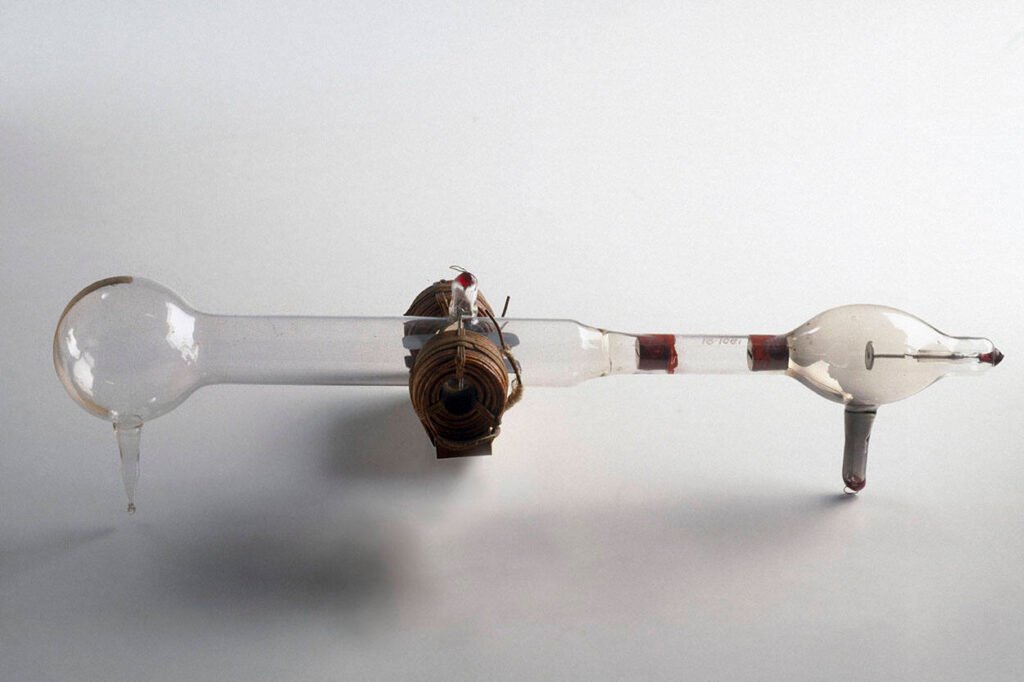
The discovery of the electron was the 1897 finding by the British physicist J. J. Thomson that cathode rays are streams of tiny negatively charged particles, far lighter than any atom. It was the first evidence that atoms have parts. Thomson announced it at the Royal Institution in London on April 30, 1897, and the particles he called corpuscles are now known as electrons.
Background to the discovery of the electron
In the mid-nineteenth century, science lecturers delighted audiences with glass tubes that glowed when a high voltage was applied across wires at their ends and most of the air was pumped out. In 1859 a German physicist improved the vacuum pump and saw that the light coming from the negative electrode, the cathode, made the glass at the far end glow with fluorescence. Some kind of ray was evidently leaving the cathode. These came to be called cathode rays.
Nobody knew what they were. One idea was that they were waves in the hypothetical ether, an invisible fluid that many physicists believed carried light. Another was that they were streams of material particles. A magnet could push the rays around, which hinted at charge. But when the German physicist Heinrich Hertz passed them between charged metal plates inside a tube, they did not bend as charged particles should. Hertz and his student Philipp Lenard also found that the rays seemed to pass through thin metal foil, which sounded more like a wave than a particle.
Evidence for particles built up in the 1890s. In 1895 the French physicist Jean Perrin found that cathode rays carried a negative charge. In January 1897 the German physicist Emil Wiechert measured the ratio of their mass to their charge and found it over a thousand times smaller than for the smallest charged atom. Lenard concluded from the distance the rays traveled through gases that, if they were particles, they had to be very small.
How the electron was discovered
J. J. Thomson, who led the Cavendish Laboratory at the University of Cambridge as Cavendish Professor from 1884 to 1918, drew on this work. According to the American Institute of Physics, he refined earlier experiments, designed new ones, gathered careful data and then made a bold leap. He ran three main experiments.
In the first, a variation on Perrin’s experiment, he built a tube ending in a pair of metal cylinders with a slit, connected to an electrometer, an instrument that catches and measures electric charge. When a magnet bent the rays into the slit, the electrometer recorded a large negative charge. When the rays were bent away, it recorded little. The charge, it seemed, could not be separated from the rays.
In the second experiment he applied a voltage between aluminum plates inside a highly evacuated tube and measured how far the beam moved on a scale. Unlike Hertz, he saw a deflection, as expected for negatively charged particles. In the third he sent rays through a slit into a bell jar of low-pressure gas and photographed their bent paths against a ruled glass plate. Together with his other measurements, this let him estimate the ratio of mass to charge for the particles, which came out far smaller than the ratio for a hydrogen ion.
From these results Thomson proposed three hypotheses: that cathode rays are charged particles, which he called corpuscles; that these corpuscles are constituents of atoms; and that they are the only constituents. Many physicists at first doubted the idea of bodies smaller than atoms. Thomson later recalled that a distinguished colleague at the Royal Institution lecture thought he had been pulling their legs.
Why the name electron?
The word electron was coined by the Irish physicist George Johnstone Stoney in 1891 for the unit of charge seen when electric current passes through chemicals. Joseph Larmor used it in a theory that did not treat it as part of the atom. When another Irish physicist, George Francis FitzGerald, suggested in 1897 that Thomson’s corpuscles were free electrons, he was using Larmor’s sense of the word. Gradually the name became attached to Thomson’s particle, and it remains the standard term.
Impact of the discovery of the electron
Thomson’s first and second hypotheses were gradually accepted, though with changes in meaning. The third proved false: electrons are not the only constituent of atoms. Thomson proposed a model in which many tiny negative corpuscles sit in a cloud of positive charge, nicknamed the plum pudding model. His former student Ernest Rutherford disproved it by showing that the atom has a small, massive, positively charged nucleus. That nucleus was later found to contain protons and neutrons, both much heavier than electrons.
Thomson received the 1906 Nobel Prize in Physics for his investigations of the conduction of electricity by gases. His son, George Paget Thomson, shared the 1937 prize for experiments that showed electrons also behave as waves, an idea at the heart of quantum theory. The electron’s particle-like behavior in light also underlies the photoelectric effect, which Albert Einstein explained.
Technology followed. The cathode ray tube that Thomson used was the ancestor of the picture tube in the television set. Understanding how electrons move through solids led to the semiconductor and the transistor, and from there to computers and modern communications. The American Institute of Physics describes the electron as only the first of a long list of fundamental particles, which now includes photons, muons and quarks.
FAQs
Who discovered the electron? J. J. Thomson is credited with the discovery in 1897, building on earlier work by Perrin, Wiechert, Lenard and others.
When was the electron discovered? Thomson announced his results at the Royal Institution on April 30, 1897, and published them in the Philosophical Magazine that October.
What did Thomson call the electron? He called the particles corpuscles. The word electron had been coined by George Johnstone Stoney in 1891 for a unit of charge.
Did Thomson win a Nobel Prize for it? He won the 1906 prize for his work on the conduction of electricity by gases, which included this research.
More in Physics
Key facts
- J. J. Thomson announced the discovery at the Royal Institution on April 30, 1897.1
- Thomson was Cavendish Professor of Experimental Physics at Cambridge from 1884 to 1918.1
- In January 1897 Emil Wiechert measured a mass-to-charge ratio for cathode rays over a thousand times smaller than for the lightest charged atom.2
- Thomson called the particles corpuscles; the word electron was coined by G. Johnstone Stoney in 1891.2
- Thomson won the 1906 Nobel Prize in Physics for work on the conduction of electricity by gases.3
- His claim that corpuscles are the only constituents of atoms proved false.2
Quick checkWho discovered the electron, and in what year?Show answer
J. J. Thomson, in 1897, from experiments on cathode rays at the Cavendish Laboratory in Cambridge.
Sources
- Nobel Foundation, J.J. Thomson: Biographical, https://www.nobelprize.org/prizes/physics/1906/thomson/biographical/
- American Institute of Physics, The Discovery of the Electron, https://history.aip.org/exhibits/electron/jjhome.htm
- Nobel Foundation, The Nobel Prize in Physics 1906, https://www.nobelprize.org/prizes/physics/1906/summary/
Editorially reviewed by Specialty Digest Editorial TeamLast reviewed November 4, 2026Researched and drafted with AI assistanceReport an issue