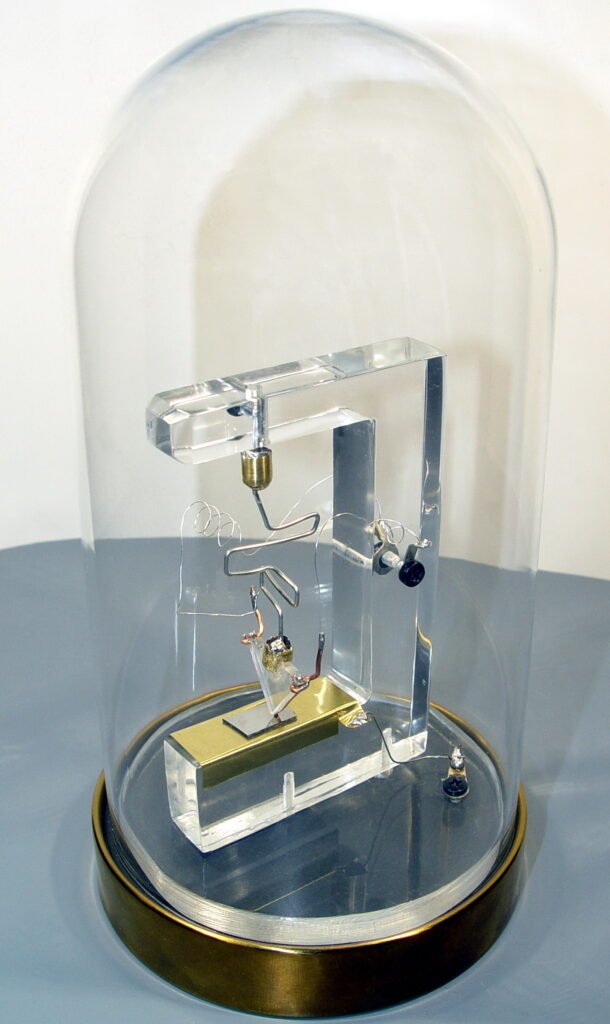
A transistor is a small semiconductor device that can amplify an electrical signal or switch it on and off. It was demonstrated at Bell Telephone Laboratories in New Jersey in late 1947, and its inventors received the 1956 Nobel Prize in Physics. Transistors replaced vacuum tubes in most electronics and are the basic building blocks of modern computers.
History of the transistor
Before the transistor, electronic amplifiers and switches depended on vacuum tubes, which the Nobel Foundation’s presentation speech calls radio valves. Tubes worked, but they were large, fragile and needed current to heat a filament.
Physicists had long hoped to do the same job with solid materials. In the 1930s, rectifiers based on semiconductors came into important use, and researchers tried to control them with an extra electrode, as a grid controls a radio valve. Those attempts failed.
Julius Edgar Lilienfeld patented several field-effect transistor configurations starting in 1925. The IEEE milestone record says there is no indication that he ever produced working models, and that if he did, they would not have worked well because germanium and silicon crystals could not yet be grown with enough purity.
The breakthrough came at Bell Laboratories. According to the IEEE record, from 17 November to 23 December 1947, in Building 1, Room 1E455, Walter Brattain and John Bardeen, under the direction of William Shockley, discovered the transistor effect and developed and demonstrated a point-contact germanium transistor.
The Institute of Electrical and Electronics Engineers dedicated a milestone plaque at the site in New Providence, New Jersey, in December 2009.
Inventor and origins of the transistor
The transistor had three principal inventors. Bardeen and Brattain built the first working device, and Shockley directed the group. In 1956 the three shared the Nobel Prize in Physics, which the Nobel Foundation says was awarded for their researches on semiconductors and their discovery of the transistor effect.
Lilienfeld’s earlier patents mean the idea of a solid-state amplifier was not new. What the Bell Laboratories team added was a working device, made possible by advances in germanium semiconductors by 1947.
The sources differ slightly on the date. The IEEE record places the first working transistor in late 1947, while the Nobel presentation speech places the discovery of transistor action in 1948. The entry therefore uses 1947 for the demonstration and notes the difference.
How a transistor works
A transistor is built from a semiconductor, a material that conducts electricity better than an insulator but worse than a metal. The Nobel speech explains that adding a tiny quantity of another element, a few parts in 100,000, makes a good semiconductor.
Some added atoms donate an extra electron, a negative charge carrier. Others, such as boron in silicon, take an electron from a neighbor and leave a hole, a gap that moves through the material and acts as a positive carrier. A semiconductor can therefore carry current by electrons, by holes or by both.
The idea that a semiconductor has two kinds of carriers, electrons and holes, was put forward in the 1930s, at a time when semiconductor rectifiers were finding important uses. It contradicted the older view of Benjamin Franklin that only one kind of carrier was needed.
Bardeen and Brattain studied the region near a negative electrode that was poor in charge carriers. Using a probe moved by a micrometer screw under a microscope, they found that when the probe was made positive and brought close to the electrode, the blockade was lifted. The probe acted as an injector of holes, and a small injection controlled a larger current.
This control is the transistor effect. A small signal controls a larger flow of current, which amplifies it, and a small voltage can also switch the current on or off. The speech summarizes the result by saying that a transistor functions much like a radio valve, but is smaller and does not require current to heat a filament.
Types of transistors
The first transistor was a point-contact device, with two fine metal contacts touching a block of germanium. The design was fragile, but it proved the principle.
The field-effect design in Lilienfeld’s patents controls current with an electric field rather than an injected current, and it became practical once pure semiconductor crystals could be made. Later transistors used silicon, and engineers learned to make them in a wide range of sizes, from large power devices to extremely small switches.
Impact of the transistor
The IEEE record describes the transistor as the beginning of solid-state electronics, which quickly reduced the size and power requirements of devices that used vacuum tubes. It credits the device with ushering in the information age through small, low-power electronics and, eventually, low-cost integrated circuits.
The Nobel speech noted that hearing aids, computing machines and telephone stations needed just such a device. Portable radio followed, since the transistor made radios small enough to carry anywhere and let AM and FM be combined in one set.
The transistor also made the modern computer practical. Early machines such as ENIAC needed thousands of tubes, while a transistor-based computer can be far smaller and use much less power.
Uses of transistors today
Transistors are found in almost every electronic device, including phones, computers, radios, televisions and medical equipment. They act as amplifiers in audio and radio circuits and as switches in digital logic.
In processors and memory chips, vast numbers of transistors are formed together on a single piece of semiconductor material in an integrated circuit. The same basic transistor effect that Bardeen and Brattain observed underlies these devices, although modern designs differ greatly from the first point-contact model.
More in Electrical Engineering
Key facts
- Walter Brattain and John Bardeen, working under William Shockley, demonstrated a point-contact germanium transistor at Bell Laboratories between 17 November and 23 December 1947.1
- Shockley, Bardeen and Brattain shared the 1956 Nobel Prize in Physics for their researches on semiconductors and their discovery of the transistor effect.2
- Julius Edgar Lilienfeld patented field-effect transistor designs from 1925, but there is no indication he built a working model.1
- A transistor functions much like a radio valve, but it is smaller and needs no current to heat a filament.3
- The transistor began solid-state electronics, which reduced the size and power needs of tube-based devices.1
Related concepts
Quick checkWho invented the transistor?Show answer
Walter Brattain and John Bardeen built the first working point-contact transistor at Bell Laboratories in late 1947 under the direction of William Shockley, and the three shared the 1956 Nobel Prize in Physics. Julius Lilienfeld had patented field-effect ideas in 1925 but is not known to have built a working device.
Sources
- Engineering and Technology History Wiki, Milestones: Invention of the First Transistor at Bell Telephone Laboratories, Inc., 1947, https://ethw.org/Milestones:Invention_of_the_First_Transistor_at_Bell_Telephone_Laboratories,_Inc.,_1947
- Nobel Foundation, The Nobel Prize in Physics 1956, https://www.nobelprize.org/prizes/physics/1956/summary/
- Nobel Foundation, The Nobel Prize in Physics 1956 presentation speech, https://www.nobelprize.org/prizes/physics/1956/ceremony-speech/
Editorially reviewed by Specialty Digest Editorial TeamLast reviewed November 4, 2026Researched and drafted with AI assistanceReport an issue