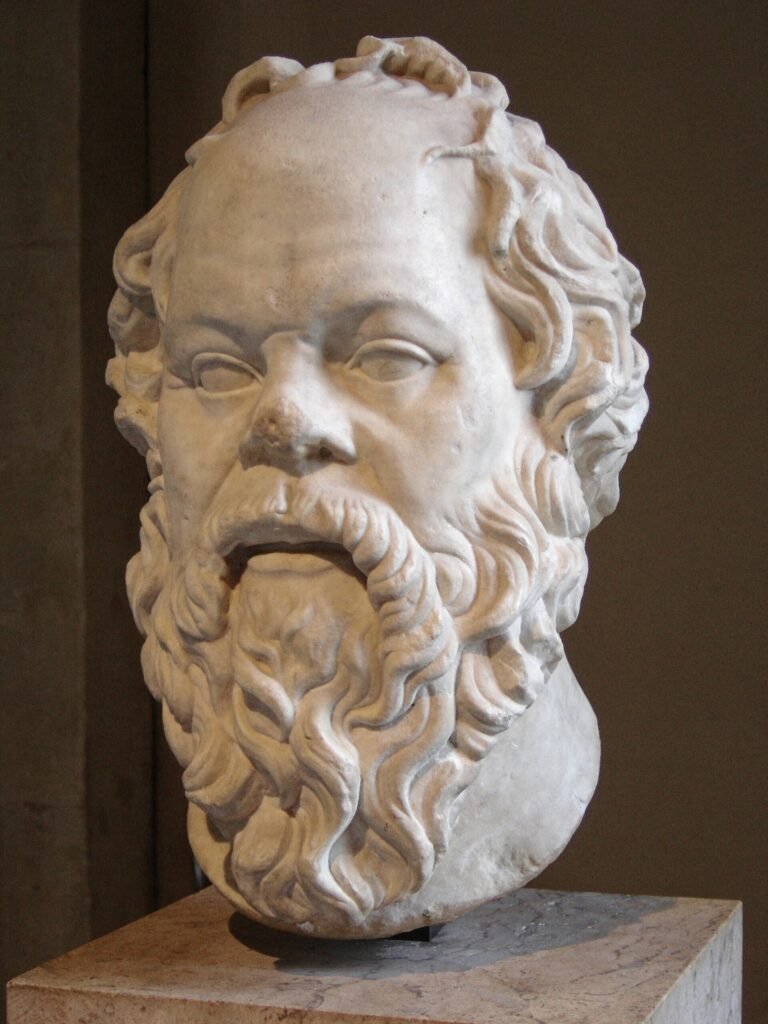
Socrates was an Athenian philosopher who lived from about 470 or 469 BCE until 399 BCE. He wrote nothing himself, and he is known mainly through the accounts of Plato, Xenophon and Aristophanes. He is remembered for questioning people about how to live well, for his claim that he knew nothing of real importance, and for his trial and execution in Athens.
Early life of Socrates
Socrates was born in Athens in 469 BCE according to the Internet Encyclopedia of Philosophy, or about 470 or 469 BCE according to the World History Encyclopedia. His father, Sophroniscus, was a stonemason, and his mother, Phaenarete, was a midwife. The family was not rich, but it was not poor either.
The World History Encyclopedia says he seems to have worked first as a sculptor, among other jobs. He married Xanthippe and had sons, and some sources mention a second wife, though these reports are less certain.
Socrates also served Athens as a hoplite, a heavily armed foot soldier, during the Peloponnesian War with Sparta. He fought at Potidaea, at Delium and at Amphipolis, and the ancient accounts praise his courage and endurance.
Career and public life of Socrates
Socrates held no office and ran no school. He spent his days in the public places of Athens questioning people who had a reputation for wisdom, and he drew a following of young men from wealthy families, one of whom was Plato.
According to Plato’s Apology, his friend Chaerephon asked the oracle at Delphi whether anyone was wiser than Socrates, and the oracle said no one was. Socrates found this puzzling because he believed he lacked knowledge. He set out to test the claim by questioning those thought to be wise, and he concluded that he was wiser only in being aware of his own ignorance. He described this work as a mission given to him by the god Apollo. He also reported a personal inner sign, which he called a daimonion.
Socrates compared himself to a gadfly sent to stir a sluggish horse, meaning the city of Athens. Many citizens found his claim to a divine mission strange, and some resented being shown up in public.
At the end of the Peloponnesian War, an oligarchic regime known as the Thirty ruled Athens. The Internet Encyclopedia of Philosophy reports that Socrates refused an order from the Thirty to help bring in the democratic general Leon of Salamis for execution.
Ideas and contributions of Socrates
Because Socrates wrote nothing, his ideas must be reconstructed from the writings of others. This is called the Socratic problem. As the Stanford Encyclopedia of Philosophy puts it, what survives is a set of interpretations, each representing a possible Socrates. Aristophanes mocked him in the comedy Clouds, produced in the 420s BCE, as a teacher of dishonest arguments. Xenophon, a soldier and historian, presents a practical moralist. Plato offers the most philosophical picture, and his early dialogues are generally treated as the closest to the historical man.
Socrates is best known for the method of question and answer that bears his name, the Socratic method. He asks someone to define a term such as courage or piety, tests the answer against other beliefs the person holds, and shows that it does not hold up. The result is often puzzlement rather than a final definition.
Three ideas recur in the accounts. The first is that the examined life matters: in the Apology he tells the jury that the unexamined life is not worth living for human beings. The second is his claim of ignorance, the view that wisdom begins with recognizing how little one knows. The third, drawn from Plato’s early dialogues, is that people always act in the way they think best, so wrongdoing comes from error about what is good. These themes shaped later work in ethics and epistemology.
Trial and death of Socrates
In 399 BCE a young poet named Meletus brought a charge against Socrates, supported by Anytus and Lycon. The charge was impiety: that he did not honor the gods of the city, that he introduced new divinities, and that he corrupted the young. The Internet Encyclopedia of Philosophy explains that an amnesty after the fall of the Thirty barred political charges, so the accusers chose religious grounds.
A jury of Athenian citizens convicted him and sentenced him to death. Plato’s Apology presents his defense, in which he argues that his questioning served the city. In the Crito, he refuses a chance to escape from prison, on the grounds that he had lived his whole life under the laws of Athens and had implicitly agreed to them. The Phaedo describes his last day among friends in his cell and his death by drinking hemlock, a poison.
Legacy of Socrates
Socrates turned attention toward the question of how people should live. The World History Encyclopedia calls him the Father of Western Philosophy, and in the Apology he distances himself from natural philosophers such as Anaxagoras, who studied the physical universe.
After his death the tradition around him grew. As the Stanford Encyclopedia of Philosophy reports, every ancient philosophical school except the Epicureans saw in him either its founder or the model its followers should aspire to. The name Socratic method is still used for teaching by guided questioning, and his trial remains a standard example in discussions of free inquiry and the limits of a city’s tolerance.
Controversies and criticism of Socrates
Socrates was controversial in his own lifetime. Aristophanes presented him as a danger to traditional religion and family life, and the Stanford Encyclopedia of Philosophy notes that the Clouds may blend features of several thinkers of the day into one figure. After the war, some of his associates were known oligarchs, and the Internet Encyclopedia of Philosophy says this raised suspicion that he threatened the democracy. Defenders point out that he also had democratic friends, such as Chaerephon, and that he refused the order of the Thirty.
The sources also disagree with one another. In Xenophon’s Apology, for example, the oracle’s message to Chaerephon is reported differently from Plato’s version. Scholars therefore treat any single portrait of Socrates with caution.
More in Philosophy
Key facts
- Socrates was born in Athens around 470 or 469 BCE and was executed in 399 BCE.1
- His father Sophroniscus was a stonemason and his mother Phaenarete a midwife.1
- He wrote nothing, so he is known through Plato, Xenophon and Aristophanes.2
- In 399 BCE he was charged with impiety and with corrupting the young, convicted by a jury and sentenced to death.1
- The Phaedo by Plato describes his death by drinking hemlock.3
Related concepts
In the news
Quick checkWhy was Socrates put to death?Show answer
An Athenian jury convicted him in 399 BCE on charges of impiety and of corrupting the young, and sentenced him to death.
Sources
- Internet Encyclopedia of Philosophy, Socrates, https://iep.utm.edu/socrates/
- Stanford Encyclopedia of Philosophy, Socrates, https://plato.stanford.edu/entries/socrates/
- World History Encyclopedia, Socrates, https://www.worldhistory.org/socrates/
Editorially reviewed by Specialty Digest Editorial TeamLast reviewed November 4, 2026Researched and drafted with AI assistanceReport an issue