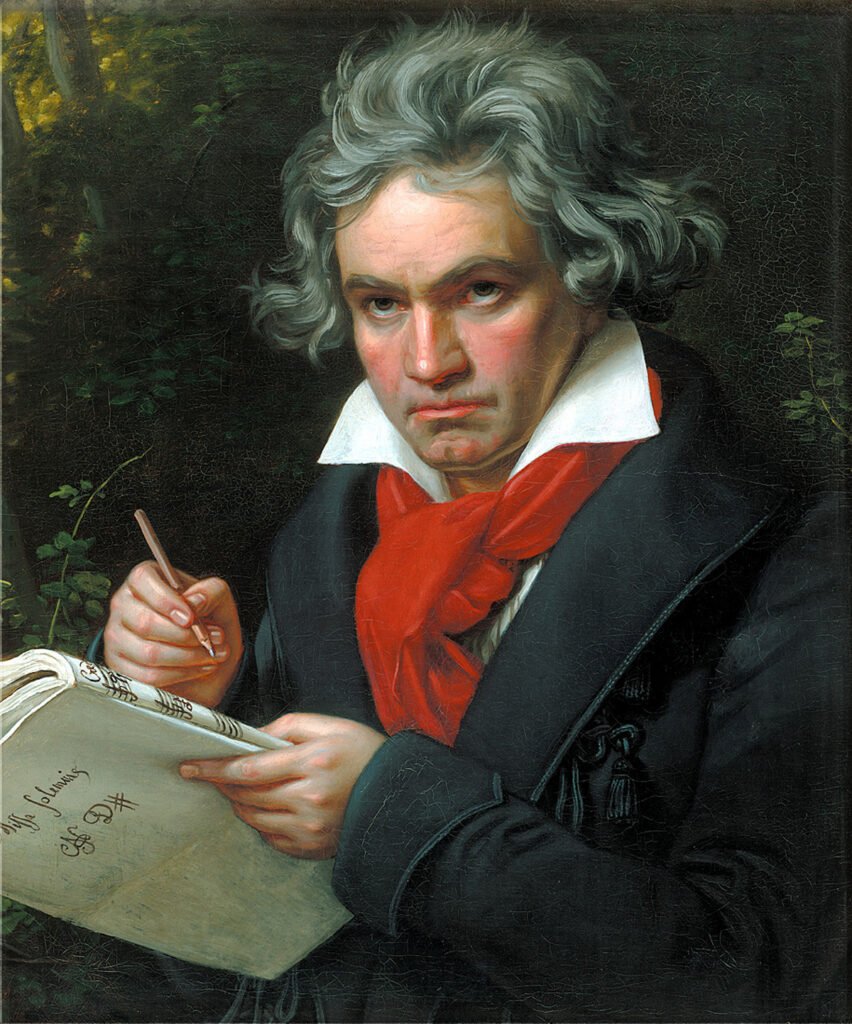
Ludwig van Beethoven (1770 to 1827) was a German composer and pianist who bridged the Classical and Romantic periods in Western music. Born in Bonn and active in Vienna for most of his adult life, he wrote nine symphonies, five piano concertos, sixteen string quartets and thirty-two piano sonatas. He continued composing as he lost his hearing, and he died in Vienna on 26 March 1827.
Early life of Beethoven
Beethoven was baptized in Bonn on 17 December 1770, according to the Beethoven-Haus Bonn, the museum at his birthplace. His grandfather, also named Ludwig van Beethoven, was court musical director in Bonn, and his father Johann was a tenor in the court choir. Music was the family trade, and the boy was trained as a performer from a young age.
On 26 March 1778 he appeared in Cologne as a piano-playing child prodigy. His first published work, a set of variations on a march, appeared in 1782, and in 1784 he was appointed deputy court organist in Bonn. In 1789 he joined the court orchestra as a viola player.
At the end of 1786 he went to Vienna hoping to take lessons from Mozart. The Beethoven-Haus notes that a meeting may have been arranged but is not documented, and on the way home he learned that his mother was dying. In 1790 the composer Joseph Haydn visited Bonn on his way to London, and Beethoven was introduced to him.
Career and major works
In November 1792 Beethoven moved to Vienna to study with Haydn, and he later took lessons from Johann Georg Albrechtsberger and Antonio Salieri. French troops occupied the Rhineland in 1794, the Bonn court was dissolved, and he lost his post there, so Vienna became his permanent home. He gave his first public performance in the city on 29 March 1795, and his Opus 1, a set of three piano trios, was distributed soon after.
On 2 April 1800 he held his first benefit concert in Vienna, which included the premiere of his First Symphony. His Third Symphony, known as the Eroica, was originally meant to be named for Napoleon Bonaparte, but when Napoleon proclaimed himself Emperor of France in 1804, Beethoven was deeply disappointed and dropped the plan. His only opera, Fidelio, was first staged on 20 November 1805 under the title Leonore and was not a success, although a revised version later did better.
On 22 December 1808 an all-Beethoven concert at the Theater an der Wien presented the premieres of the Fifth and Sixth Symphonies, the Fourth Piano Concerto and the Choral Fantasy. In 1809 three noble patrons, Archduke Rudolph, Prince Lobkowitz and Prince Kinsky, guaranteed him an annuity, on condition that he stay in Vienna. The Seventh Symphony was first performed on 8 December 1813 together with a work celebrating a victory over Napoleon.
His later years produced some of his most demanding music. The Hammerklavier Sonata dates from 1818, the Missa solemnis was completed in 1823, and the Diabelli Variations appeared the same year. On 7 May 1824 the Ninth Symphony received its premiere, and afterward he turned to the late string quartets, which are among the most admired works of chamber music.
Ideas and contributions
Beethoven expanded what a symphony or sonata could express. He lengthened and intensified the standard plan of sonata form, gave greater weight to the finales of large works, and let personal struggle and heroic effort shape the character of the music. The Ninth Symphony broke new ground by adding vocal soloists and a chorus to the orchestra, and its finale sets a poem by Friedrich Schiller in praise of joy and human brotherhood.
He also broadened the role of the composer. Earlier musicians usually worked as servants of a court or a church, whereas Beethoven built his career on public concerts, publication and the support of several patrons at once. He spoke of himself as a free artist, and this independence became an ideal for later generations of composers.
Deafness
The Beethoven-Haus reports that Beethoven realized his hearing was declining before he turned thirty, and that the loss continued until he was completely deaf. In 1802 he wrote the Heiligenstadt Testament, a letter to his brothers about his growing deafness that was never sent. The Beethoven-Haus has also published an electronic reconstruction of how his hearing faded, to help listeners understand what he lived through. From 1818 people had to write to him in the conversation books that survive today. Scholars still debate the medical cause of his deafness.
Death of Beethoven
Beethoven died on 26 March 1827 at the Schwarzspanierhaus in Vienna. His last completed work was a new finale for the String Quartet, Opus 130, written in 1826, the year before his death.
Legacy of Beethoven
Beethoven’s symphonies and quartets are performed around the world, and the melody of the Ninth Symphony’s choral finale is now widely used as a symbol of European unity. Museums and research centers preserve his legacy. The Beethoven-Haus keeps a digital archive of his works, letters and pictures, and the Ira F. Brilliant Center for Beethoven Studies at San Jose State University holds first editions, manuscripts and historical keyboards.
His music also shaped the idea of the composer as a creative genius whose works matter as individual statements. Composers of the nineteenth century, including Berlioz and Wagner, were deeply influenced by the Ninth Symphony, and Brahms quoted its main finale theme in his own First Symphony.
Controversies and criticism
Beethoven’s personal life included real conflicts. After his brother Kaspar Karl died in 1815, he assumed custody of his nephew Karl, and legal disputes with the boy’s mother, Johanna, followed over the next years. The Beethoven-Haus records that Karl attempted suicide on 6 August 1826, a crisis that deeply affected the composer during his last year.
The identity of the Immortal Beloved, the woman to whom he wrote a love letter in 1812, is unknown, and biographers have proposed several candidates without agreement. The letter was found among his papers after his death.
More in Music
Key facts
- Beethoven was baptized in Bonn on 17 December 1770 and spent most of his adult life in Vienna, where he died on 26 March 1827.1
- He moved to Vienna in November 1792 to study with Joseph Haydn.1
- His First Symphony premiered on 2 April 1800 and his Ninth Symphony on 7 May 1824.1
- He wrote the Heiligenstadt Testament about his growing deafness in 1802, and by 1818 people communicated with him in writing.1
- The Ira F. Brilliant Center for Beethoven Studies in California holds first editions, manuscripts and historical keyboards linked to his work.2
Related concepts
Quick checkWhich Beethoven symphony includes a choir?Show answer
The Ninth Symphony, first performed in Vienna on 7 May 1824. Its finale adds vocal soloists and a chorus to the orchestra.
Sources
- Beethoven-Haus Bonn, Beethoven biography and chronologies (Bonn and Vienna), https://www.beethoven.de/en/g/zeittafel-beethoven-in-wien
- Ira F. Brilliant Center for Beethoven Studies, San Jose State University, https://www.sjsu.edu/beethoven/
Editorially reviewed by Specialty Digest Editorial TeamLast reviewed November 4, 2026Researched and drafted with AI assistanceReport an issue