The Chernobyl disaster was a nuclear accident at the Chernobyl power plant in northern Ukraine, then part of the Soviet Union, on 26 April 1986. An explosion and fire destroyed Unit 4 of the plant and released large amounts of radioactive material. The World Health Organization describes it as the largest uncontrolled radioactive release in the history of the civil nuclear industry. The name is also spelled Chornobyl, which is the Ukrainian form.
Background to the Chernobyl disaster
The Chernobyl complex stands about 110 kilometers north of Kyiv and about 10 kilometers south of the Belarus border. It had four reactors of the Soviet RBMK-1000 design, with Units 1 and 2 built between 1970 and 1977 and Units 3 and 4 completed in 1983. The new town of Pripyat, about 3 kilometers away, had 49,000 inhabitants in 1986. The old town of Chornobyl, about 15 kilometers away, had 12,500, and the World Nuclear Association puts the population within 30 kilometers at 115,000 to 135,000.
The RBMK is a graphite-moderated reactor cooled by boiling water in vertical pressure tubes. It has a feature that proved dangerous in an accident: it can have a positive void coefficient, which means that more steam bubbles in the core can raise its power instead of lowering it. The reactor also had control rods whose design caused a brief power increase when they were first inserted, as shown by later analysis. These design features are central to the accident, and they are discussed alongside nuclear reactor safety in general.
Course of the accident
On the night of 25 to 26 April 1986 operators prepared a test of whether the slowing turbine could keep cooling pumps running during a power loss. The reactor had been held at reduced power, the emergency core cooling system was switched off for the test, and the reactor was in an unstable state. The test began at 1:23 a.m. When the operator tried to shut the reactor down, a sharp power surge followed, a steam explosion occurred, and a cover plate weighing about 1,000 tonnes was displaced. Fires broke out in the building and on the turbine hall roof.
The first group of 14 firefighters arrived at 1:28 a.m. Over 100 firefighters from the plant and from Pripyat took part, and they received the highest radiation doses. The fires on the roofs were contained within hours, and the fire was out by about 5:00 a.m. Units 1 and 2 were shut down on 27 April.
Two plant workers died in the night as a result of the explosion. According to the World Health Organization, of about 600 workers on site that morning, 134 received very high doses, between 0.8 and 16 gray, and developed acute radiation syndrome. Twenty-eight of them died within the first three months.
The main radioactive substances released were iodine-131, caesium-134 and caesium-137. Iodine-131 has a short half-life of eight days but can reach people quickly through air and through milk and leafy vegetables, while the caesium isotopes persist for years. The release continued for about 10 days. Most material settled near the plant, but wind carried some over Belarus, Russia, Ukraine and parts of Europe.
Aftermath of the Chernobyl disaster
The Soviet authorities evacuated about 115,000 people from the area around the reactor in 1986, according to the United Nations Scientific Committee on the Effects of Atomic Radiation, and relocated about 220,000 more from Belarus, Russia and Ukraine afterward. The World Nuclear Association gives a total of some 350,000 people moved. The disaster caused serious social and psychological disruption and large economic losses across the region.
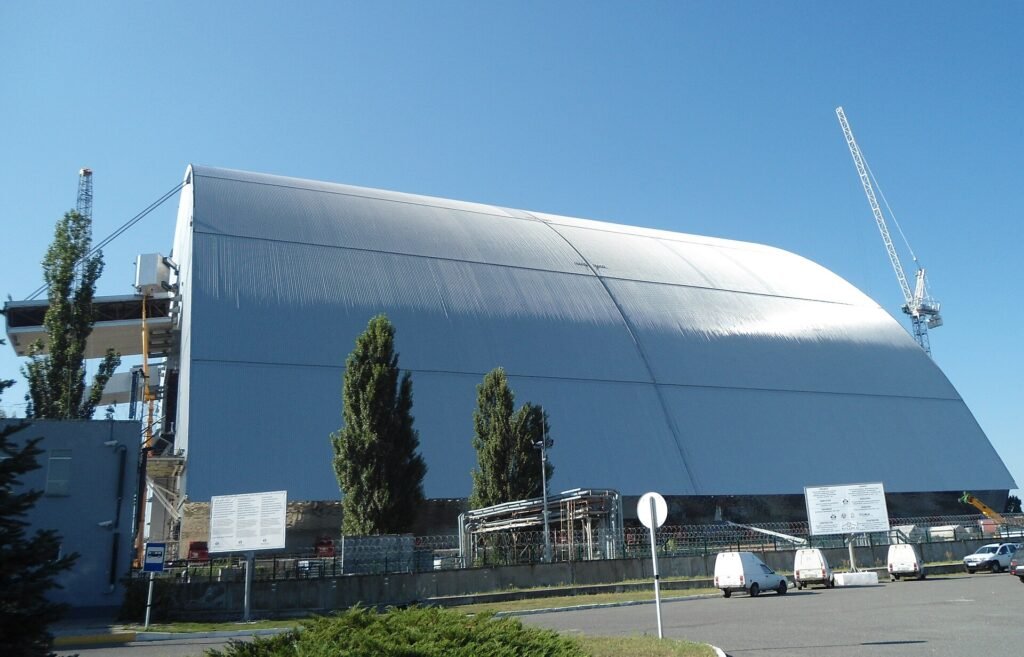
A concrete shelter, often called the sarcophagus, was built over the ruined reactor in late 1986. It was designed to last 20 to 30 years and was built quickly, so a second structure, the New Safe Confinement, was later built. Engineers moved the 36,000-tonne arch 327 meters into place over the reactor in November 2016. The World Nuclear Association describes it as the largest movable land-based structure ever built, with a design lifetime of 100 years. It reports that a drone struck its roof on 14 February 2025 and made a hole about six meters across.
The plant continued to operate for years. Unit 2 shut down after a turbine hall fire in 1991, Unit 1 at the end of 1997, and Unit 3 in December 2000.
Health effects of the Chernobyl disaster
Estimates of health effects come from large international studies. The average dose for 530,000 recovery workers was 120 millisieverts, for 115,000 evacuees 30 millisieverts, and for residents of contaminated areas 9 millisieverts over two decades. In other European countries, doses in the first year were below 1 millisievert, compared with a global average of 2.4 millisieverts a year from natural background radiation.
The clearest effect is thyroid cancer. By 2005 more than 6,000 cases had been diagnosed among people in Belarus, Ukraine and Russia who were children or adolescents at the time. Much of the thyroid dose came from radioactive iodine in contaminated milk. The World Nuclear Association cites about 5,000 cases of thyroid cancer linked to the accident and 15 deaths among them, based on UNSCEAR findings, and the UNSCEAR Committee has concluded that apart from this increase there is no evidence of a major public health impact attributable to radiation exposure two decades later.
Other effects were documented as well. Recovery workers developed cataracts in the first years, and some groups showed more anxiety. The World Health Organization warns that cancer rates in affected areas were already rising before the accident, which complicates attribution. This entry is general background, not medical advice.
Significance and legacy of the Chernobyl disaster
The accident led to major changes in nuclear safety. The International Atomic Energy Agency‘s early review in 1986 stressed operator errors, while its 1992 update placed more weight on design flaws. The accident also strengthened cooperation on safety between East and West, and fifty IAEA field missions with 200 experts from 25 countries assessed its effects between 1990 and 1991.
It also had political effects. The World Nuclear Association reports that Mikhail Gorbachev later said the accident was a more important factor in the end of the Soviet Union than his program of reform, a view that is a matter of historical debate. The disaster is often discussed alongside the Cold War, and it remains a central case in debates over nuclear power.
Key facts
- The accident occurred on 26 April 1986 at Unit 4 of the Chernobyl plant in Ukraine; the test began at 1:23 a.m.4
- The WHO calls it the largest uncontrolled radioactive release in the history of the civil nuclear industry.1
- Of about 600 workers on site, 134 developed acute radiation syndrome and 28 died within three months.1
- About 115,000 people were evacuated in 1986 and about 220,000 relocated afterward.2
- More than 6,000 thyroid cancer cases were diagnosed by 2005 in people exposed as children or adolescents.1
- The New Safe Confinement, a 36,000-tonne arch, was moved over the reactor in November 2016.3
This entry explains a medical term. It is not medical advice. If you are concerned about your health, speak with a qualified health professional.
Related concepts
Quick checkWhat caused the Chernobyl disaster?Show answer
A reactor design with dangerous characteristics combined with operating errors during a safety test caused a power surge and explosion. Investigators have weighed design and operator roles differently over time.
Sources
- World Health Organization, Radiation: The Chernobyl accident (Questions and answers, 2011), https://www.who.int/news-room/questions-and-answers/item/radiation-the-chernobyl-accident
- United Nations Scientific Committee on the Effects of Atomic Radiation, The Chornobyl Accident, https://www.unscear.org/unscear/jp/areas-of-work/chernobyl.html
- World Nuclear Association, Chernobyl Accident 1986, https://world-nuclear.org/information-library/safety-and-security/safety-of-plants/chernobyl-accident
- World Nuclear Association, Chernobyl Accident Appendix 1: Sequence of Events, https://world-nuclear.org/information-library/appendices/chernobyl-accident-appendix-1-sequence-of-events
Editorially reviewed by Specialty Digest Editorial TeamLast reviewed November 4, 2026Researched and drafted with AI assistanceReport an issue