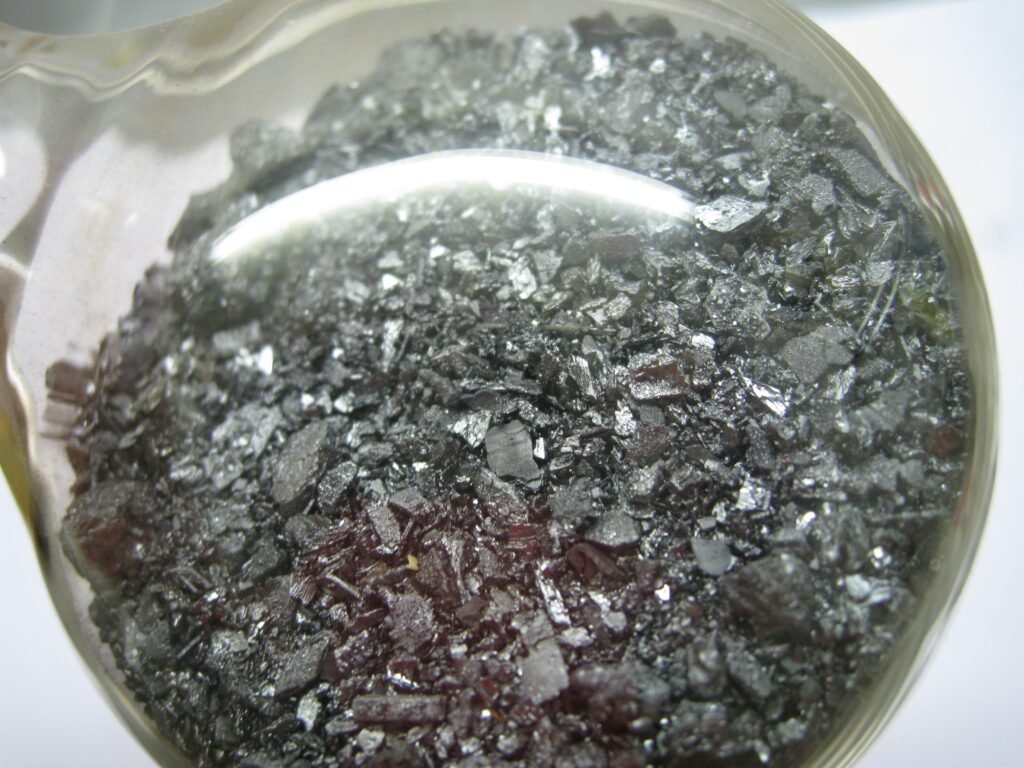
Iodine is the chemical element with atomic number 53 and the symbol I. It is a black, shiny, crystalline solid in group 17 of the periodic table, and when heated it forms a purple vapor. Iodine is an essential nutrient for humans, needed by the thyroid gland, and it is added in small amounts to table salt.
History of iodine
Iodine was discovered in France in the early nineteenth century. Bernard Courtois of Paris manufactured saltpeter, which is potassium nitrate, and used seaweed ash as his source of potassium. One day in 1811 he added sulfuric acid to the ash and saw purple fumes that condensed to form crystals with a metallic luster. Courtois guessed that this was a new element. The purple vapor and the shiny crystals he saw are the same gas and solid described in the properties of iodine below.
He gave some of the material to Charles-Bernard Desormes and Nicolas Clément, who carried out a systematic investigation and confirmed that it was a new element. In November 1813 they exhibited iodine at the Imperial Institute in Paris. Joseph Gay-Lussac proved that the substance really was new, and the English chemist Humphry Davy, who was visiting Paris, confirmed it.
Davy sent a report to the Royal Institution in London, where it was mistakenly assumed that he was the discoverer. According to the Royal Society of Chemistry, that belief persisted for more than 50 years. Courtois is now recognized as the discoverer, and the date given is 1811.
Properties of iodine
Iodine is a black, shiny, crystalline solid at 20 degrees Celsius. It melts at 113.7 degrees Celsius and boils at 184.4 degrees Celsius, and its density is 4.933 grams per cubic centimeter. When heated, iodine sublimes, which means that it passes directly from a solid to a gas without becoming a liquid first. The gas is purple.
NIST gives the standard atomic weight of iodine as 126.90447. The electron configuration is [Kr] 4d10 5s2 5p5, which leaves one electron short of a full outer shell, so iodine, like bromine and fluorine, is a halogen that readily forms the negative iodide ion. PubChem lists the oxidation states as plus 7, plus 5, plus 1 and minus 1.
PubChem also lists a Pauling electronegativity of 2.66, a first ionization energy of 10.451 electronvolts and an electron affinity of 3.059 electronvolts. The atomic radius is given as 198 picometers. The high electron affinity shows how readily an iodine atom accepts an extra electron, which is the usual behavior of a halogen.
Occurrence and production of iodine
Iodine is found in seawater as iodide, but only in trace amounts, about 0.05 parts per million. It is assimilated by seaweeds, and in the past iodine was obtained from seaweed. Courtois’s discovery began with seaweed ash, so the early history and the early production of the element were closely connected. Because seawater holds so little iodide, the ability of seaweeds to concentrate it explains why they were once a practical source.
Today the main sources of iodine are different. They are iodate minerals, natural brine deposits, which are salty waters left by the evaporation of ancient seas, and brackish waters from oil and salt wells. Iodine is obtained commercially in two ways: by releasing iodine from iodate obtained from nitrate ores, or by extracting iodine vapor from processed brine.
Uses of iodine
Photography was the first commercial use for iodine. In 1839 Louis Daguerre invented a technique for producing images on a piece of metal, and these images were called daguerreotypes. Silver iodide, like silver bromide, is sensitive to light, which is why iodine entered photography. Today iodine has many commercial uses. Iodide salts are used in pharmaceuticals, disinfectants, which are products that kill microorganisms, printing inks and dyes, catalysts, which speed up chemical reactions without being used up, animal feed supplements and photographic chemicals. Iodine is also used to make polarizing filters for LCD displays.
A small amount of iodide is added to table salt to avoid iodine deficiency, which affects the thyroid gland. Table salt treated in this way is often called iodized salt. The radioactive isotope iodine-131 is sometimes used to treat cancerous thyroid glands. The use of iodine-131 in medicine is directed by clinicians, and this article is not medical guidance.
Isotopes of iodine
Isotopes are atoms of the same element with different numbers of neutrons. NIST lists only one naturally occurring isotope of iodine, iodine-127, with an isotopic composition of 1, meaning 100 percent. An element that has a single natural isotope is called monoisotopic, and for such an element the atomic weight is the mass of that one isotope.
The Royal Society of Chemistry lists iodine-127 as the key isotope. Other isotopes of iodine exist but are radioactive and are made artificially, and iodine-131 is the one named by the Royal Society of Chemistry for its use in treating thyroid cancer.
Iodine in the body and health effects
Iodine is an essential element for humans. The Royal Society of Chemistry says that people need a daily intake of about 0.1 milligrams of iodide, and that the body contains up to 20 milligrams, mainly in the thyroid gland. This gland helps to regulate growth and body temperature. For scale, the daily need of about 0.1 milligrams is roughly one two-hundredth of the 20 milligrams held in the body.
Normally people get enough iodine from the food they eat. A deficiency of iodine can cause the thyroid gland to swell up, a condition known as goiter. The addition of iodide to table salt is one response to that risk. This overview is general background and not advice, and anyone with questions about iodine intake should speak to a qualified health professional.
More in Chemistry
Key facts
- Iodine has atomic number 53, symbol I, and sits in group 17 and period 5 of the periodic table.1
- Iodine melts at 113.7 degrees Celsius, boils at 184.4 degrees Celsius and has a density of 4.933 grams per cubic centimeter.1
- Bernard Courtois saw purple fumes from seaweed ash and sulfuric acid in 1811, and iodine was exhibited in Paris in November 1813.1
- Iodine has one naturally occurring isotope, iodine-127.2
- Humans need a daily intake of about 0.1 milligrams of iodide, and the body contains up to 20 milligrams, mainly in the thyroid gland.1
This entry explains a medical term. It is not medical advice. If you are concerned about your health, speak with a qualified health professional.
Related concepts
Quick checkWho discovered iodine?Show answer
Bernard Courtois discovered iodine in Paris in 1811 when he saw purple fumes from seaweed ash treated with sulfuric acid. Humphry Davy was mistakenly credited with the discovery for more than 50 years.
Sources
- Royal Society of Chemistry, Periodic Table: Iodine, https://periodic-table.rsc.org/element/53/iodine
- National Institute of Standards and Technology, Atomic Weights and Isotopic Compositions for Iodine, https://physics.nist.gov/cgi-bin/Compositions/stand_alone.pl?ele=I&ascii=html&isotype=some
- National Center for Biotechnology Information, PubChem Periodic Table: Iodine (element 53), https://pubchem.ncbi.nlm.nih.gov/element/53
Editorially reviewed by Specialty Digest Editorial TeamLast reviewed November 4, 2026Researched and drafted with AI assistanceReport an issue