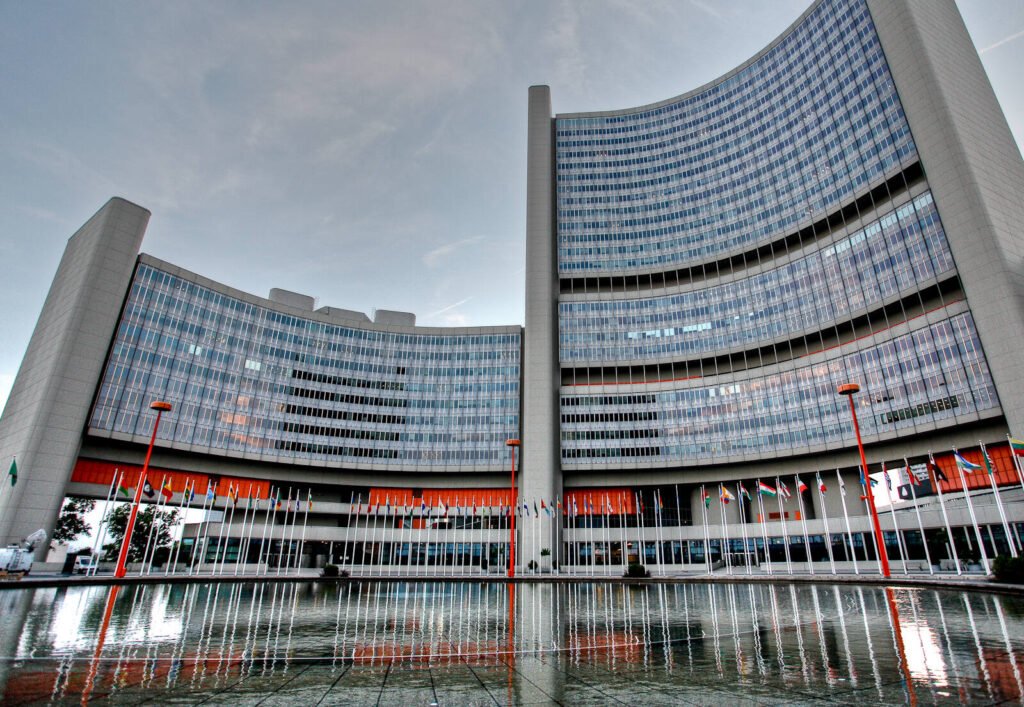
The International Atomic Energy Agency (IAEA) is an autonomous intergovernmental organization based in Vienna, Austria, that promotes the peaceful use of nuclear energy and works to verify that nuclear material is not diverted to weapons. It is linked to the United Nations through a 1957 relationship agreement, and its work covers nuclear safety, security, technology transfer and safeguards inspections.
History of the IAEA
The IAEA Statute was approved on 23 October 1956 at a conference held at United Nations headquarters in New York. It entered into force on 29 July 1957, the date usually treated as the start of the agency’s existence. The United States has been a member since that founding year.
Article II of the Statute sets the agency’s objective: to accelerate and enlarge the contribution of atomic energy to peace, health and prosperity throughout the world. The same article requires the agency to ensure, as far as it is able, that assistance it provides or supervises is not used to further any military purpose.
The IAEA and the United Nations signed their relationship agreement in 1957. Under it, the agency conducts its activities in accordance with the purposes and principles of the UN Charter. The Director General also sits on the UN Chief Executives Board, which brings together the heads of UN and UN-related bodies.
Structure and membership of the IAEA
The IAEA had 181 member states as of September 2025, according to the German Federal Environment Ministry. A 2021 report by the U.S. Congressional Research Service counted 172, so membership has grown steadily in recent years.
Three main bodies run the agency. The General Conference, made up of all member states, meets once a year to approve the budget and program. The Board of Governors has 35 member states designated and elected by the General Conference, and it meets at the Vienna headquarters several times a year. The Secretariat, led by the Director General, carries out the daily work.
The Programme and Budget Committee and the Technical Assistance and Cooperation Committee each meet twice a year. The Board appoints the Director General, with General Conference approval, for a four-year term.
What does the IAEA do?
The Statute authorizes the agency to encourage research and practical use of atomic energy, to exchange scientific information, to train experts, to set safety standards and to establish and apply safeguards. It may also act as an intermediary when one member needs materials, services, equipment or facilities from another. In practice its work falls into four areas: nuclear technology and applications, nuclear power, nuclear safety and security, and safeguards.
Safeguards are the agency’s best-known function. They are designed to give credible assurance that nuclear material and other specified items are not diverted from peaceful uses. The Treaty on the Non-Proliferation of Nuclear Weapons requires non-nuclear-weapon states that are parties to conclude comprehensive safeguards agreements with the IAEA, covering all nuclear material in all nuclear activities in the state.
The treaty defines a nuclear-weapon state as one that manufactured and exploded a nuclear weapon before 1 January 1967. That description fits China, France, Russia, the United Kingdom and the United States. In 2021 the agency was implementing safeguards agreements in more than 180 countries, and states outside the agency can also be subject to its inspections.
On safety and security, the agency drafts standards and recommendations for reactor safety, radiation protection, radioactive waste management, transport of radioactive substances, emergency preparedness and the physical protection of nuclear facilities and material. It also organizes expert-led international review missions on specific issues.
For nuclear power, the IAEA holds technical conferences, coordinates research contracts, maintains databases and publishes guidance. Its technical cooperation program also helps developing countries apply nuclear science in medicine, water management and agriculture.
Funding and governance of the IAEA
The agency’s budget has three main parts: the regular operating budget, the Technical Cooperation Fund and extrabudgetary contributions. For 2021 the regular budget assessment was $387 million, and the target for the Technical Cooperation Fund was $89.6 million. Later budgets differ, so these figures show the scale rather than the current amounts.
Under the Statute, the Board apportions expenses among members using a scale fixed by the General Conference and guided by the UN scale of assessments, which reflects capacity to pay. The Technical Cooperation Fund supports seven areas: health and nutrition, food and agriculture, water and the environment, industrial applications and radiation technology, energy, nuclear knowledge management, and nuclear safety and security.
Member states also make voluntary extrabudgetary contributions, which may go to funds such as the IAEA Low-Enriched Uranium Fuel Bank. The Director General prepares the budget estimate and sends it to the Board, which forwards it to the General Conference. The General Conference usually approves the next year’s budget each September, and both bodies need a two-thirds majority of those present and voting on budget matters.
Legal limits and the Security Council
Safeguards operate within agreements concluded between the agency and individual states. The scope of verification in a given country therefore depends on the agreement that country has signed.
The agency reports regularly to the UN General Assembly. Article III B 4 of the Statute also places a duty on it to notify the UN Security Council if it finds a threat to world peace. The UN Charter gives only the Security Council the power to adopt decisions that member states are obligated to carry out, so enforcement action against a state lies with that body and not with the agency.
This division of roles explains why the agency is often described as a verification and technical body. It builds the factual record through inspections and reports, while political and legal consequences are decided elsewhere. Its headquarters in Vienna is where the Board and General Conference meet.
More in International Relations
Key facts
- The IAEA Statute was approved on 23 October 1956 and entered into force on 29 July 1957.1
- Article II of the Statute sets the objective of accelerating and enlarging the contribution of atomic energy to peace, health and prosperity.1
- The agency had 181 member states as of September 2025.3
- The Board of Governors has 35 member states and the Director General serves a four-year term.2
- The 2021 regular budget assessment was $387 million and the Technical Cooperation Fund target was $89.6 million.2
Related concepts
Quick checkWhat are IAEA safeguards designed to do?Show answer
They are designed to give credible assurance to the international community that nuclear material and other specified items are not diverted from peaceful nuclear uses. [2]
Sources
- 1. Statute of the International Atomic Energy Agency, University of Oslo Faculty of Law treaty library, https://jus.uio.no/english/services/library/treaties/14/14-02/atomic-energy-agency.html
- 2. Congressional Research Service, IAEA Budget and U.S. Contributions: In Brief (R44384, updated April 2021), https://www.everycrsreport.com/reports/R44384.html
- 3. German Federal Ministry for the Environment (BMUKN), International Atomic Energy Agency (IAEA), https://www.bundesumweltministerium.de/en/topics/nuclear-safety/international/international-atomic-energy-agency-iaea
- 4. United Nations Security Council, What is the Security Council?, https://www.un.org/securitycouncil/content/what-security-council
Editorially reviewed by Specialty Digest Editorial TeamLast reviewed November 4, 2026Researched and drafted with AI assistanceReport an issue