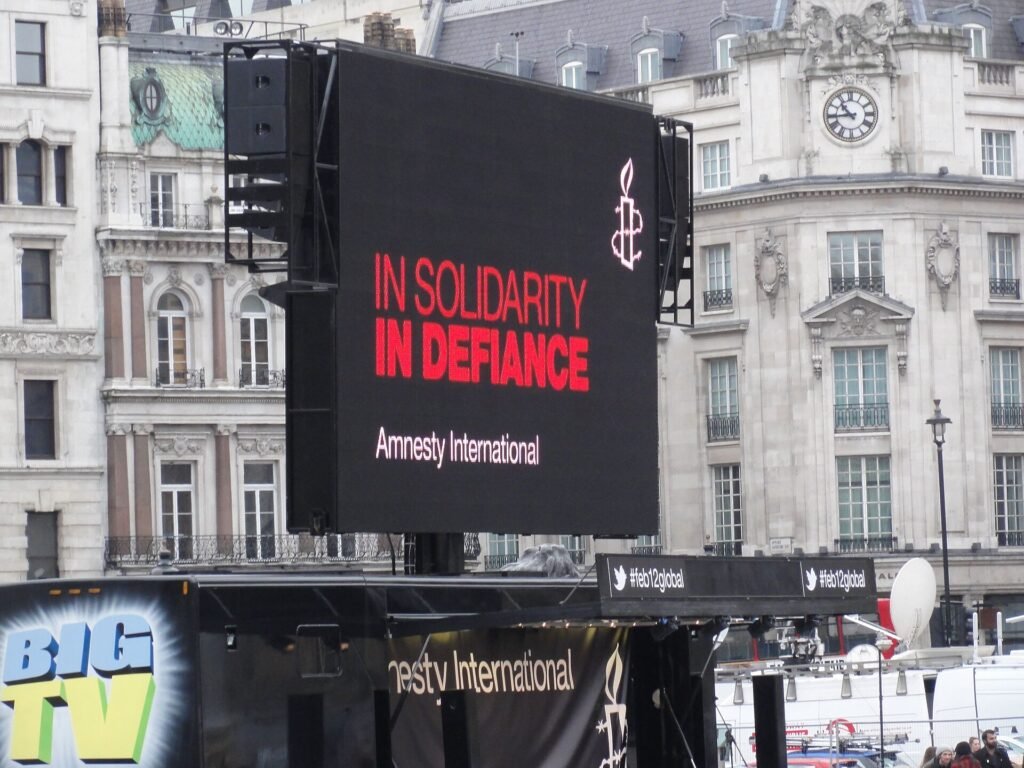
Amnesty International is a global human rights movement that researches abuses, campaigns for victims and presses governments and companies to respect people’s rights. It was founded in London in 1961 by the British lawyer Peter Benenson and received the Nobel Peace Prize in 1977.
History of Amnesty International
Amnesty International began in 1961 as a campaign to protect prisoners of conscience, people jailed for their beliefs or identity rather than for violence. Its founder, Peter Benenson, was a British lawyer. He took the idea for the organization’s logo, a lit candle surrounded by barbed wire, from a Chinese proverb: it is better to light a light than to curse the darkness.
By 1977 the Nobel Committee described its work as covering both individuals and conditions within a particular state, and it noted themes such as the death penalty. Amnesty’s findings are published in special reports, and its members organize targeted actions and campaigns to bring violations to an end.
In 1977 the Norwegian Nobel Committee awarded Amnesty the Nobel Peace Prize, with the motivation “for worldwide respect for human rights.” The Committee described it as a worldwide organization for the protection of the rights of prisoners of conscience, run by its members and independent of all governments, financial players, political convictions and religious faiths.
Mission and values
Amnesty states a vision of a world where everyone can enjoy the human rights set out in the Universal Declaration of Human Rights and other international human rights mechanisms. Its mission is to undertake research and action focused on preventing and ending grave abuses of those rights.
It names six core values, rooted in its commitment to the global community of human rights defenders in its membership:
International solidarity.
Effective action for the individual victim.
Global coverage.
The universality and indivisibility of human rights.
Impartiality and independence.
Democracy and human rights.
Structure and membership
Amnesty describes itself as a global movement of more than 10 million people. Offices around the world are guided by a shared strategic plan, the Global Strategic Framework, which covers 2022 to 2030. The organization’s statute sets out its mission and how it is run.
The movement is a membership organization. Amnesty says it is funded by members and individual supporters and is independent of any political ideology, economic interest or religion. It says it stands with victims of human rights violations wherever they are and that no government is beyond scrutiny.
What Amnesty International does
Amnesty’s method is to uncover facts, publish them and campaign for change. Its research examines violations and breaches of human rights, and its members then organize targeted actions and campaigns to bring them to an end. Its framework also asks governments to hold companies accountable for their part in abuses.
The current framework sets two global priorities:
Freedom of expression and civic space: strengthening freedom of expression and association, and securing the right to peaceful assembly for all.
Equality and non-discrimination: promoting gender, racial and intersectional justice; strengthening the rights to health, housing and social security; securing climate justice; and protecting the rights of refugees and migrants and of people on the frontlines of crises.
Alongside these, Amnesty entities may spend up to 20 percent of their resources on flexible areas of work chosen in response to local concerns, for example ending the death penalty, access to justice and preventing abuse within criminal justice systems.
The framework also sets common lenses applied to all work. They are a focus on individuals and communities at risk; attention to intersectionality, gender mainstreaming and anti-racism; and corporate accountability, including for the technology sector, where Amnesty seeks mandatory human rights due diligence laws for corporations.
The framework also describes how Amnesty intends to strengthen its own capabilities. It aims to act in solidarity with individuals and communities facing human rights challenges and to support their demands, to influence and enable duty bearers to uphold their obligations legally and in practice, and to influence and enable companies to limit harmful effects on human rights while exploring different ways of engaging with them.
Impact
Amnesty credits years of support from its members for several outcomes. It points to the abolition of the death penalty in most countries, the uncovering of dangerous spyware used to target activists, and the questioning of rulers that it describes as seemingly untouchable. These are the organization’s own claims, and the causes of such changes are complex, with many actors involved.
Criticism and controversies
One prominent dispute came in August 2022, when Amnesty published a press release saying that Ukrainian forces had located themselves next to where civilians lived, potentially putting them at risk from Russian fire.
Amnesty said it found such instances in all 19 towns and villages it visited, and that it based its assessment on rules of international humanitarian law that require parties to avoid locating military objectives within or near densely populated areas where feasible. The release drew widespread anger. In a statement, Amnesty said it deeply regretted the distress and anger caused, while fully standing by its findings, and said that its priority in any conflict is that civilians are protected.
The episode shows how research on armed conflict is judged by its audience as well as by its method. Amnesty framed its finding as a civilian protection question under humanitarian law, while many readers saw it as a judgment about the war itself.
Legacy and impact
Amnesty’s own account is that it uncovers the truth and holds the powerful to account, and the Nobel Committee in 1977 recognized it for worldwide respect for human rights. Its candle logo, drawn from a proverb about lighting a light rather than cursing the darkness, remains one of the best-known symbols in human rights work.
Key facts
- Amnesty International was founded in 1961 in London by the British lawyer Peter Benenson.2
- It won the Nobel Peace Prize in 1977 for worldwide respect for human rights.2
- It describes itself as a movement of more than 10 million people.1
- Its Global Strategic Framework covers the years 2022 to 2030.1
- It says it is funded by members and independent of any political ideology, economic interest or religion.1
Related concepts
Quick checkWho founded Amnesty International?Show answer
The British lawyer Peter Benenson founded Amnesty International in London in 1961.
Sources
- Amnesty International, About us, https://www.amnesty.org/en/about-us/
- NobelPrize.org, Amnesty International: Facts, Nobel Peace Prize 1977, https://www.nobelprize.org/prizes/peace/1977/amnesty/facts/
- Amnesty International, Statement on publication of press release on Ukrainian fighting tactics, August 2022, https://www.amnesty.org/en/latest/news/2022/08/statement-on-publication-of-press-release-on-ukrainian-fighting-tactics/
Editorially reviewed by Specialty Digest Editorial TeamLast reviewed November 4, 2026Researched and drafted with AI assistanceReport an issue