Administrative law is the body of law that governs the agencies created by legislatures to carry out and enforce statutes. It covers how agencies make rules, how they investigate and adjudicate individual cases, and how courts review agency decisions when someone challenges them. In modern states, far more day to day governance happens through administrative
Administrative Law Read More »
The branch of law governing how government agencies make rules, enforce them, and resolve disputes.
Amnesty International is a global human rights movement that researches abuses, campaigns for victims and presses governments and companies to respect people’s rights. It was founded in London in 1961 by the British lawyer Peter Benenson and received the Nobel Peace Prize in 1977. History of Amnesty International Amnesty International began in 1961 as a
Amnesty International Read More »
Amnesty International is a global human rights movement, founded in London in 1961, that researches abuses and campaigns to end them.
In simple terms Antitrust law sets limits on how companies may compete. It targets conduct that protects a firm’s position by shutting rivals out, rather than by serving customers better. Outside the United States the same field is usually called competition law. The names differ; the core concerns are close. How it works Enforcement runs
Antitrust law Read More »
Antitrust law is the body of rules that stops firms from fixing prices, abusing a dominant position, or merging in ways that harm competition.
Civil law, within common law legal systems such as those of the United States and the United Kingdom, is the branch of law that governs disputes between private parties, individuals, businesses, or organizations, over their rights and obligations toward one another. It stands apart from criminal law, which addresses offenses against the state and society
Civil Law Read More »
The branch of law governing disputes between private parties over their rights and obligations, distinct from criminal law.
Common law is a legal system built primarily from the accumulated decisions judges make in deciding individual court cases, rather than from a comprehensive legal code written in advance by a legislature. It forms the foundation of the legal systems in the United States, England and Wales, India, Canada outside Quebec, and many other countries
Common Law Read More »
A legal system built primarily from judicial precedent rather than comprehensive legislative codes, originating in medieval England.
Constitutional law is the body of law concerned with interpreting and applying a country’s constitution, the foundational document that establishes how a government is structured, how power is divided among its branches, and what rights it guarantees to individuals. It sits above ordinary legislation in most legal systems, meaning that an ordinary law conflicting with
Constitutional Law Read More »
The body of law concerned with interpreting a country's constitution, including government structure, separation of powers, and individual rights.
Contract law is the body of law that governs agreements between parties, defining what makes a promise legally enforceable and what remedies are available when one side fails to keep its end of the bargain. A contract, in its simplest definition, is an agreement that creates obligations the law can enforce, transforming an ordinary promise
Contract Law Read More »
The body of law governing enforceable agreements between parties, including their formation, performance, and remedies for breach.
Criminal law is the body of law that defines offenses against the public and the state, establishes criminal procedure, and prescribes the punishments that may follow a conviction. Unlike civil law, which resolves private disputes between individuals, criminal law treats certain harmful conduct as an offense against society as a whole, prosecuted by the state
Criminal Law Read More »
The body of law that defines offenses against the state, establishes criminal procedure, and prescribes punishment for violations.
Due process is the principle that government must follow fair, established legal procedures before depriving a person of life, liberty, or property, and that it must apply the law consistently and predictably rather than arbitrarily. It functions as a check on government power, balancing the state’s authority to act against the individual’s right to fair
Due Process Read More »
The principle that government must follow fair, established legal procedures before depriving a person of life, liberty, or property.
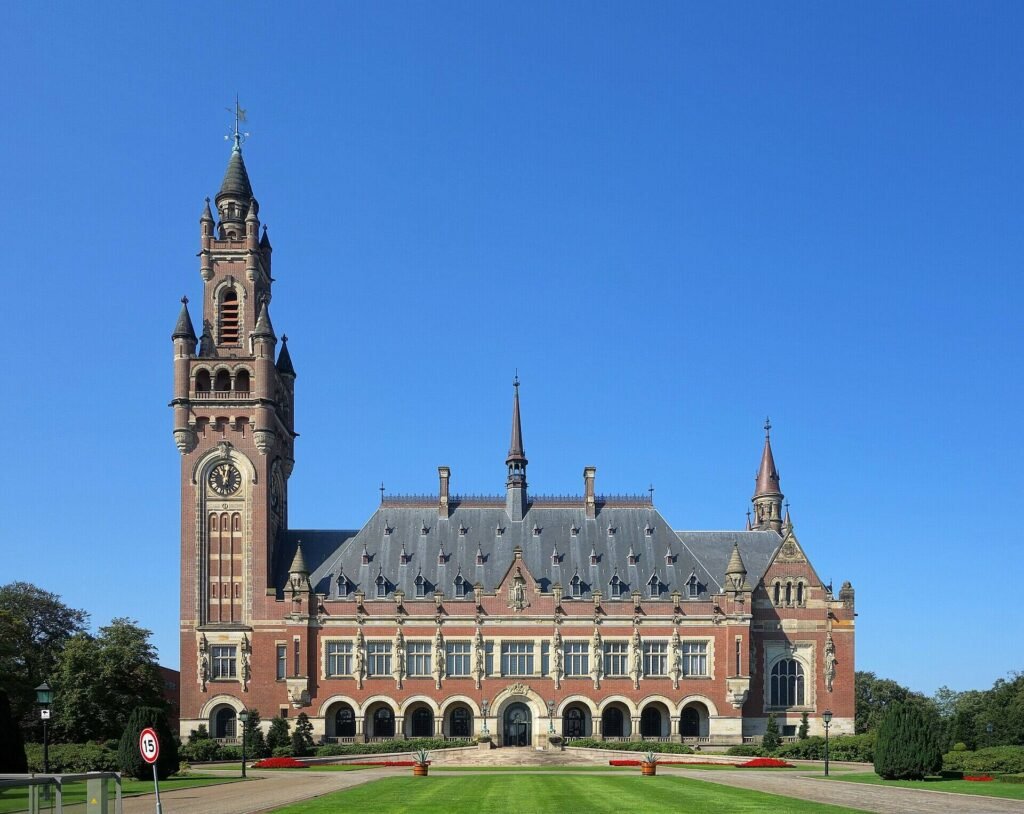
The International Court of Justice (ICJ) is the principal judicial organ of the United Nations. Seated at the Peace Palace in The Hague, it settles legal disputes between states under international law and gives advisory opinions on legal questions referred to it by authorized UN organs and specialized agencies. History of the ICJ The court
International Court of Justice Read More »
The ICJ is the principal judicial organ of the United Nations, settling legal disputes between states and giving advisory opinions from The Hague.