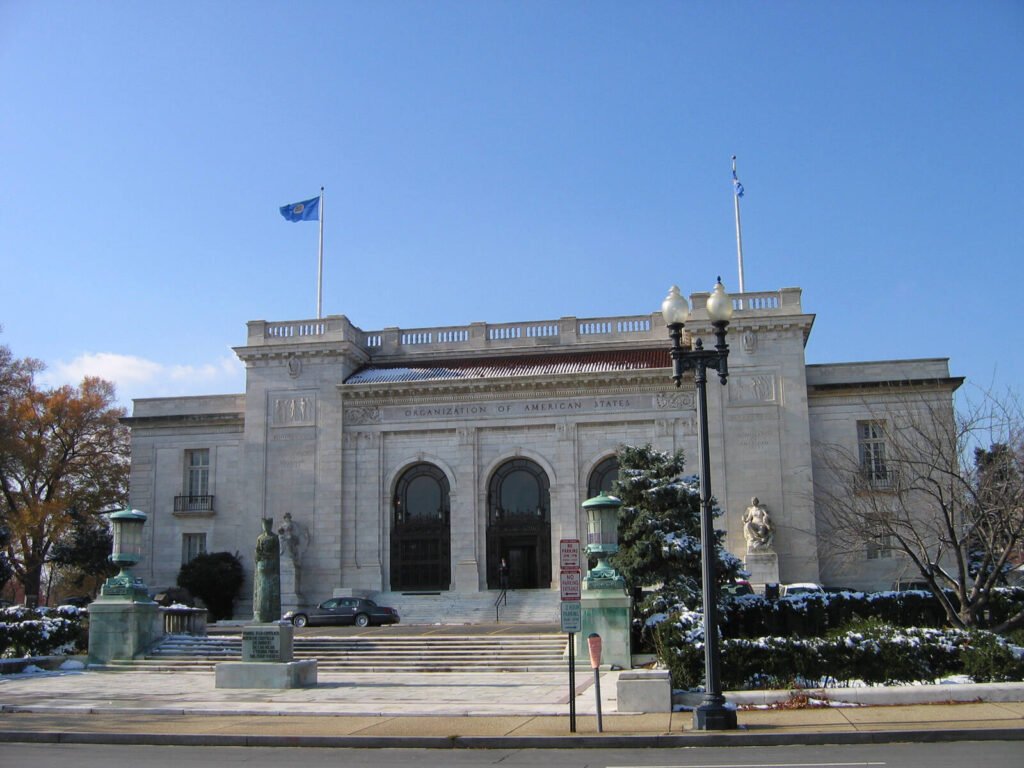
The Organization of American States (OAS) is a regional organization that brings together all 35 independent states of the Americas, with its headquarters in Washington, D.C. It describes itself as the world’s oldest regional organization and as the main political, juridical and social governmental forum in the Western Hemisphere.
History of the OAS
Some scholars trace the roots of the inter-American system to the Congress of Panama, which Simon Bolivar convened in 1826. The OAS itself dates the system’s real start to 1889, when the United States invited American states to meet. The First International Conference of American States met in Washington, D.C., from October 1889 to April 1890, with 18 states taking part. It agreed to create the International Union of American Republics.
The modern OAS came into being in 1948, when the Charter of the OAS was signed in Bogota, Colombia. The Charter entered into force in December 1951. According to the Council on Foreign Relations, the United States and 20 other governments signed it to increase regional security and commercial cooperation, and the United States hoped it would serve as a bulwark against the spread of communism during the Cold War.
The OAS emerged a year after the Inter-American Treaty of Reciprocal Assistance, known as the Rio Treaty, established a defensive military alliance in the region. The Charter was later amended by four protocols: Buenos Aires (signed 1967, in force 1970), Cartagena de Indias (signed 1985, in force 1988), Managua (signed 1993, in force 1996) and Washington (signed 1992, in force 1997).
Structure and membership of the OAS
Article 1 of the Charter says the organization exists to achieve an order of peace and justice, to promote solidarity, to strengthen collaboration, and to defend sovereignty, territorial integrity and independence. The OAS has granted permanent observer status to 70 states and to the European Union.
The Charter lists the bodies through which the OAS works: the General Assembly, the Meeting of Consultation of Ministers of Foreign Affairs, the Permanent Council and the Inter-American Council for Integral Development, the Inter-American Juridical Committee, the Inter-American Commission on Human Rights, the General Secretariat, specialized conferences and specialized organizations.
The General Assembly is the supreme organ. It consists of delegations from all member states, each with one vote, and it meets annually. The Permanent Council handles matters entrusted to it by the Assembly, monitors friendly relations among members and acts provisionally as the Organ of Consultation under the Rio Treaty. The General Secretariat, led by the Secretary General, carries out policies and had more than 700 employees across the Americas, according to the Council on Foreign Relations. The Summit of the Americas, held every two to four years, gathers national leaders.
What does the OAS do?
The OAS organizes its work around four pillars: democracy, human rights, multidimensional security, and integral development. It also supports legal cooperation among member states.
On democracy, the OAS observes elections. In 2021 it sent observation missions to Bolivia, El Salvador and Peru, among other countries. Observers can deploy only to countries that have invited them, although accepting OAS monitors has become a norm in many members. In 1992 the OAS amended its Charter to allow the suspension of states whose democratic governments are overthrown by force. In 2001 members signed the Inter-American Democratic Charter, which declared that American states have a “right to democracy” and an “obligation to promote and defend it.” In 2009 the OAS suspended Honduras after a military coup, and the country was readmitted two years later after holding elections.
On human rights, the Inter-American Commission on Human Rights is the main organ. Analysts cited by the Council on Foreign Relations credit it with uncovering abuses committed under several of the region’s military dictatorships in the 1970s and 1980s. The OAS has also launched initiatives on cybersecurity, anticorruption support in El Salvador and migration from Venezuela.
Funding and governance of the OAS
The OAS has a regular fund that supports the General Secretariat and a specific fund for particular programs. The General Assembly finances the regular fund by setting country quotas based on members’ capacity to pay. The 2022 budget allocated $81 million to the regular fund, of which the United States was required to provide a little more than $45 million, about 56 percent.
The specific fund relies on voluntary contributions. In the first half of 2022 the United States gave more than $12 million to it, roughly 49 percent of contributions in that period. The Council on Foreign Relations notes that the Inter-American Commission on Human Rights announced layoffs and suspended hearings in 2016 because of budget cuts, which one analyst attributed largely to members not meeting their financial responsibilities.
The Secretary General publishes a proposed program-budget each year, and the General Assembly approves it in a special session. An external audit board reports on the previous year’s finances each April.
Criticism and challenges
Many member governments and analysts say the OAS has institutional shortcomings. Polarized regional politics have made it hard for the organization to act quickly and decisively and to remain an impartial moderator. Members have also grown reluctant to empower independent monitoring bodies that scrutinize their own human rights records.
Critics say the OAS has sometimes lent legitimacy to flawed elections, including in Honduras in 2009 and Haiti in 2011. Some members of the U.S. Congress argue that it has failed to stop democratic erosion in Nicaragua and Venezuela. The Council on Foreign Relations also notes that an OAS audit of Bolivia’s 2019 election found clear manipulations favoring the incumbent, while some researchers later questioned that finding, arguing that there was no statistical evidence of fraud.
Supporters point to its record in defending democracy in Haiti, Peru, Guatemala and Paraguay in the 1990s. After the OAS declared Nicaragua’s November 2021 election illegitimate, Nicaragua announced its withdrawal and closed the organization’s offices in Managua in April 2022, according to the same source.
More in International Relations
Key facts
- The OAS Charter was signed in Bogota in 1948 and entered into force in December 1951.1
- The OAS brings together all 35 independent states of the Americas and has granted observer status to 70 states and the European Union.1
- The First International Conference of American States met from October 1889 to April 1890 with 18 states.2
- Each member state has one vote in the General Assembly, the supreme organ.3
- The 2022 regular fund budget was $81 million, with the United States required to provide about 56 percent.4
Related concepts
Quick checkWhat are the main organs of the OAS?Show answer
They include the General Assembly, the Permanent Council, the Inter-American Council for Integral Development, the Inter-American Commission on Human Rights and the General Secretariat. [3]
Sources
- 1. Organization of American States, Who We Are, https://www.oas.org/en/about/who_we_are.asp
- 2. Organization of American States, Our History, https://www.oas.org/en/about/our_history.asp
- 3. Organization of American States, Our Structure, https://www.oas.org/en/about/our_structure.asp
- 4. Council on Foreign Relations, The Organization of American States, https://www.cfr.org/backgrounder/organization-american-states
Editorially reviewed by Specialty Digest Editorial TeamLast reviewed November 4, 2026Researched and drafted with AI assistanceReport an issue