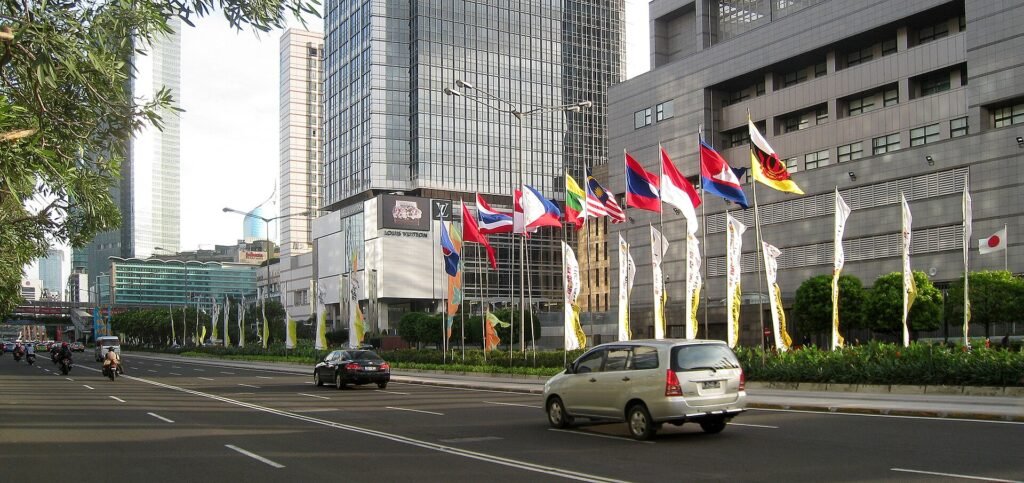
The Association of Southeast Asian Nations, or ASEAN, is a regional organization of 11 member states that promotes economic, political and security cooperation in Southeast Asia. It was established on 8 August 1967 in Bangkok, Thailand, and its secretariat is in Jakarta, Indonesia. Timor-Leste became the 11th member on 26 October 2025.
History of ASEAN
ASEAN was founded with the signing of the ASEAN Declaration, also called the Bangkok Declaration, by Indonesia, Malaysia, the Philippines, Singapore and Thailand. The Council on Foreign Relations notes that the five founders wanted a common front against the spread of communism during the Cold War. In 1976 the members signed the Treaty of Amity and Cooperation in Southeast Asia, which stresses mutual respect and noninterference in each other’s affairs.
Membership doubled by the end of the 1990s. Brunei Darussalam joined on 7 January 1984, followed by Viet Nam on 28 July 1995, Lao PDR and Myanmar on 23 July 1997, and Cambodia on 30 April 1999. The end of Cambodia’s civil war in 1991, the end of the Cold War and the normalization of relations between the United States and Vietnam in 1995 brought relative peace to mainland Southeast Asia and made enlargement possible. In 1995 the members also signed a treaty to refrain from developing, acquiring or possessing nuclear weapons.
The Asian financial crisis of 1997, which began in Thailand, pushed members to integrate their economies more closely. The roadmap for an ASEAN Community was declared in 2009, and the community, resting on three pillars, was launched in 2015. Timor-Leste applied for membership in 2011, received observer status in 2022 and was admitted on 26 October 2025. That year’s summit in Kuala Lumpur, chaired by Malaysia, opened the same day.
Structure and membership
ASEAN is headed by a chair, a position that rotates annually among the leaders of member states, and it is assisted by the ASEAN Secretariat in Jakarta. The Secretary-General of ASEAN and the Secretariat act as the coordinating body that helps ASEAN bodies reach decisions. Each member state also appoints a Permanent Representative to liaise with the Secretary-General and the Secretariat.
Important decisions are usually made through consultation and consensus, guided by the principles of noninterference in internal affairs and the peaceful resolution of conflicts. Other bodies include the ASEAN Summit, the ASEAN Coordinating Council and the Community Councils, and the ASEAN Charter provides the legal framework for the organization.
The three community pillars
The ASEAN Community rests on a Political-Security Community, an Economic Community and a Socio-Cultural Community. In 2015, leaders also adopted a post-2015 vision called ASEAN 2025: Forging Ahead Together. It combines a Community Vision with a blueprint for each of the three pillars.
ASEAN also builds ties beyond its borders. It develops friendly relations and dialogues with external partners, which its own description lists as ASEAN entities, human rights bodies, ambassadors of non-member states to ASEAN, ASEAN committees in third countries, other regional and international organizations, and non-member countries’ ambassadors to ASEAN. Economically, the Council on Foreign Relations reports that the bloc has played a central role in Asian economic integration. It joined negotiations toward what is described as the world’s largest free trade agreement and has signed six free trade deals with other governments in the region.
Population and economy
As of 2024, the Council on Foreign Relations counted about 678 million people in ASEAN countries, which made the group the third most populous region in the world. Their combined gross domestic product was 3.9 trillion dollars. These figures were calculated before Timor-Leste became a member, so they cover ten countries rather than eleven.
The Council on Foreign Relations noted in 2025 that proposed U.S. tariff increases created trade uncertainty for several export-dependent economies in the region. Such pressures test a group whose members have different priorities, and they explain why trade policy is a regular topic at ASEAN summits.
Criticism and challenges
Analysts disagree about how well the ASEAN approach works. Critics say the group’s influence is limited by a lack of strategic vision, diverging priorities among members and weak leadership. A senior fellow at the Council on Foreign Relations has argued that the norms of consensus and noninterference have grown outdated and have hindered ASEAN’s influence on issues such as relations with China and crises within particular member states.
Supporters reply that the style of consultation and consensus has improved relations among states that were once hostile. Kishore Mahbubani, a former Singapore ambassador to the United Nations, has credited that style with producing quiet diplomatic successes that few outside the region noticed. The bloc’s biggest tests, according to critics, are developing a shared approach to Myanmar’s civil war and to China, especially over territorial disputes in the South China Sea. The admission of Timor-Leste also drew objections from Myanmar’s junta, which argued that the country’s contacts with Myanmar’s civilian-led exiled forces broke the principle of noninterference.
ASEAN vs. the European Union
ASEAN is often compared with the European Union, since both are regional groupings. They work very differently. ASEAN relies on consultation and consensus, a chair that rotates each year and a secretariat in Jakarta. The EU has seven institutions, including a Parliament elected every five years, and its institutions produce laws that apply across its 27 member states. ASEAN’s approach is deliberately lighter and leaves each government in control of its own policy.
Legacy and impact
ASEAN grew from five founding states to eleven while keeping its practice of consensus and noninterference. It is now one of the main organizations through which Southeast Asian governments negotiate with each other and with major powers.
More in International Relations
Key facts
- ASEAN was established on 8 August 1967 in Bangkok by Indonesia, Malaysia, the Philippines, Singapore and Thailand.1
- Timor-Leste became the eleventh member on 26 October 2025.1
- The ASEAN Community, with political-security, economic and socio-cultural pillars, was launched in 2015.1
- The Secretariat is based in Jakarta, and the chair rotates annually.2
- As of 2024, ASEAN's ten members at that time had a combined GDP of about 3.9 trillion dollars.2
Related concepts
In the news
Quick checkHow does ASEAN make decisions?Show answer
Important decisions are usually reached through consultation and consensus, guided by the principles of noninterference in internal affairs and peaceful resolution of conflicts.
Sources
- ASEAN, About ASEAN, https://asean.org/about-asean/
- Council on Foreign Relations, What Is ASEAN? (2025), https://www.cfr.org/backgrounder/what-asean
Editorially reviewed by Specialty Digest Editorial TeamLast reviewed November 4, 2026Researched and drafted with AI assistanceReport an issue