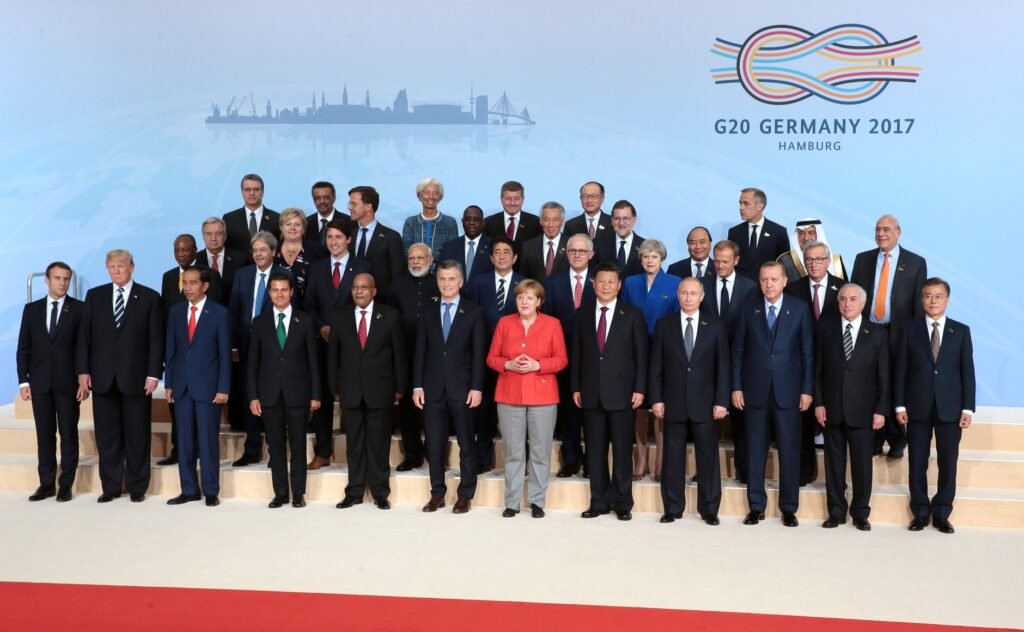
The G20, or Group of Twenty, is an informal forum of 19 countries, the European Union and the African Union that coordinates global economic and financial policy. Finance ministers and central bank governors began meeting in 1999, and leaders held their first summit in November 2008. The G20 has no permanent secretariat, and its presidency rotates each year among the members.
History of the G20
The G20 began in 1999 as a forum for finance ministers and central bank governors. The finance ministers of the G7 proposed it in response to the global financial crisis of 1997 to 1999, and it was formally created at their meeting on 25 September 1999. It was meant to be a new mechanism for informal dialogue within the Bretton Woods system, so that systemically significant economies could discuss key economic and financial policy issues and promote stable and sustainable world growth. The first ministerial meeting took place in Berlin in December 1999.
The leaders’ summit began after the global financial crisis of 2008. On 14 and 15 November 2008, U.S. President George W. Bush invited the leaders of the G20 countries to Washington, D.C., creating the first G20 summit. The leaders agreed to meet again, and the second summit followed in London on 1 and 2 April 2009 under British Prime Minister Gordon Brown. The third was in Pittsburgh on 24 and 25 September 2009, and the fourth in Toronto on 26 and 27 June 2010.
The founding design set a policy focus from the start. The G20 Research Group notes that the forum was meant to be deliberative, with a mandate to promote international financial stability, and that its chair would rotate among participants on two-year terms, with the first chairs chosen from the G7 countries. Canada hosted the second ministerial meeting in 2000.
In January 2010, personal representatives of the leaders, called sherpas, decided that after the sixth summit the leaders would meet once a year, usually in the fall, starting with France in 2011.
Structure and membership
The G20 consists of 19 countries, the European Union and the African Union, with representatives of the International Monetary Fund and the World Bank also taking part. The 19 countries are Argentina, Australia, Brazil, Canada, China, France, Germany, India, Indonesia, Italy, Japan, Mexico, Russia, Saudi Arabia, South Africa, South Korea, Turkey, the United Kingdom and the United States. The original 1999 group had 18 country members, namely the G7 plus eleven other economies chosen to give regional balance.
The African Union was invited to become a full member at the New Delhi summit in 2023. The group has no permanent secretariat. Instead, the presidency rotates annually among members, and the host country sets the agenda and runs the meetings. In 2026 the United States holds the presidency, with the leaders’ summit planned for Miami, Florida, and a finance ministers and central bank governors meeting in Asheville, North Carolina.
What the G20 does
The G20 was created as a body for deliberation rather than decision. Its mandate is to promote discussion and study and to review policy issues among industrialized countries and emerging markets with a view to promoting international financial stability. Leaders issue declarations, and members then carry out commitments through their own governments and through other organizations.
Preparation takes place all year. The finance ministers and central bank governors continue to meet on their own, usually around the spring and sometimes the fall meetings of the IMF and the World Bank, and again in the weeks before the summit. Many other ministerial meetings and working groups also take place. The 2026 presidency lists trade, critical minerals, economic growth and innovation among its themes.
Engagement groups
Each year, several engagement groups gather to advise the leaders and extend the G20’s work beyond governments. They include the Business 20, Civil 20, Labour 20, Science 20, Think 20, Urban 20 and Women 20. Their role is to give advice to the leaders and to extend the work of the G20 beyond government meetings. Because they bring in business, civil society, labor, scientists, researchers, cities and women, they widen the range of voices around a forum that is otherwise made up of governments and central banks.
Funding and governance
The G20 has no permanent secretariat, and its presidency rotates annually among the members. Each presidency sets the priorities for its year and hosts the meetings, which is why the themes of the 2026 presidency differ from those of earlier years. This arrangement keeps the group flexible, though it also means its agenda can shift from one year to the next.
Criticism and challenges
The G20’s informal design draws both praise and doubt. The G20 was created as a deliberative rather than a decisional body, so it does not issue binding decisions in the way a treaty organization does. Membership was also contested from the start. The G20 Research Group at the University of Toronto records that the selection of countries involved diplomacy among the G7, that some proposed lists left out Australia, Korea, Turkey or Saudi Arabia, and that the inclusion of China was never seriously in doubt.
Another point of debate is the balance between the economic focus of the finance track and the broader topics that leaders add. Presidencies differ in how far they push beyond financial stability, so the G20 can look quite different from one year to the next.
G20 vs. G7
The G7 is a smaller group of advanced economies, and it launched the G20 finance track. The G20 added eleven other countries to the G7 members at the start, including large emerging economies such as China, India and Brazil. That wider membership is why the G20 is described as bringing together industrialized countries and emerging markets.
More in International Relations
Key facts
- The G20 finance ministers and central bank governors forum was formally created on 25 September 1999.1
- The first G20 leaders' summit was held in Washington, D.C., on 14 and 15 November 2008.1
- The G20 consists of 19 countries, the European Union and the African Union.1
- The African Union was invited to join as a full member at the 2023 New Delhi summit.1
- The G20 has no permanent secretariat, and its presidency rotates annually among members.2
Related concepts
In the news
Quick checkWho are the members of the G20?Show answer
Nineteen countries, the European Union and the African Union, with representatives of the IMF and World Bank also taking part.
Sources
- G20 Research Group, University of Toronto, What is the G20?, https://g20.utoronto.ca/g20whatisit.html
- G20 2026 United States Presidency, official site, https://www.g20.org/
Editorially reviewed by Specialty Digest Editorial TeamLast reviewed November 4, 2026Researched and drafted with AI assistanceReport an issue