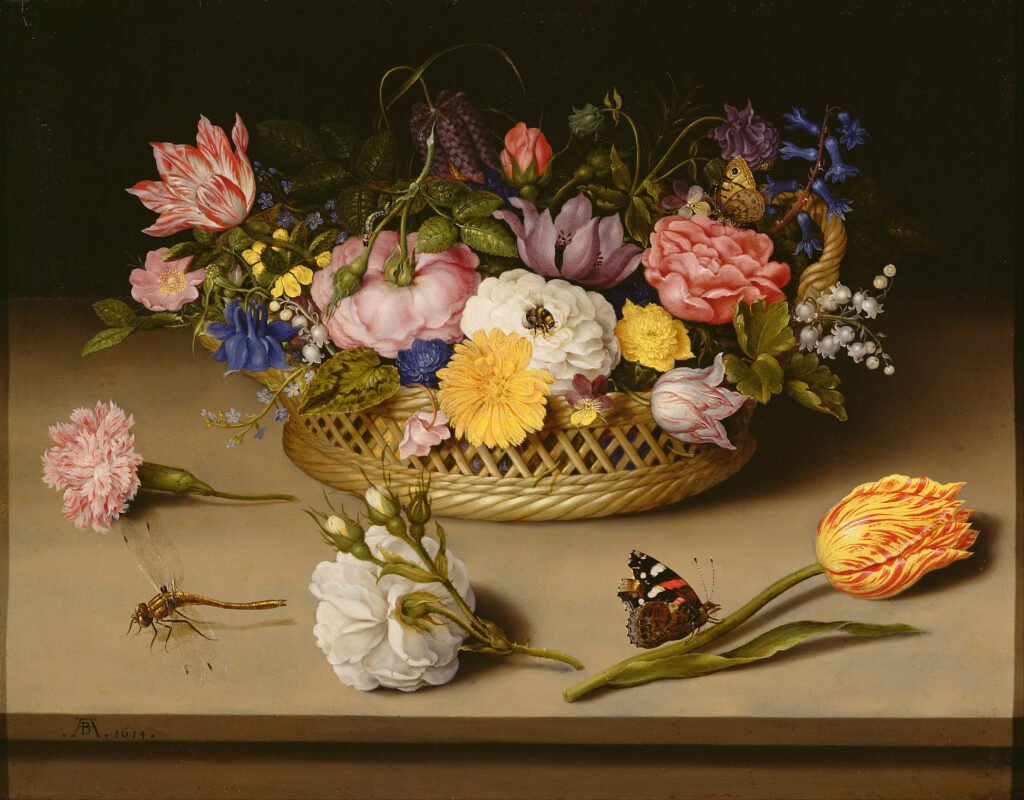
Still life is a genre of visual art depicting arrangements of inanimate objects, typically everyday items such as fruit, flowers, dishes, or household goods, composed and lit deliberately by the artist rather than observed in a found setting. Although long regarded as a minor genre compared to history painting or portraiture, still life has produced some of the most technically celebrated and conceptually rich works in the history of Western and Asian art.
Historical Development
Still life elements appeared in ancient Egyptian tomb paintings and Roman wall decoration long before the genre was formally recognized, but it achieved independent status as a distinct category primarily in seventeenth century Netherlands, where a prosperous merchant class created strong demand for smaller, affordable paintings suited to private homes. Dutch and Flemish painters developed elaborate subcategories, including banquet pieces displaying lavish food, flower pieces documenting rare and expensive blooms, and vanitas compositions using skulls, extinguished candles, and wilting flowers to symbolize mortality and the transience of worldly pleasure.
Symbolic and Formal Functions
Beyond simple documentation of objects, still life has long served symbolic purposes, with specific items carrying culturally understood meanings; a skull signaled mortality, an hourglass measured time running out, and overripe fruit suggested the fleeting nature of sensory pleasure. The genre also became an important space for formal experimentation, since a controlled arrangement of static objects allowed painters to study light, shadow, texture, and composition without the complications of a moving or expressive human subject.
Modern and Contemporary Developments
Paul Cezanne used still life extensively to investigate how three-dimensional form could be represented through color and faceted brushwork, directly influencing the subsequent development of Cubism by Pablo Picasso and Georges Braque. Henri Matisse and other twentieth century painters continued treating still life as a vehicle for color and compositional experimentation rather than purely decorative subject matter. Contemporary artists have expanded the genre to include photography, assemblage, and digital imagery, often using commercial or mass-produced objects to comment on consumer culture.
Techniques and Composition
Still life painters carefully control lighting, often using a single directional light source to create strong contrasts that reveal texture and three-dimensional form, and they plan the arrangement of objects to create a sense of visual balance, rhythm, and depth. Many painters use preliminary sketches to work out composition before beginning a finished painting, adjusting the placement, scale, and spacing of objects to guide the eye of the viewer through the canvas in a deliberate sequence.
Cultural Variations
Chinese and Japanese painting traditions developed related but distinct approaches to depicting flowers, fruit, and household objects, often emphasizing restrained brushwork, empty space, and symbolic associations drawn from literary and philosophical traditions rather than the dense, illusionistic realism favored in Dutch still life painting. Spanish painters including Francisco de Zurbaran developed a particularly austere, dramatically lit still life tradition distinct from the more decorative Dutch and Flemish approach.
Notable Collections and Markets
Major museums including the Rijksmuseum in Amsterdam and the Prado in Madrid maintain extensive still life holdings reflecting the genres historical importance in Dutch, Flemish, and Spanish painting, and specialized still life galleries remain a consistent draw for visitors interested in the technical virtuosity the genre demands. Auction markets for historical still life paintings have remained relatively strong and stable compared with more speculative contemporary art categories, partly because the genre has a long, well-documented history of connoisseurship and authentication.
Photographers working in a still life tradition, including advertising and fine art photographers, have adapted many compositional and lighting principles developed by painters centuries earlier, demonstrating the continuing relevance of still life conventions even as the technical medium used to create the images has changed completely.
Relationship to Other Genres
Still life frequently appears as a secondary element within larger compositions, such as objects arranged on a table within a portrait or domestic interior scene, blurring the boundary between still life as an independent genre and still life as a supporting compositional device. This flexible relationship allowed many painters who specialized primarily in portraiture or interior scenes to also develop considerable skill in rendering the texture and material qualities associated with dedicated still life practice.
Regional Dutch Specializations
Individual Dutch cities developed recognizable specialties within the still life tradition, with Haarlem painters particularly associated with modest breakfast scenes featuring simple foods and tableware, while Antwerp and other wealthier centers favored more opulent banquet pieces displaying imported luxuries such as citrus fruit, lobster, and fine porcelain that advertised the prosperity and global trading connections of their owners.
American painters of the early twentieth century, including Georgia O’Keeffe in her large-scale flower paintings, reinterpreted still life conventions on a dramatically enlarged scale, using close cropping and magnification to transform familiar botanical subjects into bold, nearly abstract compositions that challenged the traditionally modest physical scale associated with the genre.
FAQ
Why was still life historically ranked below other genres?
Academic art hierarchies established in Europe during the seventeenth century ranked genres partly by subject importance, placing history painting and portraiture above still life because it depicted inanimate objects rather than human action or narrative.
What is a vanitas painting?
A vanitas is a type of still life using symbolic objects such as skulls, snuffed candles, or decaying flowers to remind viewers of mortality and the transient nature of earthly pleasure and achievement.
Is still life only painted from real objects?
Most historical still life was painted from arranged real objects, though many artists worked partly from memory or combined studies of different objects observed at different times into a single invented composition.
More in Visual Arts
Editorially reviewed by Specialty Digest Editorial TeamLast reviewed November 4, 2026Researched and drafted with AI assistanceReport an issue