Macbeth is a tragedy by William Shakespeare about a Scottish nobleman who murders his king after a prophecy by three witches and is then destroyed by guilt and violence. It was probably written around 1606 or 1607, and its only early text is the First Folio of 1623. The Royal Shakespeare Company notes that the compact Folio text suggests it was edited for performance.
Background and creation of Macbeth
In 1603 James VI of Scotland became James I of England. The Folger Shakespeare Library notes that Shakespeare’s London was immediately alive with interest in all things Scottish, that many Scots followed their king to London and attended the theaters, and that Shakespeare’s company became the King’s Men under James’s patronage. The company sometimes staged plays for the king, as it had for Queen Elizabeth.
Shakespeare turned to Raphael Holinshed’s Chronicles of England, Scotland and Ireland for his material. In the eleventh-century Scottish history found there he met a spectacle of violence: armies slaughtered, kings assassinated, nobles ambushed and rebels executed. He also found stories of witches and wizards advising traitors. The Folger editors point out that such accounts could feed the new king’s belief in a link between treason and witchcraft, and that James had himself executed women as witches.
The play cannot be dated exactly. The Royal Shakespeare Company observes that it contains many compliments to James, which suggests a Jacobean origin. A procession of kings in Act 4 celebrates his ancestors, since James traced his line to Banquo. The Porter’s talk of equivocation in Act 2 is read as an allusion to the trial of the Gunpowder Plot conspirators in early 1606. The Folger’s reference page gives about 1606 or 1607.
Shakespeare changed his source in one important way. In Holinshed, Banquo helps Macbeth plot against King Duncan. In the play he becomes an adversary, and his descendants are promised the crown, which the RSC says would have pleased the reigning king, who claimed descent from Banquo.
Summary of Macbeth
The play is set mostly in Scotland. After a battle, three “Weird Sisters” meet Macbeth and his comrade Banquo and prophesy that Macbeth will be king and that Banquo’s descendants will also reign.
Macbeth and his wife plot to kill King Duncan, who is about to be a guest at their castle, so that Macbeth can take the throne. After Macbeth murders Duncan, the king’s two sons flee and Macbeth is crowned. Fearing that Banquo’s heirs will take over, Macbeth has Banquo killed. At a royal banquet that evening he sees Banquo’s ghost covered in blood.
Macbeth consults the sisters again and is comforted by ambiguous promises. Meanwhile the nobleman Macduff rides to England to join Duncan’s elder son Malcolm, and Macbeth has Macduff’s wife and children murdered. Lady Macbeth goes mad and dies by suicide. Malcolm and Macduff lead an army against Macbeth, who learns that the sisters’ promises were tricks but fights on. Macduff kills him, and Malcolm becomes king of Scotland.
Themes and interpretation of Macbeth
The Folger editors Barbara Mowat and Paul Werstine read the play as a story of a man who murders a king and kinsman to gain a crown, only to lose what people need to be happy: sleep, food, friends and love. They list the questions it raises. Why do people do evil knowing it is evil? Is Macbeth tempted by fate, pushed by his wife or driven by ambition? Why does he fall apart after the murder, unable to sleep and seeing ghosts, and then turn to killing friends and innocents?
Readings have shifted over time. In earlier centuries, the editors write, the story was seen as a study of a heroic individual who commits an evil act and pays a heavy price as his conscience, and the natural forces for good in the universe, destroy him. More recently it has been applied to nations that overreach themselves. Today the line between Macbeth’s evil and the supposed goodness of those who oppose him is often blurred, attitudes to witches and witchcraft are being reconsidered, and critics ask new questions about how maleness and femaleness are portrayed.
The witches are central to these debates. Their later promises are described in the Folger synopsis as ambiguous, and Macbeth discovers that they are tricks. The editors add that attitudes to witches and witchcraft are themselves changing, which affects how audiences understand the sisters.
Text and authorship of Macbeth
Macbeth was first printed in the 1623 First Folio, which is the only early printed text. The RSC says its brevity suggests that it was edited for the stage and revised, possibly by the playwright Thomas Middleton. The Hecate scenes in particular look like additions and resemble scenes in Middleton’s The Witch.
The Folger editors add that since the nineteenth century some scholars have thought parts of the Folio text are by Middleton, and that attempts to identify his contributions precisely remain the subject of fierce controversy. They also say no scholar believes the Folio was printed straight from Shakespeare’s own papers. Editors therefore regularize some names, such as the Folio’s spelling Dunsmane for Dunsinane and its several spellings of Birnam.
Reception and legacy of Macbeth
No one knows for certain when the play first reached the stage. The earliest firm record is an eyewitness account by Dr. Simon Forman, who saw it at the Globe Theatre in April 1611. The RSC and the Folger both think it was most likely performed earlier at court before King James, in August or December 1606.
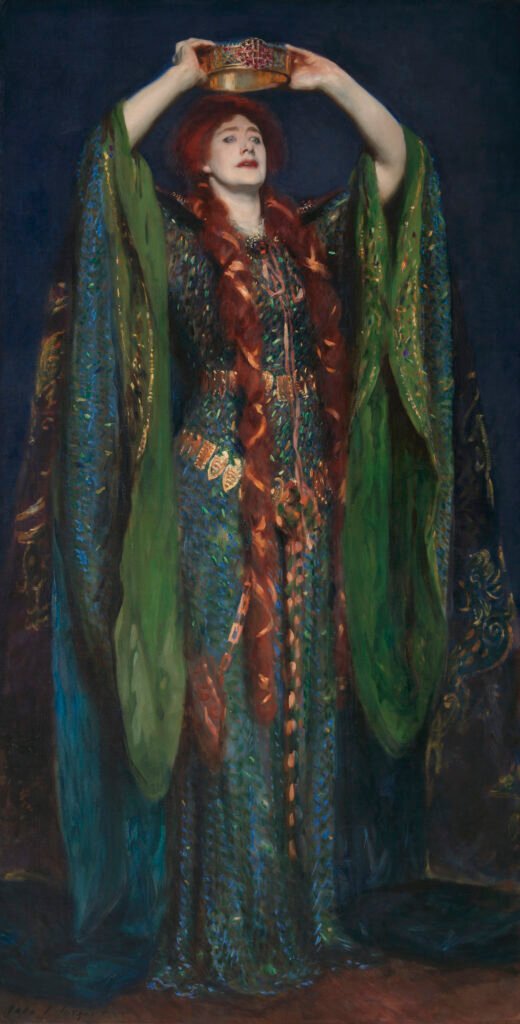
Artists responded quickly to its images. The Folger owns a 1793 painting by Henry Fuseli of the apparition scene in Act 4, bought by the library’s founder Henry Clay Folger in 1922. The portrait of the actress Ellen Terry as Lady Macbeth by John Singer Sargent, shown above, is another example of how theater and painting fed each other.
The Folger editors close with the point that Macbeth speaks to each generation with a new voice. The Folger’s reference page lists its own Folger Theatre productions of the play from 2001 and 2008. The work’s closest relatives in the Shakespeare canon are his other great tragedies, but its compact structure and its Scottish setting give it a character of its own.
More in Literature
Key facts
- Macbeth was probably written around 1606 or 1607, after James VI of Scotland became James I of England in 1603.12
- Shakespeare drew on Raphael Holinshed's Chronicles and recast Banquo as an adversary of Macbeth, unlike in the source.2
- The only early printed text is the 1623 First Folio.23
- Scholars have long debated whether Thomas Middleton added material, notably the Hecate scenes.23
- Dr. Simon Forman recorded seeing the play at the Globe Theatre in April 1611.12
Related concepts
Quick checkWhat is the only early printed text of Macbeth?Show answer
The First Folio of 1623, in which the play was first printed.
Sources
- Folgerpedia, Macbeth (Folger Shakespeare Library), https://folgerpedia.folger.edu/Macbeth
- Royal Shakespeare Company, Dates and Sources: Macbeth, https://www.rsc.org.uk/macbeth/about-the-play/dates-and-sources
- Folger Shakespeare Library, An Introduction to This Text: Macbeth (Barbara Mowat and Paul Werstine), https://www.folger.edu/explore/shakespeares-works/macbeth/an-introduction-to-this-text/
- Folger Shakespeare Library, About Shakespeare's Macbeth (Barbara Mowat and Paul Werstine), https://www.folger.edu/explore/shakespeares-works/macbeth/about-shakespeares-macbeth/
Editorially reviewed by Specialty Digest Editorial TeamLast reviewed November 5, 2026Researched and drafted with AI assistanceReport an issue